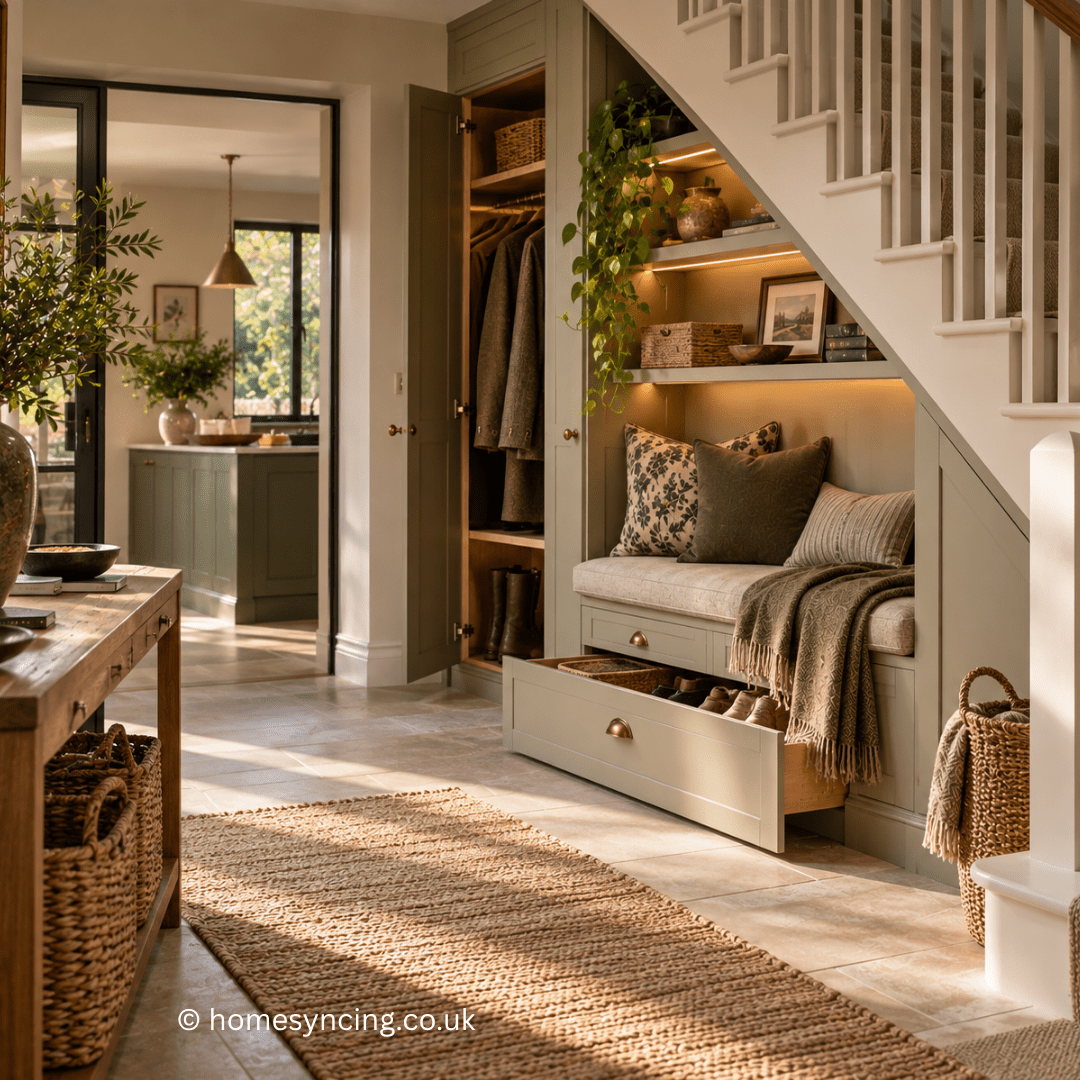
There are few homes that seem to have quite enough storage.
Coats gather in the hallway. Shoes multiply by the door. Spare bed linen occupies half a wardrobe, while chargers, paperwork, children’s games and all the other necessities of daily life somehow find their way onto surfaces that were once beautifully clear.
The temptation is to assume that the answer is simply more cupboards.
Often, it isn’t.
Some of the best storage solutions for small spaces come from looking again at the parts of a house we tend to overlook: the awkward space beneath a staircase, the narrow strip beside a chimney breast, the wall above a doorway or the sloping eaves of an attic bedroom.
Older houses are particularly good at presenting these puzzles. Uneven walls, alcoves and curious corners may make standard furniture difficult to accommodate, but they can also inspire wonderfully individual solutions.
The secret to an organised home isn’t hiding everything from sight. It is giving the things you use a sensible place to live – and making that storage feel as though it belongs there.
Begin with What You Actually Need to Store
Before commissioning fitted cupboards or buying another basket, spend a little time understanding the problem.
What is causing the clutter?
If shoes are permanently scattered across the hallway, you probably need accessible shoe storage rather than another general-purpose cupboard.
If kitchen worktops are crowded with appliances, look at whether cupboards could be reorganised before adding more furniture.
If a bedroom wardrobe is overflowing, the problem might be an inefficient arrangement of rails and shelves rather than a lack of overall space.
Good storage starts with the objects themselves.
Group similar things together and consider how frequently you use them. Everyday possessions should be easy to reach. Seasonal or occasional items can occupy higher shelves, the back of cupboards or less accessible areas.
This simple distinction can transform how effectively existing storage works.
Make Better Use of Vertical Space
When floor space is limited, look upwards.
Many homes contain considerable unused space between the top of furniture and the ceiling. Taking shelving or cabinetry higher can provide useful storage without occupying another centimetre of floor.
In a kitchen, tall cupboards can accommodate serving dishes and equipment used only occasionally. In a sitting room, floor-to-ceiling bookshelves can turn an empty wall into a miniature library. In a bedroom, cupboards above wardrobes can provide somewhere for suitcases, spare bedding or seasonal clothing.
There is an aesthetic benefit too.
Tall joinery can emphasise the proportions of a room and make the ceiling appear higher, particularly when cabinetry is painted in a colour related to the walls.
But don’t automatically fill every wall from floor to ceiling.
Storage needs breathing space just as furniture does.
A beautifully proportioned cupboard with a little wall visible around it can sometimes be more successful than squeezing cabinetry into every available gap.
Transform the Space Under the Stairs
Few awkward spaces have quite as much potential as the area beneath a staircase.
In many homes it becomes an accidental cupboard: coats hanging from every available hook, shoes piled on the floor and mysterious boxes gradually migrating towards the darkest corner.
Thoughtful under-stairs storage can make far better use of it.
Fitted cupboards that follow the slope of the staircase can provide concealed storage for coats, vacuum cleaners, ironing boards and household supplies.
Deep pull-out drawers work particularly well for shoes because they make the full depth accessible. Rather than kneeling down and reaching into a dark cupboard, the contents come to you.
Where the staircase is wide enough, part of the space might become something more inviting.
A built-in bench with drawers underneath creates somewhere to sit while putting on shoes. Add a cushion, a wall light and perhaps a small shelf above, and an awkward architectural space becomes a useful part of the hallway.
In the right position, it might even become a reading nook.
Give the Hallway Somewhere to Put Everything
Hallways are often among the smallest and hardest-working spaces in a home.
They need to accommodate coats, shoes, bags, umbrellas, post, keys and all the paraphernalia that accompanies people through the front door.
The most successful hallway storage ideas make those everyday habits easier.
A shallow cupboard may be sufficient for coats without narrowing the passage unnecessarily. A bench with shoe storage beneath gives people somewhere to sit, while hooks positioned at sensible heights encourage coats and bags to be put away.
A small shelf, console or wall-mounted drawer can provide somewhere for keys and post.
Baskets are useful here, particularly for hats, scarves and gloves, but they work best when each has a purpose. A hallway filled with anonymous baskets can simply become clutter concealed inside other clutter.
If you have children, storage they can actually reach is far more likely to be used.
Good organisation should make the easiest action the tidiest one.
Use Alcoves Rather Than Fighting Them
Alcoves are among the most characterful features of older houses, particularly those found either side of a chimney breast.
Rather than searching endlessly for furniture with exactly the right dimensions, consider allowing the architecture to dictate the solution.
Fitted cupboards with shelves above can provide an elegant mixture of concealed and open storage. Books, ceramics and favourite objects remain visible, while less decorative necessities disappear behind doors below.
Freestanding furniture can work equally well.
An old cupboard, chest of drawers or narrow bookcase placed within an alcove often brings more individuality than perfectly fitted joinery.
There is no rule that every recess needs to be filled precisely.
Sometimes the small gaps around a freestanding piece are what allow an old room to retain its character.
Turn Window Seats into Storage
A window is naturally somewhere we are drawn towards.
If the architecture allows, a built-in window seat can make that part of the room even more useful.
Drawers beneath the seat are ideal for toys, blankets, books or games. A hinged seat can provide deeper storage, although everyday items are usually easier to reach in drawers because the cushions don’t have to be removed each time.
Keep the upholstery relatively simple.
A comfortable seat cushion, one or two patterned cushions and perhaps a small wall light are often enough to turn the space into somewhere genuinely inviting.
The best window seats don’t look like storage at first glance.
They simply look like somewhere you would like to sit.
Make Awkward Corners Work Harder
Nearly every home contains a corner that conventional furniture refuses to understand.
Perhaps it is too narrow for a cupboard, too shallow for a chest of drawers or interrupted by a radiator, sloping ceiling or structural column.
These spaces reward imagination.
A narrow set of shelves might accommodate cookery books in a kitchen. A tiny alcove can become a drinks cupboard. A shallow recess might hold a run of hooks rather than a bulky wardrobe.
Even a few carefully positioned corner shelves can provide useful storage without dominating a room.
Before ordering bespoke furniture, however, ask whether the space actually needs filling.
Not every nook and cranny requires storage.
Occasionally the best thing to put in an awkward corner is a lamp, a chair or nothing at all.
Find Storage Beneath the Eaves
Attic rooms often contain generous floor space beneath sloping ceilings that is difficult to use conventionally.
This is ideal territory for built-in storage ideas.
Low cupboards can follow the roofline, providing storage for clothes, luggage, children’s toys or seasonal belongings while leaving the taller parts of the room clear for furniture and movement.
Drawers can be particularly useful because they make deep spaces easier to access.
In bedrooms, fitted wardrobes can sometimes be designed around the slope of the roof rather than stopping where the ceiling begins to fall.
Well-designed eaves storage has another advantage: it can visually simplify an awkward room.
Instead of adding several pieces of freestanding furniture beneath competing roof angles, a calm run of cabinetry can help the architecture feel more coherent.
Rethink the Wardrobe Before Buying a Bigger One
A wardrobe can be enormous and still be badly organised.
Before deciding you need more bedroom storage, look carefully inside what you already have.
A single rail with a large empty area beneath it may not be making good use of the available height. Adding a second rail for shorter clothes can significantly increase hanging capacity.
Shelves above the rail can hold bags and boxes, while drawers below provide somewhere for folded clothes.
Shelf dividers can keep stacks of knitwear or bed linen under control, while smaller boxes prevent accessories from disappearing towards the back.
The inside of wardrobe doors can sometimes accommodate hooks or shallow organisers too, provided they don’t interfere with the contents when the doors close.
The principle is simple: organise storage around what you own rather than expecting your belongings to conform to an arbitrary arrangement.
Choose Furniture That Earns Its Space
In smaller homes, furniture that performs more than one function can be invaluable.
An ottoman at the end of a bed can store spare blankets. A coffee table with drawers can keep remote controls and chargers out of sight. A bench in a hallway can conceal shoes beneath its seat.
Beds with built-in drawers are particularly useful where there isn’t room for additional cupboards.
Even a traditional chest can work hard. Used as a coffee table or placed beneath a window, it provides both a surface and substantial concealed storage.
There is, however, a balance to strike.
Not every piece of furniture needs a secret compartment.
Choose multifunctional furniture where it genuinely solves a problem rather than simply because storage has been added to it.
Use Open and Closed Storage Together
A completely open room can look cluttered. A room made entirely from closed cupboards can feel rather severe.
Combining the two usually creates a more comfortable balance.
Hide practical things behind doors and drawers.
Display the things worth seeing.
Books, pottery, framed photographs and a few treasured objects can bring life to open shelving, while paperwork, cables, toys and household supplies are generally happier behind a cupboard door.
This distinction is particularly useful in living rooms.
Low cabinetry can conceal technology and everyday clutter while shelving above holds books and objects collected over time.
The result feels organised without appearing sterile.
Make Kitchen Storage Work Harder
The kitchen is one room where every centimetre can matter.
Look first at the places that are commonly wasted.
Narrow gaps can sometimes accommodate pull-out cupboards for bottles and jars. Deep corner cupboards become considerably more useful when fitted with mechanisms that bring their contents forward.
Drawer dividers prevent utensils from becoming tangled, while deep drawers can be more convenient than low cupboards for pans and crockery.
A pantry cupboard needn’t be enormous either.
Even a relatively narrow cabinet can hold a surprising quantity when shelves are carefully spaced according to what actually needs to fit on them.
Keep frequently used ingredients at eye level and reserve the highest shelves for occasional equipment.
And before adding more kitchen storage, have a clear-out.
There is little benefit in commissioning beautiful cabinetry simply to provide permanent accommodation for three appliances nobody uses.
Don’t Overlook the Space Behind Doors
The back of a door is one of the simplest areas to put to work.
Hooks can hold dressing gowns, bags or towels. Purpose-made over-door organisers can provide additional storage in bedrooms, utility rooms and cupboards.
Inside pantry and cupboard doors, shallow racks may hold smaller items that would otherwise become lost on deep shelves.
Keep weight and door function in mind.
Storage shouldn’t prevent a door from opening properly or place excessive strain on hinges.
Done thoughtfully, however, this otherwise unused surface can solve several small storage problems at once.
Give Utility Spaces Proper Organisation
Utility rooms, boot rooms and laundry cupboards rarely need to be glamorous, but they benefit enormously from good planning.
Store cleaning products together and keep them appropriately secured, particularly in households with children or pets.
Use wall-mounted storage for brooms, brushes and mops rather than allowing them to lean in a corner.
Shelves above appliances can hold laundry supplies and baskets, while cupboards can conceal less attractive necessities.
If there is room, a tall cupboard for the vacuum cleaner, ironing board and cleaning equipment can prevent these awkward objects from migrating elsewhere in the house.
Utility storage is at its best when you can find what you need without moving three other things first.
Use Baskets Where They Make Sense
Woven baskets introduce warmth and texture while concealing the less picturesque parts of everyday life.
They are particularly useful for throws, toys, magazines and accessories.
Natural materials such as willow, rattan and seagrass sit comfortably alongside timber furniture, painted cabinetry and stone floors, making them as decorative as they are useful.
But baskets aren’t the solution to every storage problem.
Small objects thrown indiscriminately into a large basket soon become impossible to find.
Use them for categories of belongings rather than miscellaneous clutter.
One basket for blankets is useful.
A basket labelled mentally as ‘things we don’t know where to put’ is simply a portable version of the original problem.
Let Colour Make Storage Part of the Room
Storage doesn’t have to disappear.
Painted cabinetry can become one of the most attractive features in a room.
Soft olive, deep forest green, warm mushroom and earthy neutral shades work particularly well with natural timber, aged brass and woven textures.
In a small room, painting fitted storage in a similar colour to the walls can make it feel quieter and more architectural.
Alternatively, darker cabinetry can create depth and provide a deliberate focal point.
Consider the room throughout the day before choosing a colour.
Natural light can transform paint dramatically, particularly in hallways and north-facing rooms.
Samples are worth living with before making a decision.
Use Bespoke Storage Where It Truly Helps
Made-to-measure joinery can be transformative, particularly where architecture makes standard furniture impractical.
Under stairs, beneath sloping ceilings, around chimney breasts and within irregular alcoves are all places where bespoke storage can make excellent use of difficult dimensions.
But bespoke doesn’t necessarily mean covering an entire room in cabinetry.
Often the most successful joinery solves one particular problem beautifully.
If commissioning fitted furniture, think beyond its immediate use.
Could adjustable shelves make it more adaptable? Could a cupboard intended for children’s toys later accommodate books or household storage? Can components be repaired or altered in future?
Homes change, and good storage should be capable of changing with them.
A Little DIY Can Go a Long Way
Not every storage improvement requires a carpenter.
Simple additions can make existing furniture considerably more useful.
Adding hooks inside a cupboard, fitting an extra shelf, installing dividers in drawers or repainting an old chest of drawers can transform pieces you already own.
A pegboard can be particularly effective in workshops, utility spaces and craft rooms, where tools and equipment need to remain visible and accessible.
Old furniture deserves another look too.
A neglected chest of drawers may work perfectly in a hallway once repainted and fitted with new handles. An old cupboard might become linen storage on a landing.
Reusing existing furniture often produces a home with more character than buying everything new.
Don’t Organise the Character Out of Your Home
There is a particular kind of beautifully photographed interior in which apparently nobody owns a charging cable, pair of muddy shoes or pile of post.
Real homes are different.
The purpose of clever storage isn’t to erase every sign of life. It is to prevent everyday possessions from overwhelming the rooms in which that life happens.
Leave books where they are read.
Keep a basket of blankets beside the sofa if people actually use them. Give muddy boots somewhere sensible to dry rather than expecting them to vanish immediately into immaculate cabinetry.
A house can be organised and still feel generous, relaxed and lived in.
In fact, it usually should.
Creating a Place for Everything
The most effective clever storage solutions rarely announce themselves.
They are the drawer beneath the stairs where shoes naturally disappear at the end of the day. The cupboard above a wardrobe containing winter bedding. The window seat that quietly holds children’s toys. The narrow shelf that finally gives the cookery books somewhere sensible to live.
Before buying more furniture, look carefully at your home.
Look upwards, beneath stairs and beds, inside cupboards and behind doors. Notice the alcoves, eaves and peculiar little spaces that conventional furniture tends to ignore.
Then decide which of them genuinely deserves to work harder.
Because creating an organised home isn’t about filling every available nook and cranny with storage.
It is about using space thoughtfully enough that the things you need have somewhere to belong – while leaving enough room for the house, and the people within it, to breathe.
We have some great storage pieces here
For daily inspiration for your home and lifestyle, follow us on Instagram.