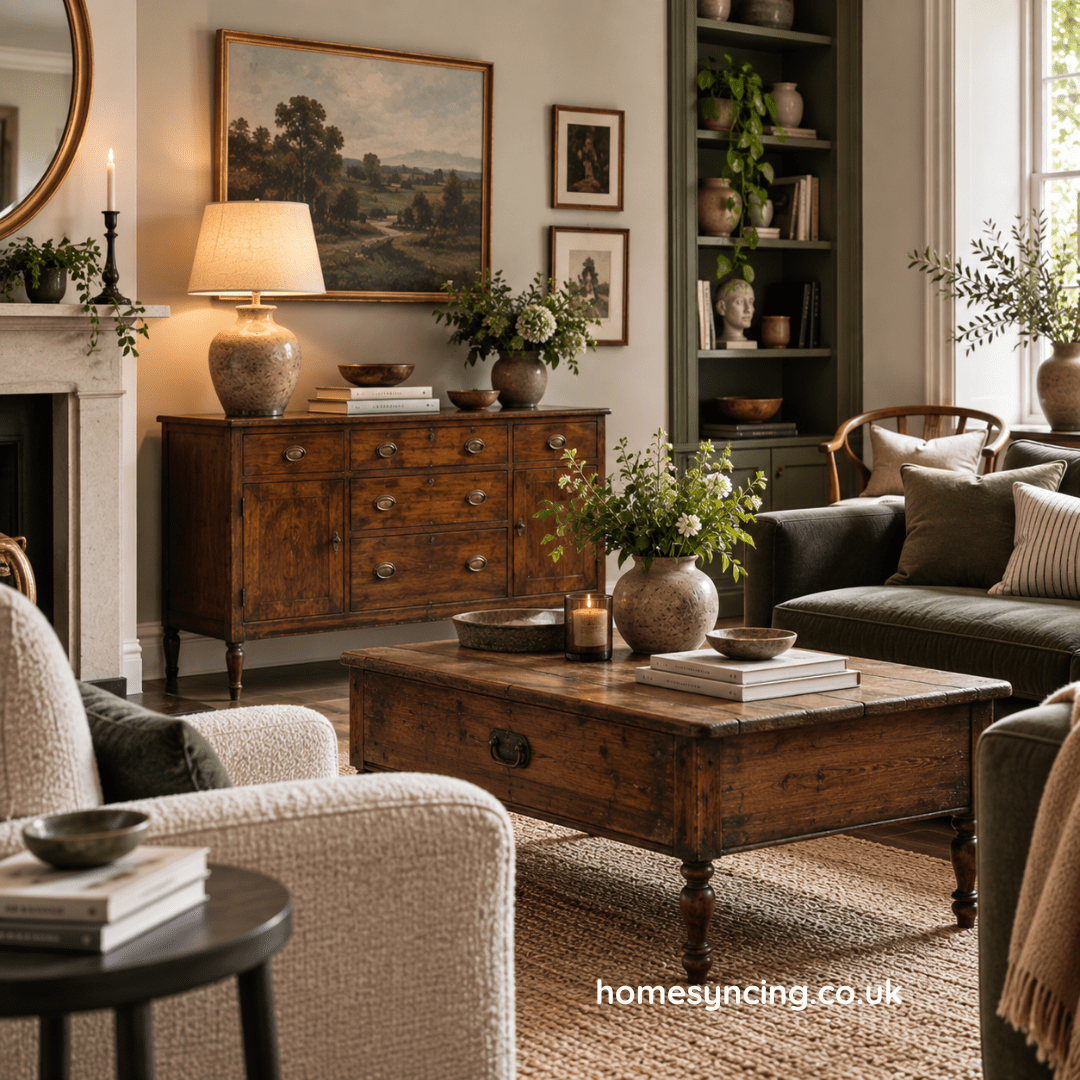
There is something rather appealing about a room that refuses to reveal exactly when it was decorated.
An old wooden table might sit beneath a contemporary pendant light. A newly upholstered sofa shares the room with a chest that has belonged to the family for years. On a modern sideboard stands an old ceramic jug, while a favourite painting — perhaps inherited, perhaps found at a market one rainy Saturday — hangs above it.
Nothing quite matches.
And yet, somehow, everything belongs.
Learning how to mix old and new furniture is one of the best ways to create a home with character. Rather than choosing everything from one period, collection or style, it allows a room to grow naturally, bringing together pieces you have inherited, discovered and chosen for yourself.
Done well, the result doesn’t look deliberately ‘eclectic’. It simply feels like a home that has gathered its contents over time.
And that is often where the most interesting interiors begin.
Why old and new furniture work so well together
Homes have always evolved.
Furniture was once made to last for generations. A table might remain in a family while chairs came and went around it. A chest could move from bedroom to hallway, while newer pieces were introduced as fashions and ways of living changed.
The result was a natural mixture of periods.
It is only relatively recently that we have become accustomed to the idea of buying complete collections of matching furniture and creating a room all at once.
There is nothing wrong with that, of course, but something can be lost when every piece is the same age, finish and style.
Older furniture brings patina, craftsmanship and a sense of history. New furniture can bring comfort, practicality and cleaner lines. Put the two together and each can make the other more interesting.
The old prevents the new from feeling anonymous.
The new prevents the old from feeling like a period display.
Begin with something you love
The easiest way to mix old and new furniture is not to begin with a set of rules.
Begin with a piece you genuinely want to keep.
It might be your grandmother’s chest of drawers, an old farmhouse table, a vintage armchair or a battered wooden trunk picked up years ago and somehow carried from house to house.
Let that be your starting point.
Rather than asking, What matches this?, ask what might sit comfortably alongside it.
An ornate antique chest, for example, may not need another ornate piece beside it. A simple contemporary lamp can give it space to be noticed. Likewise, a very modern sofa can gain warmth from an older side table or characterful wooden cabinet.
Contrast is often more effective than imitation.
The aim isn’t to make a new piece look old or an old piece look new.
It is to allow each to be itself.
Don’t try to match every wood
This is one of the great worries when mixing furniture.
Can oak sit beside walnut? What about pine? Does a dark wooden sideboard work with a lighter coffee table?
Usually, yes.
Walk through an old house and you are unlikely to find every piece of timber in precisely the same shade. Different woods entered the home at different times and aged differently according to sunlight, use and care.
That variation can make a room feel richer.
The secret is repetition rather than exact matching.
If you introduce one dark wooden piece into a room filled with pale timber, it may feel slightly isolated. Repeat that deeper tone elsewhere — perhaps in a picture frame, lamp base, chair legs or small table — and suddenly it feels intentional.
Try to think of wood as a family of natural colours rather than a single finish that must be perfectly matched.
Grain, age and texture are part of its charm.
Let one period lead, rather than compete
Mixing old and new furniture doesn’t mean every room needs equal quantities of both.
In fact, rooms often feel calmer when one style quietly leads and the other provides contrast.
In a contemporary home, most of the furniture might be simple and modern, with an antique chest, vintage mirror or old wooden table bringing character.
In a period property, the balance might be reversed. Traditional furniture and architectural features can form the backdrop, while contemporary lighting, a modern sofa or a simpler coffee table prevents the room feeling too formal.
Think of it as a conversation.
If every piece is trying to speak at once, the room becomes noisy.
Give some pieces the leading role and allow others to support them.
Use shape to create harmony
When furniture comes from different periods, colour isn’t the only thing that can connect it.
Look at shape.
A curved contemporary armchair might echo the rounded edge of an older table. The straight lines of a modern console can sit comfortably beneath a traditional rectangular mirror. Turned wooden legs on an old chair may be picked up subtly in the shape of a lamp.
These small connections aren’t always consciously noticed, but they help a room feel considered.
You can also use shape deliberately to create contrast.
A room containing a great deal of heavy, rectangular furniture may benefit from something round: a circular mirror, curved chair or round coffee table.
Similarly, an ornate antique piece can look particularly striking beside something much simpler.
Sometimes opposites make the best companions.
Mix polished with imperfect
One of the pleasures of older furniture is that it has usually lost its fear of being touched.
There may be a faint ring on a table, a worn handle on a cupboard or a small dent in the top of a chest.
These marks give a piece texture and history.
Place something like this in a room containing newer furniture and it immediately softens the surroundings.
The reverse works too.
If a room contains several rustic, heavily aged pieces, adding something with a cleaner finish can stop it becoming overly themed.
Pair a weathered wooden table with contemporary dining chairs. Place a simple modern lamp on an old console. Hang a clean-lined mirror above a characterful sideboard.
The contrast between refined and worn is often what gives a room depth.
Upholstery can bridge the gap
Fabric is one of the easiest ways to bring different periods together.
An old chair doesn’t have to retain fabric that makes it feel dated. Reupholstering it in linen, wool or a well-chosen contemporary pattern can give it another life without losing the beauty of its frame.
Equally, a modern sofa can sit happily in a traditional room when cushions and throws introduce colours or textures that relate to older furniture around it.
Don’t feel that period furniture requires period fabric.
Often the most successful combinations are unexpected.
A Georgian-style chair in a simple woven cloth can feel wonderfully fresh. A mid-century armchair covered in a traditional check might suddenly look quite at home beside an old oak chest.
The furniture provides the history.
The fabric can bring it into the present.
Use colour to hold everything together
When furniture comes from several periods, a considered colour palette can provide the thread that runs through the room.
This doesn’t mean everything has to match.
Instead, choose a handful of colours that appear in different forms.
Perhaps the green of an old painted cabinet is echoed in cushions on a new sofa. A warm rust shade in a vintage rug might reappear in a lampshade or piece of artwork. The honeyed tone of an old oak table can be picked up in baskets, picture frames or natural fabrics.
Walls are important too.
Soft whites, warm neutrals and earthy colours often provide an easy backdrop for furniture from different eras. Deeper colours can be equally successful, particularly where they make both antique timber and newer pieces feel grounded.
Rather than asking whether two pieces of furniture match one another, sometimes it is more useful to ask whether they both belong within the room’s wider palette.
Don’t turn your home into a theme
There is a difference between taking inspiration from a period and recreating it.
A cottage doesn’t need every piece of furniture to be rustic.
A Victorian house doesn’t require exclusively Victorian furniture.
And a modern home needn’t contain only contemporary design.
Architecture and furniture don’t have to come from the same moment in history.
Indeed, contrast can make the original features of a building more noticeable. A simple contemporary table can draw attention to old floorboards. A modern chair can look striking beside a traditional fireplace. An antique cabinet can bring warmth to a newly built room.
Allow the building to have its history and the furniture to have its own.
Your home is where those stories meet.
Give statement pieces some breathing room
If you own a particularly beautiful old piece, resist the temptation to surround it with several other pieces competing for attention.
Give it room.
An old sideboard beneath a simple mirror can have far more presence than the same sideboard crowded with decorative furniture and objects.
The same applies to striking contemporary design.
A sculptural chair or modern console can look wonderful in a room containing older furniture precisely because it is different.
Not every gap needs filling.
Empty space helps us notice what is there.
Use lighting to bring periods together
Lighting is particularly good at crossing the divide between old and new.
A contemporary lamp on an antique table can make both pieces feel more interesting. Likewise, a traditionally shaped lamp can soften the clean lines of a modern sideboard.
Think beyond the style of the lamp itself and consider the light it produces.
Warm pools of light help furniture of different periods sit together naturally. A table lamp beside an old armchair, a pair of lamps on a newer console or a floor lamp illuminating an inherited cabinet can draw separate pieces into the same atmosphere.
After dark, it is often the lighting rather than the furniture that makes a room feel whole.
Remember the smaller pieces
Mixing old and new doesn’t always require a large antique wardrobe or designer sofa.
Small pieces can completely alter the character of a room.
An old stool beside a modern bath. A vintage mirror above a new console table. An antique occasional chair in the corner of a contemporary bedroom. A modern lamp on an old bedside table.
These smaller combinations are a good place to begin if you are nervous about mixing styles.
They also make rooms easier to change.
A small table can move from the sitting room to a hallway. A chair can travel from bedroom to landing. A mirror that once hung above a fireplace might later find a home above a sideboard.
Furniture becomes part of the household rather than permanently attached to one particular room.
Be careful with too much ‘faux old’
There is nothing wrong with new furniture inspired by traditional designs.
In fact, it can be an excellent way to introduce character when genuine antiques aren’t practical or available.
But a room can begin to feel artificial if everything has been deliberately distressed, aged or designed to look as though it has been there for centuries.
Let some things simply be new.
A beautifully made new wooden table doesn’t need false scratches to earn its place beside an antique chair. It will acquire its own marks soon enough.
Authenticity comes from the mixture.
Old things can look old. New things can look new.
Time will take care of the rest.
Choose furniture for quality, not just age
Old doesn’t automatically mean good, just as new doesn’t automatically mean disposable.
What matters is how a piece has been made.
Look at proportion, materials and construction. Open drawers. Notice joints and handles. Consider whether the piece feels sturdy enough for the job it is expected to do.
This idea has deep roots in British design.
The Arts and Crafts movement emerged partly as a reaction against poor-quality mass production, placing renewed importance on traditional craftsmanship, useful objects and honest materials.
Those principles still make sense in a modern home.
Whether a piece was made a hundred years ago or last month, furniture that has been thoughtfully designed and properly constructed is far easier to live with — and far more likely to become the ‘old furniture’ of the future.
Let personal objects connect the room
Furniture may provide the structure of a room, but smaller possessions give it personality.
Books, ceramics, pictures, photographs, baskets and objects gathered over the years can help connect furniture from very different periods.
A contemporary sideboard topped with old family photographs immediately feels more personal. A modern coffee table carrying a stack of well-loved books loses some of its newness. An antique cabinet displaying contemporary ceramics begins to feel relevant rather than preserved.
This is where a home stops being an exercise in interior design and starts becoming yours.
Objects don’t need to be valuable to matter.
They simply need a reason to be there.
Allow the room to evolve
Perhaps the most important thing to remember when mixing old and new furniture is that you don’t have to get everything right at once.
Rooms need time.
Live with the old table before deciding what chairs it needs. Move the inherited cabinet to another wall. Try the contemporary lamp on the antique sideboard. Bring a chair downstairs and see whether it suddenly makes sense somewhere unexpected.
Some combinations will work immediately.
Others won’t.
That is part of the pleasure.
The most characterful homes are rarely the result of following a formula. They are built gradually from useful things, beautiful things, inherited things and things discovered simply because somebody couldn’t quite bear to leave them behind.
A home with more than one story
Perhaps that is why old and new furniture sit together so naturally.
They remind us that a home doesn’t belong to a single moment.
The old table carries whatever happened around it before. The new chair belongs to life as it is now. In time, that chair will acquire its own faded patch, scratched leg or familiar creak, and the distinction between ‘old’ and ‘new’ will matter rather less.
So don’t worry too much about whether everything matches.
Look instead for balance, good materials and pieces you genuinely want to live with.
Keep the inherited chest.
Choose the new sofa you love.
Put the modern lamp on the old table and see what happens.
A home becomes interesting when different stories are allowed to share the same room.
Further Reading: Affordable Decorating Ideas That Will Transform Your Home, Sustainable Chic: A Beginner’s Guide to Circular Design, The Psychology of Colour in the Home, How to Choose and Measure for a Dining Table
Daily Inspiration: Follow Us on Instagram, BlueSky, Threads , Pinterest, Twitter, TikTok