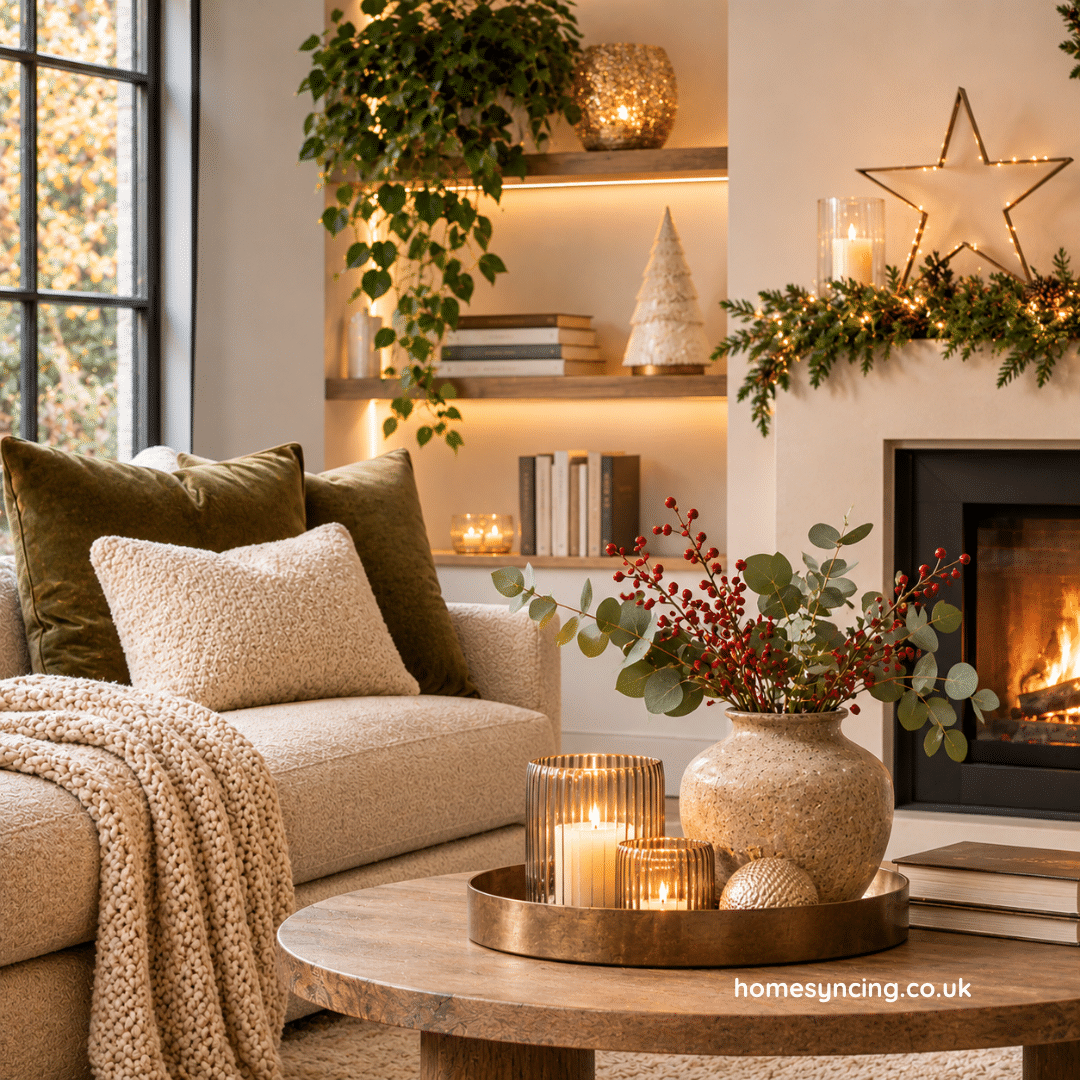
Christmas decorating should bring warmth, character and a little magic into our homes, not leave every surface crowded and every room overwhelmed. With a few thoughtful choices, it is possible to create a beautifully festive home that still feels comfortable, welcoming and entirely your own.
There is something rather wonderful about the first decorations coming out of storage.
The familiar boxes appear, carefully wrapped ornaments are rediscovered, and decorations that haven’t seen daylight since last January suddenly bring back memories of Christmases past.
There might be a bauble bought on a family holiday, something handmade by a child many years ago, or a slightly battered decoration that has somehow become one of the most treasured.
Before long, the house begins to change.
The Christmas tree takes its place, fairy lights appear around the windows, and a little greenery brings the scent and colour of the season indoors.
Yet somewhere between the first box being opened and the final ornament finding a home, it is surprisingly easy to go a little too far.
The mantelpiece becomes crowded, the dining table disappears beneath decorations, and every available corner seems to demand something festive.
There is certainly nothing wrong with a home full of Christmas cheer. But Christmas decorating without the clutter offers a different approach, one that celebrates the season without losing the comfort and character of the rooms we enjoy throughout the year.
It isn’t about having fewer decorations for the sake of it.
It is about choosing where they will make the greatest difference and giving the things we love enough space to be appreciated.
A Beautiful Christmas Home Doesn’t Need to Be Filled with Decorations
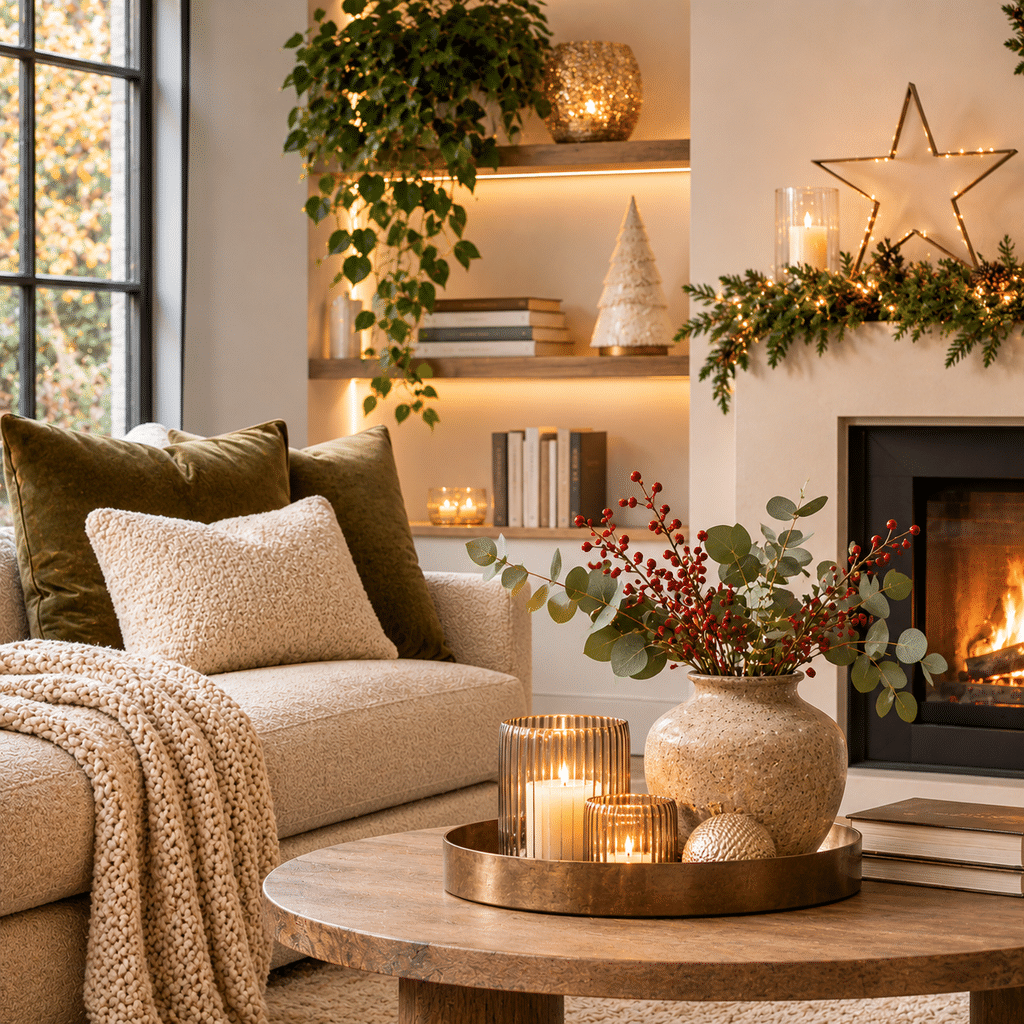
Think of the Christmas interiors that stay in your memory.
Perhaps it is a tree glowing softly in the corner of a living room, a wreath hanging on an old wooden door or a dining table dressed with evergreen branches and candlelight.
Often, it is one carefully considered detail that creates the strongest impression.
A beautifully decorated Christmas tree doesn’t need competing displays on every nearby surface. A generous arrangement of greenery can bring enough festive character to a hallway without requiring additional ornaments, garlands and lights.
The most welcoming rooms tend to have a sense of balance.
There are places for the eye to rest, furniture remains comfortable to use, and the decorations feel like a natural part of the home rather than something temporarily imposed upon it.
Before you begin decorating, take a little time to consider what you already have.
Which decorations do you genuinely look forward to seeing each year? Where do they look their best? Are there things that have remained in the boxes for several Christmases?
You may discover that a smaller selection of favourites creates just as much pleasure as displaying everything.
And there is no rule that says every decoration must come out every year.
Begin with the Room, Not the Decorations
One of the easiest ways to avoid a cluttered Christmas interior is to start with the room itself.
Look at the colours, materials and furniture already present.
A contemporary living room with natural timber, warm neutral fabrics and simple furnishings might look particularly beautiful with evergreen foliage, soft white lights and a few carefully chosen ornaments.
A more traditional room, with darker furniture and richly coloured upholstery, may lend itself to deep reds, antique gold, velvet ribbons and familiar decorations collected over many years.
Neither approach is better than the other.
The aim is to work with the character of your home rather than trying to transform it into something completely different for a few weeks.
Consider where the decorations will sit.
A large ceramic vase on a sideboard might become a lovely seasonal display with a few branches of greenery. A favourite decorative bowl could hold pine cones or Christmas baubles, while a simple wreath can bring interest to an otherwise plain wall.
Sometimes, the most successful Christmas styling comes from using familiar objects in a slightly different way.
And because these pieces already belong in the room, the finished arrangement often feels more natural.
Give Your Christmas Tree Room to Shine
For many households, the Christmas tree is the centre of the celebrations.
It deserves a little space.
A tree squeezed between furniture, surrounded by boxes or positioned where everyone has to walk around it can make even a generously sized room feel crowded.
Before putting it up, consider whether the furniture could be rearranged.
Moving an occasional chair or side table may provide enough room without disrupting the way the living room works.
Think about the scale of the tree, too.
A large tree can be beautiful, but it isn’t necessarily the best choice for every home. A smaller tree with a carefully considered collection of decorations can be equally striking.
When it comes to decorating, there is no need to fill every branch.
Allowing some of the natural shape of the tree to remain visible gives individual ornaments more prominence.
Try beginning with the lights, then adding the decorations you particularly love.
Step away occasionally and look at the overall effect before adding more.
You may find that the tree feels complete long before the box is empty.
For real trees, choose a suitable stand, keep the water topped up and position the tree away from radiators, fireplaces and other sources of heat.
Make sure that neither the tree nor its electrical cables obstruct walkways or exits.
A beautiful Christmas tree should be something to enjoy, not something everyone has to negotiate their way around.
Let Natural Greenery Do the Decorating
There is a quiet elegance to decorating with natural materials.
Evergreen branches, pine cones, dried seedheads and winter foliage introduce colour and texture without requiring an abundance of manufactured ornaments.
They also connect the home with the season unfolding beyond the windows.
A simple arrangement of holly and evergreen foliage can look lovely in a hallway. A few branches placed in a substantial ceramic vase may be all that is needed on a dining room sideboard.
For a more contemporary finish, try keeping arrangements loose and informal rather than tightly symmetrical.
Allow branches to follow their natural shapes, leaving space between the stems.
The beauty often lies in their irregularity.
Natural decorations can work particularly well alongside timber furniture, stoneware, glass and woven textiles.
If gathering foliage, use material from your own garden or somewhere you have permission to collect it. Take only what you need and avoid damaging trees or shrubs.
Remember that some traditional festive plants, including holly and ivy, can be harmful if eaten, so keep potentially toxic berries and foliage away from children and pets.
Fresh and dried arrangements should also be kept away from naked flames and direct heat.
Used thoughtfully, natural materials can create a wonderfully seasonal atmosphere without overwhelming the room.
Choose a Colour Palette That Feels at Home
Christmas decorating has never been short of colour.
Traditional red and green, gold and silver, winter whites, rich burgundy and earthy natural shades all have their place.
But combining too many different colours and finishes can make a room feel visually busy.
A more considered approach is to choose a small palette that complements your existing interior.
If your home features warm neutrals and natural wood, evergreen foliage, antique brass and muted burgundy can introduce a festive richness without feeling overpowering.
Olive green, cream and warm metallic finishes work beautifully in contemporary interiors, while deep red velvet ribbons can bring a traditional Christmas note to a simple arrangement.
You don’t need to buy an entirely new collection of decorations to achieve this.
Begin with what you already own, grouping together pieces that work well with the room.
And don’t feel that every ornament has to match.
A treasured handmade decoration or a family heirloom deserves its place, whatever the colour scheme.
The purpose of a palette is to create a little harmony, not to remove the personality from Christmas.
Make More of Christmas Lighting
Few things create a festive atmosphere quite like Christmas lights.
On a dark December evening, the gentle glow of a tree or a string of lights around a window can make a room feel wonderfully welcoming.
Yet more lights don’t always create a better effect.
Too many competing displays can make a space feel restless, particularly when different colours, brightness levels and flashing settings are combined.
Instead, think about the lighting already in your home.
A table lamp beside the sofa, a softly illuminated sideboard and the warm glow of Christmas tree lights may be all that is needed.
Warm-white fairy lights often work particularly well with natural materials and softer interior colour schemes.
Try choosing one or two areas to illuminate rather than placing lights on every available surface.
A wreath with subtle lighting can make a lovely focal point, while a simple string of lights woven through a garland can bring warmth to a mantelpiece.
Battery-operated LED candles are another option for creating atmosphere without a naked flame.
Whatever lighting you choose, check that it is suitable for the intended location, follow the manufacturer’s instructions and replace damaged light sets.
The aim is to create a gentle, inviting glow that complements the room rather than competing with it.
Give the Mantelpiece a Little Breathing Space
The mantelpiece is often one of the first places we decorate for Christmas.
It is also one of the easiest places to overcrowd.
Garlands, candles, stockings, ornaments, photographs and festive signs can quickly accumulate until the original character of the fireplace disappears.
A simpler arrangement can be far more effective.
Consider choosing one main feature.
Perhaps a generous garland, a collection of decorative candleholders or a few carefully positioned ceramic ornaments.
Varying the height and shape of objects can create interest, while leaving clear space between them allows each piece to stand out.
If the mantelpiece already holds treasured photographs or decorative objects, consider temporarily moving a few elsewhere.
They can return when the Christmas decorations are packed away.
And if you have a working fireplace, take particular care with decorations.
Garlands, stockings, candles and other combustible materials must be kept safely away from heat and flames.
A mantelpiece should feel festive without compromising safety or becoming difficult to maintain.
Keep the Christmas Dining Table Practical
A beautifully decorated Christmas table is one of the pleasures of the season.
There is something special about gathering around a table dressed for the occasion, particularly when the darker evenings encourage us to linger a little longer over supper.
But a dining table must still have room for dining.
Large arrangements, tall candles and an abundance of decorative objects may look attractive in photographs, yet they can make conversation difficult and leave little space for food.
Begin with the practical elements.
Consider how many people will be seated, where serving dishes will go and whether guests can see one another comfortably.
Then introduce a few carefully chosen details.
A linen table runner, a low arrangement of evergreen foliage or a simple ceramic bowl filled with seasonal decorations can bring festive character without taking over the table.
For a more contemporary look, combine natural textures with understated tableware and a
Further Reading: Affordable Decorating Ideas That Will Transform Your Home, Sustainable Chic: A Beginner’s Guide to Circular Design, The Psychology of Colour in the Home, How to Choose and Measure for a Dining Table
Daily Inspiration: Follow Us on Instagram, BlueSky, Threads , Pinterest, Twitter, TikTok