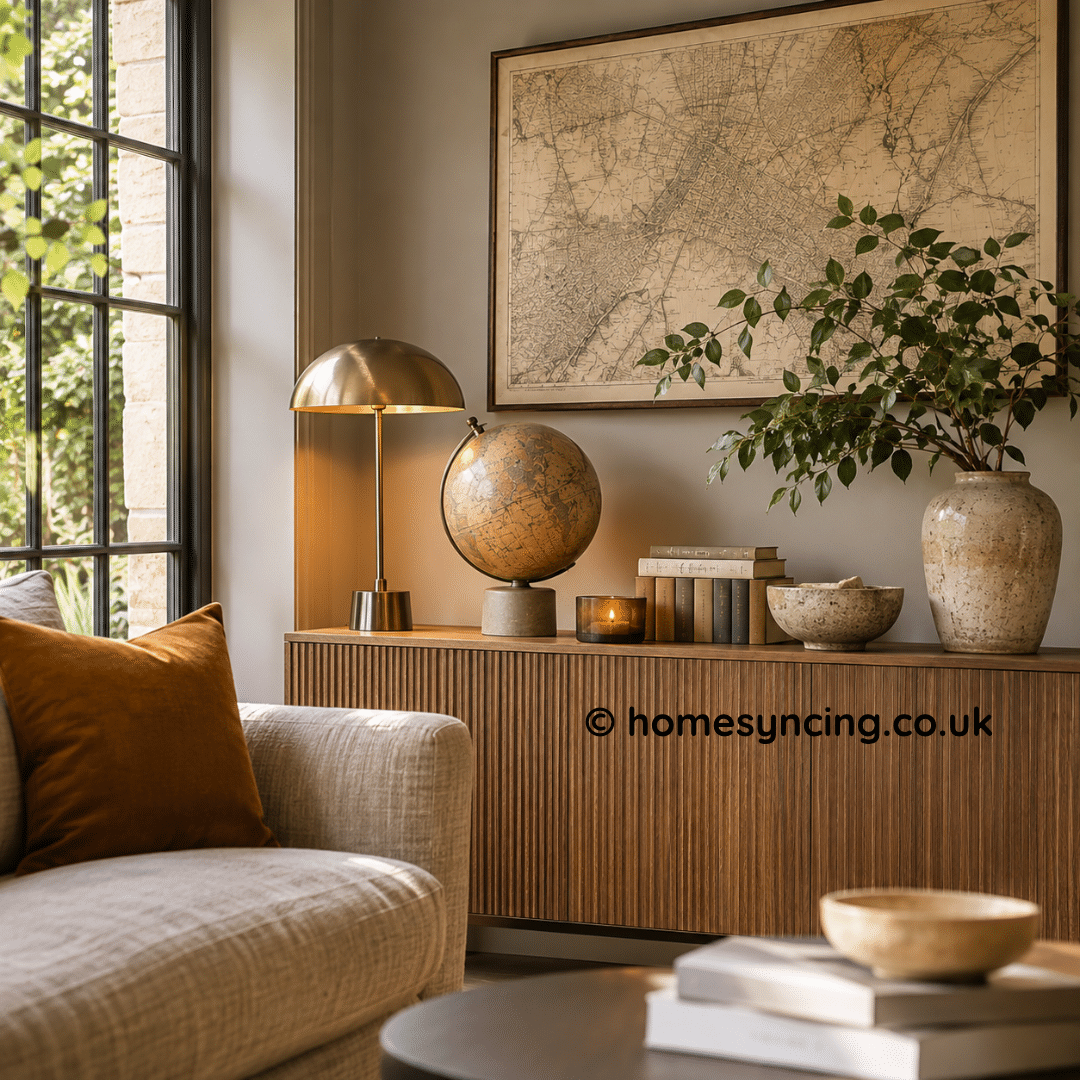
Some of the most interesting things in a home are those that invite a closer look. A globe resting on a bookshelf, an old map of a familiar coastline or a curious little object picked up on a journey can catch the eye in a way that even the most beautiful piece of furniture sometimes cannot.
These are the things that make us stop and wonder. Where did they come from? What was their original purpose? And what made someone choose to keep them?
There is a particular pleasure in surrounding ourselves with objects that have a story to tell. They need not be valuable or rare. A map of somewhere much loved, a piece of pottery brought home from a holiday or a globe that has passed through several generations can bring a sense of personality to a room.
The art lies in giving these objects a place where they can be enjoyed, allowing their character to become part of the home without turning the room into a museum.
The Quiet Fascination of Maps
Maps have a remarkable ability to capture our imagination. At first glance, they are practical things, created to help us understand places and find our way. Yet they can also be extraordinarily beautiful, with delicate lines, carefully drawn coastlines and place names that speak of another time.
An old map of Britain might reveal the changing names of towns and counties, while a chart of the Norfolk coast can show familiar stretches of shoreline in an entirely different light. Even a contemporary map can carry meaning when it depicts somewhere important to us.
This is what makes maps so appealing as decoration. They offer something beyond colour and pattern. They encourage curiosity and provide a connection to the wider world.
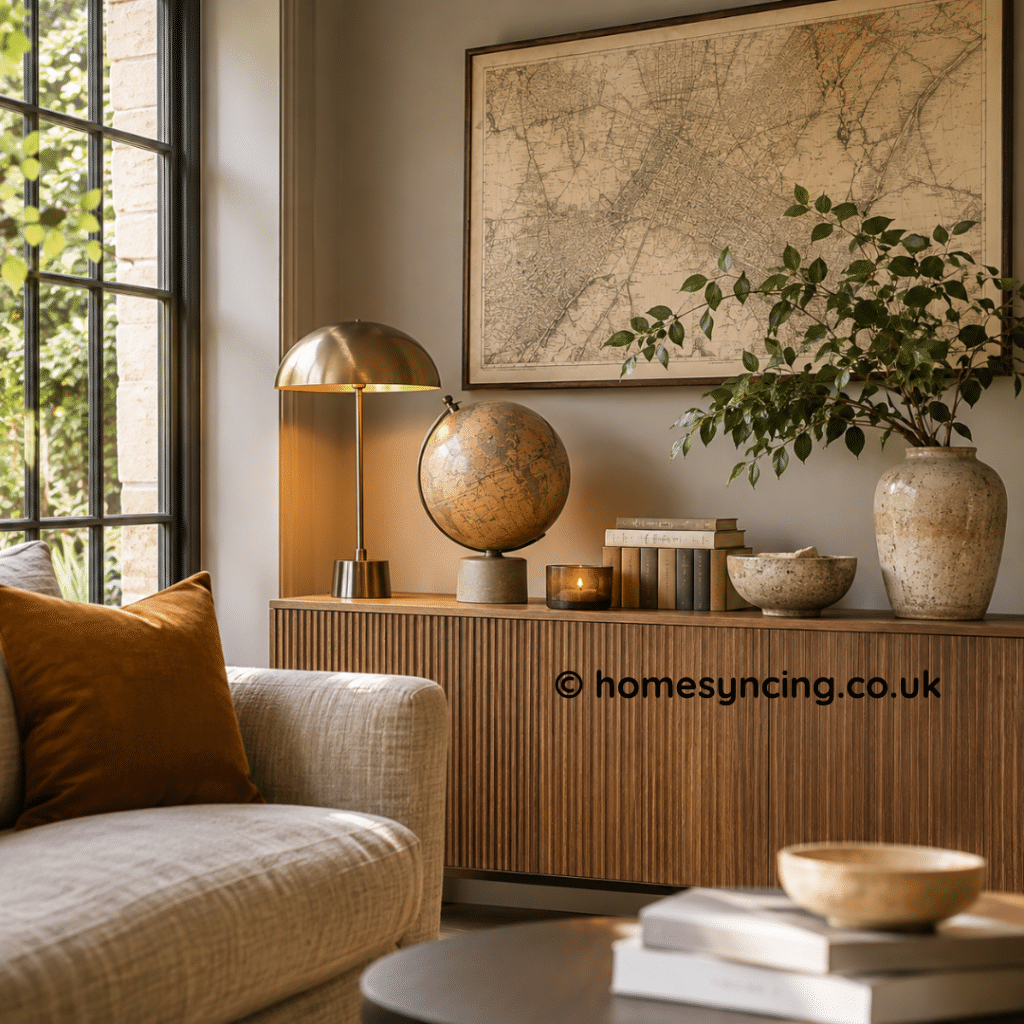
A framed map can look particularly handsome above a console table, sideboard or writing desk. Its intricate detail provides interest without necessarily requiring bold colours, making it well suited to both traditional and contemporary interiors.
The choice of frame can make a considerable difference. A simple oak frame gives an old map a fresh, understated appearance, while a darker wooden frame can complement the warmth of aged paper. A generous mount allows the detail to breathe and prevents the arrangement from feeling too busy.
For a more personal display, consider a map of somewhere that holds a special memory. It might be the village where you grew up, a city you once lived in or a favourite stretch of countryside.
Such a piece becomes more than a decoration. It becomes a small reminder of the places that have shaped your life.
Globes: Beautiful Objects with a Sense of Adventure
There is something enduringly appealing about a globe. Perhaps it is the satisfying curve of its surface, the familiar outline of the continents or the simple pleasure of turning it slowly and discovering somewhere new.
Globes have long been associated with learning, exploration and curiosity. Historically, they appeared in libraries, studies and rooms devoted to reading and collecting. Today, they can be just as attractive in a sitting room, hallway or bedroom.
The most successful arrangements allow a globe to be appreciated as an object in its own right.
A globe placed on a wooden sideboard can create a handsome focal point, particularly when accompanied by a small stack of books or a simple ceramic vase. On a bookshelf, it introduces a welcome change from the straight lines of book spines and shelving.
Larger floor-standing globes can be especially striking where there is enough space around them. Their rounded forms provide an interesting contrast to the more angular shapes of furniture, while their stands can introduce the warmth of wood or metal.
It is worth paying attention to the globe’s colours and finish. Muted blues, warm creams and softly aged tones can sit comfortably alongside natural timber, linen and contemporary upholstery. More colourful globes may work beautifully in rooms where a little contrast is welcome.
There is no need to recreate the atmosphere of an old-fashioned study. A globe can look wonderfully at home in a light, modern interior, where its detail and distinctive shape provide just enough interest.
The Beauty of Objects with a Past
Not every object needs to have travelled across the world to possess an interesting history.
A small brass instrument, an old wooden box, a piece of handmade pottery or a vintage magnifying glass can bring character to a shelf or table. Often, it is the evidence of use that makes these things appealing.
The gentle wear on a wooden surface, the softened colour of aged metal or the irregular finish of hand-thrown ceramics can reveal something about how an object was made and used.
Such details are difficult to reproduce convincingly, and they are part of the reason older pieces can sit so comfortably alongside newer furniture.
A contemporary oak cabinet, for example, might be given a little individuality by the addition of an old map and a decorative brass object. Equally, a modern sitting room can be softened by a collection of books, ceramics and carefully chosen curiosities.
The contrast between old and new is often what makes an arrangement feel natural.
Of course, not every vintage-looking object is genuinely old. Reproductions and decorative pieces inspired by historical designs can be attractive in their own right. The important thing is to choose objects for their craftsmanship, proportions and visual appeal rather than simply because they suggest a particular period.
Creating a Display That Feels Collected, Not Cluttered
There is a fine distinction between a collection that invites interest and one that overwhelms the room.
The most appealing displays often look as though they have developed gradually. A favourite book sits beside a small globe, a ceramic vessel introduces a different texture, and a framed picture provides a backdrop.
Yet arrangements that appear effortless usually benefit from a little thought.
Begin with one object that has a strong presence. This might be a globe, a large piece of pottery or an interesting wooden box. Then introduce a small number of complementary pieces, varying their heights and shapes.
Books are particularly useful because they can be arranged horizontally as well as vertically, creating different levels on which smaller objects can rest.
Try not to place everything in a straight line. Allow some pieces to sit slightly forward and others further back, giving the display depth.
It is equally important to leave empty space between objects. This allows the eye to settle and gives each piece an opportunity to be appreciated.
A collection does not have to be displayed all at once. Rotating favourite objects throughout the year can be a lovely way to rediscover them, particularly when changing the arrangement of a mantelpiece, cabinet or bookshelf.
Finding the Right Place for a Globe or Map
One of the pleasures of decorating with unusual objects is discovering how well they can work in unexpected places.
A globe need not be confined to a study, just as a map does not have to hang above a desk.
In a hallway, a framed map can create an interesting first impression, particularly when positioned above a narrow console table. A small globe or decorative instrument placed nearby adds another layer of interest without requiring a great deal of space.
In a sitting room, a globe can sit among books and ceramics on open shelving. Its curved shape breaks up the regular lines and introduces a pleasing sense of movement.
A dining room sideboard provides another attractive setting. Here, a globe might be combined with a table lamp, a shallow bowl and a piece of framed artwork to create a display that can be enjoyed without interfering with the practical use of the room.
Bedrooms can also benefit from these quieter decorative details. A small map of a favourite place or a carefully chosen object on a chest of drawers can make the space feel more personal.
The best position is usually somewhere the object can be seen and enjoyed naturally, rather than placed simply to fill an empty surface.
Mixing Materials, Periods and Styles
Maps, globes and decorative curiosities often bring together a wonderful variety of materials.
Paper, timber, brass, glass, leather and ceramics each have their own texture and character. When combined thoughtfully, they can create an interior that feels layered without becoming overly elaborate.
A globe with a dark wooden stand might look particularly attractive on a pale oak cabinet, while a brass magnifying glass can introduce warmth to a shelf filled with books and simple pottery.
There is no need for every material to match.
In fact, a room can become far more interesting when polished and matt surfaces, old and new objects, and light and dark finishes are allowed to sit alongside one another.
The key is to establish a sense of connection. This might come from repeating a particular colour, choosing objects with similar proportions or allowing one material to appear in several places around the room.
A brass lamp, for example, can provide a subtle link to the metal detailing on a globe. A wooden picture frame might echo the finish of a nearby table.
These small relationships help an arrangement feel considered without making it appear too carefully coordinated.
Letting Objects Reflect the People Who Live There
Perhaps the most appealing quality of decorating with maps and collected objects is the opportunity to create a home that feels genuinely individual.
A house furnished entirely from a single collection may look beautifully coordinated, but it is often the unexpected pieces that make a room memorable.
A map of a favourite walking route, a piece of pottery discovered in a small workshop or an object inherited from a relative can bring a sense of continuity between past and present.
These possessions may have little monetary value, yet their personal significance can make them among the most treasured things in a home.
There is also no need for a collection to follow a particular theme. Interests change, tastes develop and objects are acquired at different stages of life.
A globe might sit happily beside contemporary artwork, while an old wooden box can share a shelf with modern ceramics. Such combinations often feel more authentic than displays arranged to recreate a particular historical style.
It is this gradual accumulation of meaningful things that gives a home its individuality.
Caring for Maps and Collected Objects
Objects that are displayed and enjoyed will naturally need a little care, particularly if they are older or made from delicate materials.
Original maps and prints are especially vulnerable to strong sunlight, which can cause colours to fade and paper to deteriorate. Where possible, display valuable or sentimental examples away from direct sunlight and consider using suitable archival mounts and glazing.
Globes should also be protected from prolonged exposure to strong sunlight, excessive heat and moisture. Gentle dusting with a soft, dry cloth is usually preferable to using cleaning products that may damage printed surfaces or finishes.
For older wooden and metal objects, the appropriate care depends on their materials and condition. It is often best to avoid vigorous polishing, particularly where the existing patina contributes to the character or historical interest of the piece.
Taking a little care helps preserve the qualities that made these objects appealing in the first place.
A Home Full of Curiosity and Character
The most interesting homes are not necessarily those filled with rare antiques or expensive furniture. More often, they are places where the things we choose to live with reveal something about our interests, memories and experiences.
A globe can encourage a moment of curiosity. A map can recall a favourite place. An unusual object can prompt a conversation or remind us of someone who once owned it.
Together, these pieces bring a richness to an interior that goes beyond decoration.
There is no need to fill every shelf or create an elaborate display. Sometimes a single object, thoughtfully placed, is enough to transform an ordinary corner into something memorable.
And perhaps that is the lasting charm of maps, globes and collected curiosities. They remind us that a home is not simply a collection of rooms and furniture, but a place shaped by the stories of the people who live there.
The loveliest interiors always leave a little room for curiosity.
Take a look at our Globes here! 🌍
Further Reading: Affordable Decorating Ideas That Will Transform Your Home, Sustainable Chic: A Beginner’s Guide to Circular Design, The Psychology of Colour in the Home, How to Choose and Measure for a Dining Table
Daily Inspiration: Follow Us on Instagram, BlueSky, Threads , Pinterest, Twitter, TikTok