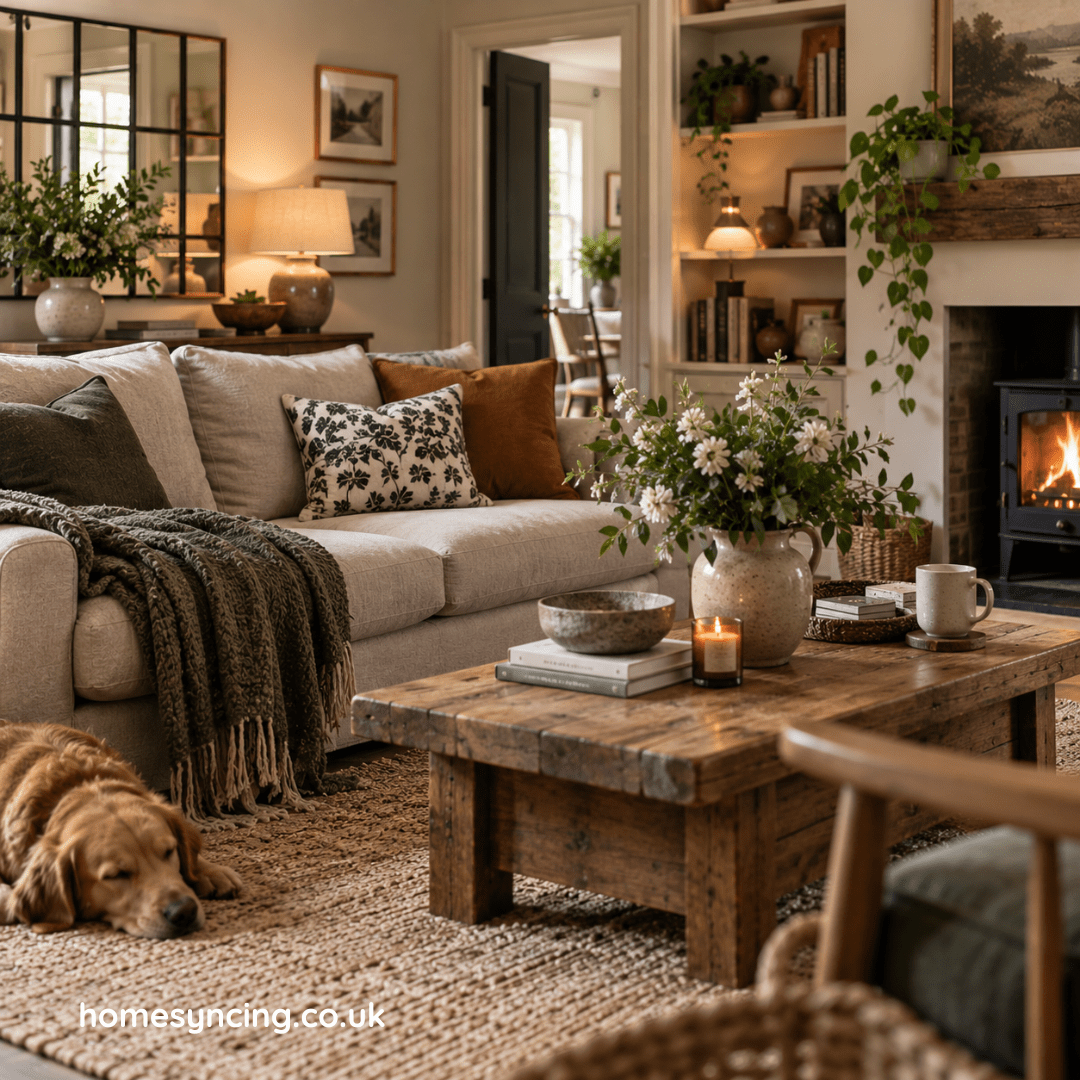
There is a particular kind of home that is difficult to describe, yet instantly recognisable when you step through the door.
It is beautiful, certainly, but not immaculate. There may be books beside a chair, flowers gathered loosely into a jug and a pair of well-worn shoes by the back door. The furniture hasn’t all come from the same collection and not everything is perfectly matched. An old table might bear the faint marks of countless family meals, while a newer lamp sits quite happily beside it.
Nothing feels too precious.
And, most importantly, you feel that you can sit down.
Creating a beautiful home that still feels lived in is less about achieving a particular interior style and more about finding a balance: between old and new, order and imperfection, things chosen for their beauty and things kept because they mean something.
The loveliest homes are rarely finished. They grow.
Start with how you actually live
Before thinking about colours, furniture or decorative objects, consider something more fundamental.
How do you use your home?
Not how you imagine you ought to use it, but how life really happens within its walls.
Perhaps everyone gravitates towards the kitchen rather than the sitting room. Maybe the dining table is used as much for homework and paperwork as it is for dinner. Perhaps a supposedly decorative chair in the bedroom permanently holds tomorrow’s clothes.
These habits matter.
A home feels comfortable when it accommodates everyday life rather than constantly asking its inhabitants to behave differently.
Arrange furniture around the things you genuinely do. Put a lamp beside the chair where somebody actually reads. Give keys a bowl near the door where they are naturally put down. Place a side table within reach of the sofa rather than wherever it looks most symmetrical.
Good interiors begin with usefulness.
Beauty tends to follow.
Don’t buy everything at once
Few things make a room feel less lived in than everything being perfectly coordinated.
A matching furniture set may be convenient, but rooms often become more interesting when their contents have arrived at different times and from different places.
This is something older houses teach us particularly well.
Their interiors evolved. Furniture was moved between rooms, inherited, repaired and adapted. New things appeared alongside old ones. Styles overlapped because life overlapped.
There is no reason a modern home should be different.
A contemporary sofa can sit beside an antique table. A rustic wooden sideboard can work beneath a modern print. An inherited chair can be reupholstered rather than replaced simply because its fabric no longer suits the room.
Give yourself permission to leave a space unfinished while you wait for the right piece.
A home gathered slowly usually tells a more interesting story than one bought in an afternoon.
Mix old and new furniture
One of the easiest ways to create a home that feels established is to mix furniture from different periods.
Too much newness can make a room feel like a showroom. Too much old furniture, unless carefully handled, can make it feel heavy.
Together, they often bring out the best in each other.
The clean shape of a newer sofa might make an old chest look more characterful. A contemporary lamp can bring freshness to a traditional console table. An aged wooden cabinet can add warmth to a simple modern room.
Don’t worry excessively about matching woods, either.
Oak, pine, walnut and painted finishes have lived together in houses for generations. What matters more is balance. If one dark piece feels isolated, repeat a similar tone somewhere else — perhaps in a picture frame, lamp base or smaller table.
The result should feel connected rather than coordinated.
Choose natural materials that improve with age
Some materials are particularly good at being lived with.
Wood develops marks and variations. Linen softens. Leather creases. Brass loses its brightness and gains a patina. Stone bears subtle evidence of years of use.
These changes aren’t necessarily flaws.
They are part of what gives a home character.
Natural materials can be particularly helpful when you want an interior to feel relaxed because they rarely look completely uniform, even when new. The grain of timber, weave of linen and variations in handmade ceramics introduce subtle irregularity.
And those irregularities matter.
A room in which every surface is flawless can feel curiously impersonal. A room containing materials that change with time tends to feel warmer.
When choosing furniture, ask yourself not only how it looks today, but how it might look after five or ten years of ordinary life.
The best pieces often become better companions with age.
Let useful things be beautiful
We sometimes divide our possessions into two camps: the practical things we need and the beautiful things we display.
The distinction needn’t be so clear.
A basket can hold blankets and look lovely beside the sofa. A ceramic bowl can collect keys in the hallway. Books can provide colour as well as something to read. A wooden bench can offer somewhere to sit while also filling an awkward stretch of wall.
This is an old idea, but a useful one.
Homes have always contained objects that are both practical and pleasing to look at: earthenware jugs, woven baskets, wooden stools, candlesticks, quilts and well-made furniture.
Bringing usefulness and beauty together reduces the need to decorate simply for decoration’s sake.
It also makes rooms feel believable.
The things are there because they have a purpose.
Display the things that tell your story
There is little point in creating a beautiful home if, in the process, you remove everything that makes it yours.
Photographs matter. So do children’s drawings, inherited objects, favourite books, holiday finds and the slightly peculiar ornament that would never be chosen by an interiors stylist but makes you smile whenever you see it.
These are the things that separate a home from a photograph of a home.
The trick is not necessarily to display everything at once.
Bring together small collections. Hang a group of pictures rather than scattering them around the room. Give treasured objects enough space to be noticed. Rotate things occasionally, putting some away and rediscovering them later.
A display becomes more interesting when there is a reason behind it.
A shelf of books you have actually read will always have more personality than books chosen because their spines match the wallpaper.
Allow furniture to show signs of life
There is a moment in the life of a new dining table when the first scratch feels like a minor disaster.
Then comes another.
Eventually, you stop counting.
Years later, those marks become almost invisible because they belong to the table’s history: meals eaten, homework completed, Christmas presents wrapped, cups of tea put down without coasters despite repeated requests to the contrary.
Of course, good furniture should be looked after. But looking after something isn’t the same as keeping it untouched.
A home isn’t a museum.
Wooden furniture can be polished and maintained. Upholstery can be cleaned. Stone can be cared for. Yet expecting everything to remain pristine can make a room uncomfortable to inhabit.
Buy things that are capable of being used.
Then use them.
Don’t style every surface
A sideboard does not necessarily need three candlesticks, two books, a vase, a tray and an artfully placed decorative object.
Sometimes it needs a lamp and a bowl.
Perhaps some flowers when there are flowers in the garden.
Leaving a little empty space is one of the simplest ways to make a home feel calm without making it feel sparse.
It also leaves room for life.
A console table might temporarily hold a parcel waiting to be posted. The dining table might acquire a vase of daffodils in spring and a bowl of apples in autumn. A side table needs somewhere to put a cup of tea.
If every surface has been styled to completion, ordinary life becomes an intrusion.
Leave some room for it.
Books make a home feel inhabited
Books have a remarkable ability to settle a room.
They soften shelves, bring colour and give otherwise decorative spaces a sense of purpose. A few beside an armchair suggest that somebody actually sits there. Cookery books in a kitchen and gardening books near a back door quietly connect the room with the life taking place around it.
There is no need to organise them by colour.
Unless, of course, that is genuinely how you like to organise books.
Arrange them in the way that makes sense to you. Some can stand upright, others can lie in small stacks. Larger books can sit on a coffee table or console, particularly if they are ones you enjoy returning to.
Books are personal objects.
Let them look personal.
Bring the garden indoors
Flowers can make even the most carefully decorated room feel more relaxed.
They needn’t be elaborate arrangements.
In fact, something cut from the garden often feels more at home than a perfectly constructed bouquet. A few branches in a tall vase, sweet peas in a little jug or autumn seed heads gathered into an old pot can be enough.
Houseplants have a similar effect.
Their shapes are irregular. They grow in unexpected directions. Leaves appear and occasionally fall. They introduce something alive into rooms dominated by straight lines and solid objects.
This gentle unpredictability helps soften an interior.
And the display naturally changes with the seasons — blossom in spring, garden flowers through summer, berries and foliage in autumn, evergreen branches in winter.
A home needn’t look exactly the same throughout the year.
Make lighting feel natural
Few things alter the atmosphere of a room as quickly as lighting.
A beautiful room can feel surprisingly unwelcoming beneath one bright overhead light.
Instead, think in layers.
Table lamps on sideboards and console tables create pools of light. A floor lamp beside a chair makes a corner inviting. Wall lights can gently illuminate pictures, bookshelves or architectural details.
As evening arrives, different lamps can be switched on according to how the room is being used.
This variation is important.
It means the room changes with the day rather than remaining permanently illuminated in the same way.
A home should look different at half past eight on a winter evening from how it looks at midday in June.
Embrace a little asymmetry
Perfect symmetry can be wonderfully satisfying, but too much of it can make a home feel formal.
Try allowing things to sit slightly more naturally.
A lamp at one end of a sideboard might be balanced by flowers and a small stack of books at the other rather than another identical lamp. Pictures can be grouped in a collection instead of arranged with mathematical precision. An armchair can turn towards the window rather than sitting squarely against a wall.
Rooms don’t always need to be centred.
Often, the slightly unexpected placement of a piece of furniture is what gives the space character.
This is particularly true in older houses, where alcoves, fireplaces, uneven walls and oddly positioned doors have always required a certain amount of improvisation.
Rather than seeing awkward architecture as something to overcome, work with it.
Give every room something with age
Not every home comes with beams, old floorboards and centuries of history.
Nor does it need to.
One or two older pieces can bring a surprising amount of depth to a newer room.
It might be an old mirror, a vintage stool, a battered wooden trunk or a piece of furniture inherited from family. It needn’t be valuable. Its usefulness lies partly in the fact that it has already had a life.
If antiques aren’t for you, look for furniture made from tactile natural materials or pieces with a sense of craftsmanship and permanence.
Character doesn’t have to mean grand.
A simple wooden table can have as much presence as an ornate cabinet.
Hide some clutter, but not all of it
A lived-in home isn’t the same thing as a cluttered home.
Storage matters.
Sideboards, cabinets, baskets and drawers give everyday possessions somewhere to go and allow the things you do want to see to stand out.
The aim, however, isn’t to remove every trace of daily life.
A blanket folded over an armchair, spectacles beside a book or a pair of boots near the door can make a room feel occupied rather than untidy.
Think of it as editing rather than clearing.
Hide the cables, paperwork and practical clutter that distracts you.
Keep the things that say somebody lives here.
Create a home that can change with you
Perhaps the greatest mistake we make when decorating is believing that one day the house will be finished.
It probably won’t be.
And that is rather the point.
Rooms change because our lives change. Furniture moves. Children grow. New pictures arrive. Old pieces are inherited. Something bought for the hallway finds its way into the bedroom, while the chair that never quite worked in the sitting room suddenly looks completely at home in the kitchen.
Allow for that.
Choose furniture you can imagine using in more than one place. Buy objects because you love them rather than because they complete a particular ‘look’. Give yourself permission to rearrange things when a room no longer works as it once did.
The most enduring homes aren’t frozen at the moment they were decorated.
They evolve.
The beauty of a lived-in home
A beautiful home does not have to be a perfect one.
Quite the opposite.
Its beauty can lie in the worn arm of a favourite chair, the uneven row of books, the flowers beginning to droop in yesterday’s vase and the dining table that has acquired a history nobody intended to give it.
These things tell us that a home is being used.
So choose good furniture and look after it. Fill your rooms with colours and materials you enjoy. Find places for the things you have collected and leave space for the things still to come.
But don’t be so concerned with creating a beautiful interior that you become afraid to live in it.
Move the chair towards the fire.
Put your feet up.
Leave the book on the table because you’re going to read another chapter later.
The loveliest homes are not simply looked at.
They are lived in.
Further Reading: Affordable Decorating Ideas That Will Transform Your Home, Sustainable Chic: A Beginner’s Guide to Circular Design, The Psychology of Colour in the Home, How to Choose and Measure for a Dining Table
Daily Inspiration: Follow Us on Instagram, BlueSky, Threads , Pinterest, Twitter, TikTok