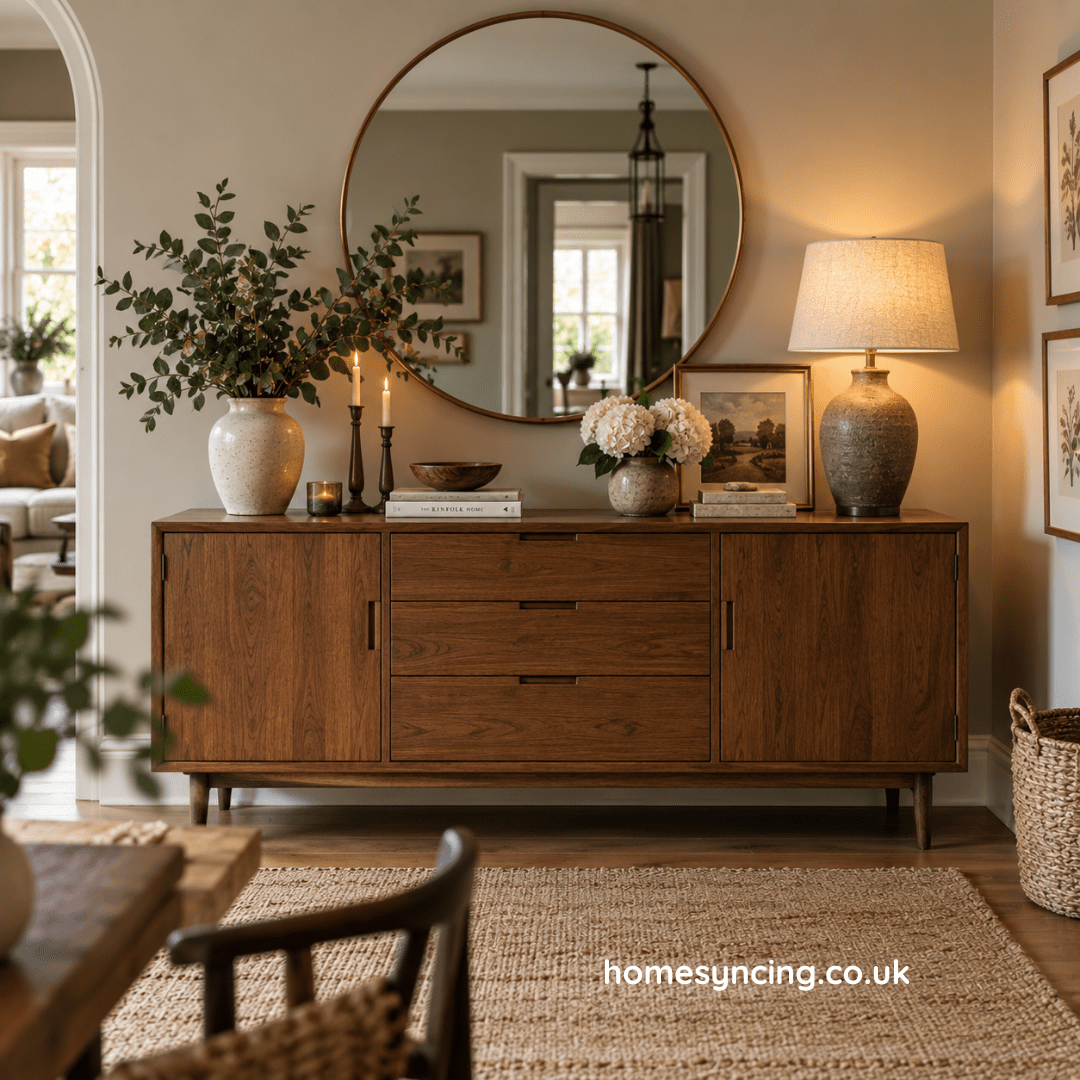
A sideboard is one of those wonderfully dependable pieces of furniture.
It stores the things we would rather not see, gives us a useful surface for the things we do, and often sits quietly against a wall waiting to be made something of.
And that is usually where the question begins.
What should go above it?
The answer is not always a mirror, although mirrors can be very useful. Nor does every sideboard need a large piece of artwork hanging centrally above it. Sometimes the best arrangement is a little less obvious: a group of smaller pictures, a shelf carrying much-loved objects, a wall light or even a stretch of empty wall left deliberately calm.
The key is to think of the sideboard and the wall above it as one composition.
The two should feel connected, without looking overly planned.
Here are 12 ideas for what to put above a sideboard, whether yours sits in a dining room, hallway, sitting room or bedroom.
1. Hang a large mirror
A mirror is one of the most reliable choices above a sideboard.
It brings height to the arrangement, reflects light and can make a darker or smaller room feel more open.
In a hallway, this can be especially useful. A mirror above a sideboard or console offers a practical place to check your reflection on the way out, while also helping the space feel brighter.
In a dining room or sitting room, a large mirror can reflect lamps, artwork, windows or even the garden beyond, adding another layer to the room.
Think about proportion.
A mirror that is too small can look slightly lost above a substantial sideboard. As a rough guide, choosing something around two-thirds to three-quarters of the width of the furniture often creates a pleasing balance.
It does not need to be exact.
A tall narrow mirror can also work beautifully, particularly if the sideboard itself is long and low.
2. Choose one statement piece of artwork
A single large painting or print can give a sideboard real presence.
This works particularly well when the furniture sits on a long, otherwise empty wall.
The artwork provides a focal point, while the sideboard anchors it below.
There is no need to match the colours precisely.
In fact, art often looks more interesting when it introduces something unexpected. A room filled with natural tones might benefit from a richer, moodier painting. A traditional wooden sideboard can be refreshed by contemporary artwork. A simple modern piece can gain warmth from an older landscape or still life.
What matters most is scale.
If the artwork is too small, the arrangement may feel disconnected. Choose something generous enough to hold its own above the furniture.
Then resist the urge to crowd the surface beneath it.
A lamp, a few books or a vase may be all that is needed.
3. Create a gallery wall
Not every wall needs one large object.
A gallery wall can be a lovely alternative, particularly in homes where pictures have been collected gradually over time.
Family photographs, small landscapes, botanical prints, sketches and inherited pieces can all sit together.
The trick is to create some sense of connection.
That might come from similar frames, a repeated colour palette or simply the spacing between each picture.
It does not need to be perfectly symmetrical.
In fact, a slightly looser arrangement often feels more relaxed and lived in.
Begin with the largest picture and build around it. Lay the frames on the floor first if you are uncertain, then move them around until the arrangement feels balanced.
A gallery wall is particularly effective above a sideboard because the furniture gives the collection a clear base.
4. Add a shelf
A shelf above a sideboard can be both practical and decorative.
It allows you to display objects vertically rather than covering the entire surface of the furniture, which can be useful in a smaller room.
Books, ceramics, framed pictures and small pieces of art can be layered along the shelf.
The advantage is flexibility.
Unlike a single picture, a shelf can change with the seasons and with your interests.
You might add a vase of spring branches in March, bring out autumn pottery later in the year, or rearrange books and pictures whenever the room starts to feel tired.
Keep some space between objects.
A shelf packed edge to edge can quickly feel busy, while a few well-chosen pieces will have much more impact.
5. Use wall lights
Wall lights above a sideboard can transform the entire area.
They create height and structure while bringing soft, atmospheric light into the room.
A pair of wall lights works particularly well when the sideboard is centred on a wall, especially in a dining room or sitting room.
They can frame a mirror, artwork or even a central empty space.
This is a particularly good idea if the sideboard surface is already needed for practical things and you do not want to fill it with table lamps.
Wall lights also help a room feel layered after dark.
That matters more than we sometimes realise.
A beautifully styled sideboard can feel flat under one bright ceiling light. Add softer lighting at eye level and the room immediately becomes warmer.
6. Hang a collection rather than a picture
Some of the most interesting things to put above a sideboard are not pictures at all.
A collection of decorative plates can create a striking display.
So can woven baskets, carved wooden pieces, vintage trays or small mirrors.
These arrangements work especially well in homes with a more relaxed, collected character.
The appeal lies in repetition.
A group of similar objects creates rhythm, while differences in shape, colour or age keep the display interesting.
There is also something appealing about using everyday or once-useful objects as decoration.
Old plates, for instance, carry both pattern and history. Woven pieces introduce texture. A collection of small mirrors catches light in a way that a single large one cannot.
The effect feels personal rather than simply styled.
7. Leave the wall mostly bare
Sometimes the best answer is very little.
If the sideboard itself is particularly beautiful, the wall above it may not need much at all.
A striking timber grain, carved doors or an unusual silhouette can already give the room enough interest.
In this case, perhaps all that is needed is one small picture or a single wall-mounted object.
Or nothing.
Empty space gives furniture room to breathe.
This can be particularly effective in rooms that already contain patterned wallpaper, architectural details, several pieces of artwork or a great deal of texture.
Not every surface has to be filled.
A quiet wall can make the rest of the room feel more considered.
8. Add a large clock
A large wall clock can work wonderfully above a sideboard, particularly in a kitchen, dining room or hallway.
It introduces shape, scale and practicality at the same time.
Round clocks are especially useful above long rectangular furniture because the contrast softens the arrangement.
Choose something with enough presence.
A tiny clock will look uncertain above a large sideboard, while a generous one can become a focal point.
Traditional wooden or metal clocks suit characterful interiors, while simpler designs work well in more contemporary rooms.
The key is to avoid over-decorating around it.
A clock is already doing a job.
Let it have some space.
9. Use wallpaper as the feature
Sometimes the wall itself can be the decoration.
Patterned wallpaper, a mural or even a deeper paint colour behind a sideboard can create enough visual interest without anything substantial hanging above.
This is especially effective when the sideboard has a simple shape.
A botanical wallpaper can bring softness and movement. A darker painted wall can make lighter timber stand out beautifully. A mural can turn the whole area into a focal point.
If the background is already busy, keep the styling on top of the sideboard restrained.
A lamp, perhaps a vase and one or two smaller objects may be enough.
The more the wall is doing, the less the furniture surface needs to do.
10. Lean artwork rather than hanging it
Not every piece of art needs to be fixed to the wall.
Larger framed prints, paintings or mirrors can be leaned against the wall on top of a sideboard.
This creates a more relaxed, informal look and makes it easier to move things around.
It also allows objects to overlap slightly.
A smaller framed picture can sit in front of a larger one. A lamp can partly overlap one side. A vase of flowers can soften the arrangement.
This layered approach can make a sideboard feel less formal.
It works particularly well in bedrooms, sitting rooms and relaxed dining spaces.
Just make sure anything heavy is stable and safe.
A beautifully casual arrangement should not actually be precarious.
11. Bring in something sculptural
If you want the area above a sideboard to feel a little different, consider something sculptural.
A carved wooden panel, metal wall piece or textured object can add depth in a way that flat artwork cannot.
This is particularly useful in rooms that already contain several framed pictures.
A sculptural piece brings contrast.
It may catch the light differently through the day, cast subtle shadows and add texture to an otherwise flat wall.
This type of display often suits simpler sideboards best.
Let the shape and material become the focus rather than surrounding it with too many additional objects.
12. Use a seasonal arrangement
The wall above a sideboard does not need to remain exactly the same all year.
One of the pleasures of having a generous surface beneath it is that the whole area can change with the seasons.
In spring, you might introduce branches, blossom and lighter artwork.
In summer, simple flowers and airy textures may feel enough.
Autumn suits deeper tones, dried foliage and warmer lighting.
At Christmas, a garland, wreath or collection of candles can give the sideboard a completely different character.
The important thing is not to overdo it.
Seasonal styling is usually most successful when it feels as though it belongs naturally in the room rather than having been added as a separate layer.
A few thoughtful changes can be more effective than a complete transformation.
How high should you hang something above a sideboard?
This is where many otherwise lovely arrangements go slightly wrong.
Artwork and mirrors are often hung too high.
The object should feel connected to the furniture below, not as though it is floating somewhere near the ceiling.
As a general rule, leave a modest gap between the top of the sideboard and the bottom of the artwork or mirror.
The exact distance will depend on the scale of both pieces, but the arrangement should read as one group.
Step back and look at the whole wall.
If your eye sees the sideboard and artwork as two separate things, try lowering the wall piece slightly.
Should artwork be wider than a sideboard?
Usually, no.
Artwork that is slightly narrower than the sideboard tends to feel more balanced.
A very wide piece can overwhelm the furniture beneath it unless the wall itself is particularly generous.
Again, there are no absolute rules.
A long panoramic print can work above a low, wide sideboard, just as a tall portrait can look elegant above something narrower.
Think in terms of visual weight rather than measurements alone.
The wall decoration and furniture should feel as though they belong to the same arrangement.
What should you put on top of a sideboard?
Once the wall above is sorted, the surface itself becomes much easier.
You do not need to fill it.
A lamp at one end can create height. Books can add another level. A vase, bowl or piece of pottery brings shape.
Try arranging objects in small groups rather than spreading them evenly across the entire surface.
Vary the height.
A tall lamp beside a lower stack of books and a medium-sized vase will usually feel more natural than three objects of exactly the same height.
And leave some empty space.
A sideboard is furniture, not a display case.
It may still need to hold serving dishes at dinner, a bowl of keys in the hallway or the inevitable collection of things that briefly land there before finding their proper home.
Let the room decide
The best thing to put above a sideboard is not necessarily the thing you saw in somebody else’s room.
It is the thing that makes sense in yours.
A dark hallway might benefit from a large mirror.
A dining room may need artwork or soft wall lighting.
A sitting room full of pictures might be better with something sculptural — or nothing at all.
Look at what is already happening around the sideboard.
Consider the height of the ceiling, the width of the wall and the furniture nearby.
Then think about how you want that part of the room to feel.
More open?
More intimate?
More personal?
More practical?
The answer usually becomes much clearer.
A sideboard should feel part of the room
Perhaps the most successful sideboards are the ones that do not look as though they have been styled in isolation.
The mirror above reflects something worth seeing. The lamp is switched on each evening. The books are ones you actually open. The vase changes according to what is growing in the garden.
The arrangement develops alongside the room.
And that is really the point.
Choose something for the wall that gives the sideboard presence, but not so much that it overwhelms it.
Add a few things you enjoy looking at.
Leave enough space for ordinary life.
Then allow it to change.
Because the loveliest rooms rarely stay exactly the same for very long.
Further Reading: Affordable Decorating Ideas That Will Transform Your Home, Sustainable Chic: A Beginner’s Guide to Circular Design, The Psychology of Colour in the Home, How to Choose and Measure for a Dining Table
Daily Inspiration: Follow Us on Instagram, BlueSky, Threads , Pinterest, Twitter, TikTok