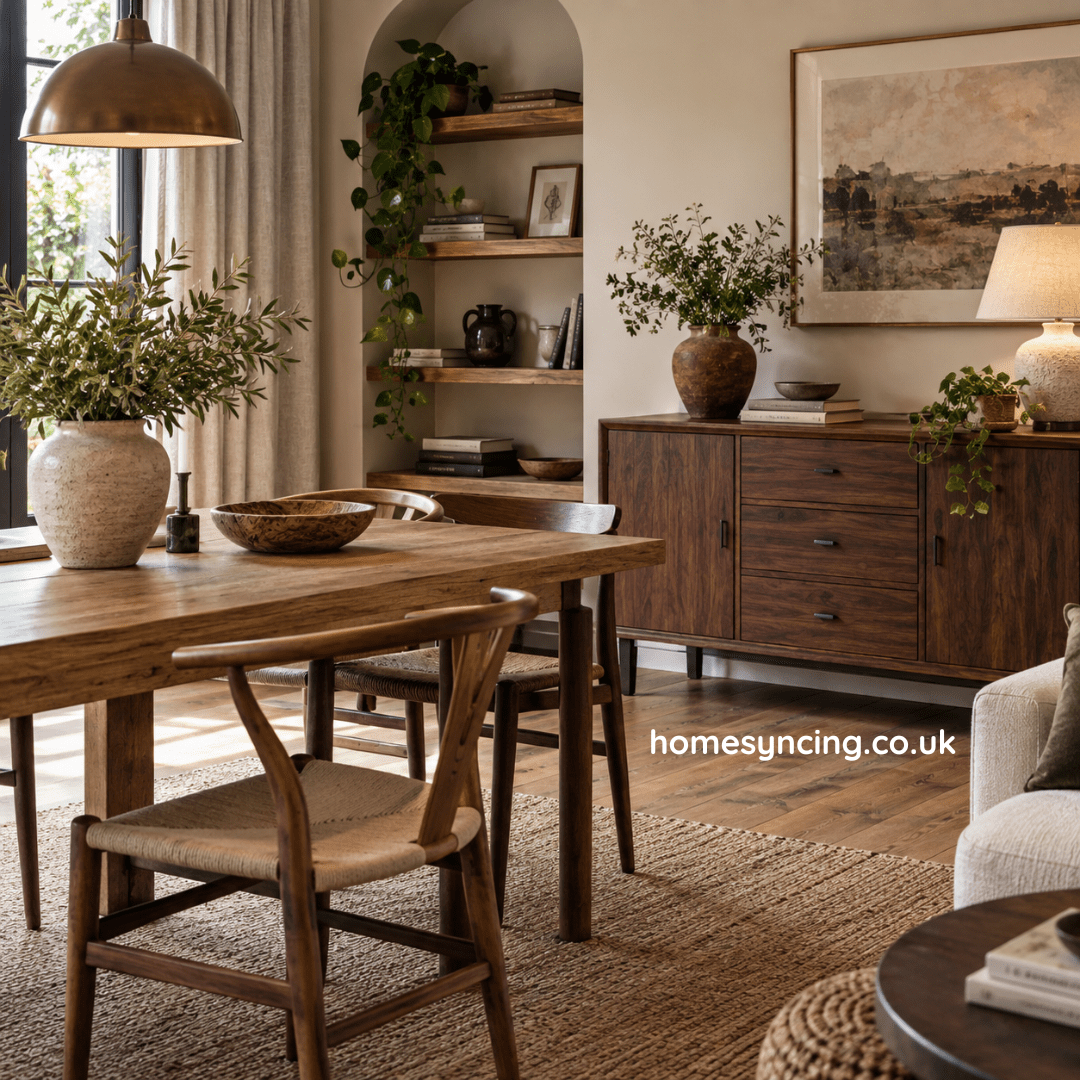
There was a time when furnishing a room seemed to come with an unwritten rule: choose a wood and stick to it.
Oak dining table? Oak chairs.
Walnut sideboard? Better find something walnut to go beside it.
Somewhere along the way, matching became confused with harmony.
Yet walk through almost any old house and you will find a rather different story. Furniture arrived at different times. Pieces were inherited, moved from room to room, repaired and replaced. An oak table might sit beside a mahogany chair; a painted cupboard might share a wall with a darker chest.
The woods did not necessarily match.
The room did.
Learning how to mix different wood tones is less about finding identical finishes and more about creating connections between them. Pale and dark, old and new, polished and weathered can all live happily together.
In fact, allowing different woods into a room can give it something matching furniture sometimes struggles to achieve.
A sense that it has grown there.
Why mixing wood tones works
Wood is naturally varied.
Even two pieces cut from the same tree will not be identical. Grain changes, knots appear, colour shifts and the finished timber alters further as it is exposed to daylight and years of use.
Trying to make every wooden surface in a room match exactly can therefore feel strangely at odds with the material itself.
Different woods bring depth.
Pale oak can introduce warmth without heaviness. Darker walnut can provide richness and contrast. Pine has its own softness, while reclaimed and aged timbers bring marks and variations that new furniture has yet to acquire.
Together, they can make a room feel layered and established.
The secret is knowing where to create contrast and where to introduce a little continuity.
Start with the wood you cannot change
Before bringing another piece of wooden furniture into the room, look at what is already there.
Floorboards are usually the obvious starting point.
Then there may be doors, beams, window frames, fitted cupboards or a fireplace. These larger elements form part of the room’s existing palette and are often impractical — or entirely unnecessary — to change.
Think of them as the backdrop rather than something every piece of furniture must match.
A room with pale oak flooring does not require pale oak furniture.
Quite the opposite.
A darker wooden table can stand out beautifully against a lighter floor, while a painted sideboard can break up the timber altogether.
Begin with what the room already gives you.
Then build from there.
Look at undertones, not just light and dark
Two woods can be similar in depth and still look surprisingly uncomfortable together.
Often, the reason is their undertone.
Some timbers have warm golden, honey or reddish tones. Others appear cooler, greyer or more neutral.
Oak can range from pale and slightly grey to deeply golden. Walnut is often richer and browner. Pine can become distinctly honey-coloured as it ages.
You do not need to become an expert in identifying every species of timber.
Simply stand back and look.
Does the wood feel warm or cool? Golden or grey? Red or brown?
Wood tones sharing broadly similar undertones will usually sit together easily, even when one is much darker than the other.
But contrasting undertones can work too.
They simply need a little more thought elsewhere in the room.
Don’t be afraid of contrast
Contrast is often what makes mixed wood furniture look intentional.
Imagine a room with a pale wooden floor, pale wooden dining table, slightly different pale wooden chairs and another almost-but-not-quite-matching pale wooden cabinet.
Rather than harmonious, it can begin to look as though everything was meant to match but somehow missed.
Introduce a dark sideboard and suddenly the differences feel deliberate.
A clear contrast is often easier on the eye than several near-matches.
The same applies in reverse.
A room containing dark beams and substantial antique furniture can benefit from a lighter oak table or painted cabinet.
You are not trying to disguise the differences.
You are allowing them to become part of the room.
Repeat each wood tone somewhere
One of the simplest ways to mix different wood tones successfully is repetition.
If a dark walnut sideboard is the only dark wooden object in an otherwise pale room, it may feel slightly isolated.
Give that colour an echo elsewhere.
It might be the frame of a mirror, the legs of an armchair, a picture frame or a small occasional table.
It does not need to be the same wood.
The eye simply needs to encounter a similar depth of colour again.
This creates a visual thread through the room.
The same principle works with lighter timber. A pale oak coffee table might connect with a wooden lamp base, woven basket or the frame of a chair.
Repetition makes difference feel deliberate.
Let one wood tone lead
A room containing several wood finishes does not need them all in equal measure.
In fact, it is often better if one acts as the dominant tone.
This might naturally be the flooring, a large dining table, fitted cabinetry or a substantial piece of furniture.
Allow that wood to establish the general character of the room, then introduce one or two contrasting tones around it.
A pale oak dining table might be the dominant timber, for example, with darker chairs and a painted sideboard.
Or an old dark wooden floor might provide the background for lighter furniture.
Think of it rather like putting together an outfit.
Not every element needs equal attention.
Some things provide the foundation. Others bring contrast.
Mix old wood with new
One of the loveliest ways to mix wood tones is to combine furniture of different ages.
Older timber often develops a depth that is difficult to reproduce artificially.
Sunlight changes it. Polishing alters it. Hands touch the same edges for decades. Small knocks and scratches soften the surface.
Place an older piece beside something new and the contrast can bring both to life.
An antique chest beside a contemporary oak bed can make a bedroom feel immediately more established. A new dining table surrounded by older chairs gains character. A clean-lined sideboard can sit beautifully beneath an aged wooden mirror.
Do not try too hard to make the new furniture look old.
Let it be new.
Given enough dinners, house moves and cups put down without coasters, it will acquire a history of its own.
Painted furniture can provide a pause
If a room begins to feel overwhelmed by timber, introduce something painted.
Painted furniture gives the eye somewhere to rest between different wood tones.
A painted sideboard can sit between wooden flooring and a timber dining table. A painted bedside cabinet can soften a bedroom containing a wooden bed and wardrobe.
This is particularly useful when you already have several different woods and do not want to add another.
The colour does not have to be dramatic.
Warm whites, muted greens, earthy neutrals, charcoal and soft greys can all work beautifully alongside natural timber.
A painted piece can also draw attention to the wood around it by providing contrast.
Sometimes the best way to make wood look beautiful is to put less wood beside it.
Use rugs to separate wooden furniture from wooden floors
A wooden table placed directly on a wooden floor creates a large concentration of timber.
If the tones are very similar, the furniture can disappear into the floor.
If they are very different, the contrast may feel stronger than you intended.
A rug can solve both problems.
It creates a visual break between the two surfaces and gives each wood room to stand on its own.
In a dining room, a generous rug beneath the table can define the dining area while separating table legs from floorboards.
In a sitting room, a rug beneath a wooden coffee table does much the same.
Natural fibres, wool and subtly patterned rugs work particularly well because they add another texture without competing with the grain of the timber.
Add softer materials
A room containing a great deal of wood needs softness.
Without it, even beautiful timber can begin to feel hard.
Curtains, rugs, upholstered furniture, cushions and lampshades interrupt wooden surfaces and make the room more comfortable.
They also help connect different tones.
Imagine a dark wooden chair and pale oak table. They may initially feel quite separate. Add a warm neutral rug beneath them and linen curtains nearby, and suddenly both woods belong to the same broader palette.
Soft furnishings are the bridge.
They stop us noticing every furniture finish individually and encourage us to see the room as a whole.
Remember that black can be useful
Black or very dark finishes can act almost like punctuation in a room.
A dark picture frame, lamp base, chair leg or cabinet handle can provide definition among several warm wood tones.
This can be particularly effective when mixing pale oak with medium and darker woods.
You do not need much.
A few small repetitions are enough to give the room structure.
Metal can perform a similar role.
Iron, aged brass and bronze introduce another material, breaking up timber while sitting comfortably alongside it.
This is one reason old interiors often handle multiple wood tones so successfully: wood rarely appears alone.
There are metals, textiles, stone, ceramics and glass alongside it.
What about mixing oak and walnut?
Oak and walnut can work extremely well together.
Their contrast is part of the appeal.
Oak is generally lighter, while walnut brings a deeper, richer brown. Put them together and each becomes more noticeable.
Rather than trying to blend them, allow the contrast to show.
An oak dining table can work with darker walnut-toned chairs. A walnut sideboard can add depth to a room containing pale oak flooring. An oak console can lighten a hallway containing darker wooden doors.
Look for some connection elsewhere through fabrics, accessories or repeated dark and light tones.
The two woods do not need to match.
They simply need to belong to the same room.
Can you mix light and dark wood furniture?
Yes — and it is often one of the most successful combinations.
Light and dark wood give a room depth.
The important thing is balance.
Avoid placing all the dark furniture at one end of the room and all the pale pieces at the other. Instead, distribute the tones so your eye moves naturally around the space.
If the largest piece is dark, introduce smaller dark details elsewhere.
If the floor is pale, allow lighter elements to appear again in another part of the room.
You are creating rhythm rather than symmetry.
A little repetition is usually enough.
Don’t forget the furniture legs
When deciding whether pieces work together, we tend to look at tabletops, cabinet fronts and doors.
But furniture legs can make a surprising difference.
A sofa with dark wooden feet can help connect with a darker sideboard across the room. Dining chairs with pale timber legs can relate to an oak table even if their seats are upholstered.
These smaller details are useful because they repeat wood tones without adding another large expanse of timber.
Look around the room at eye level, then look lower.
You may find you already have more connections than you realised.
Avoid the almost-match
Perhaps the trickiest combination is not two obviously different woods, but two that are very nearly the same.
A dining table and sideboard in slightly different versions of golden oak can sometimes look more awkward than oak beside dark walnut.
Why?
Because the eye assumes they were intended to match.
If you cannot find an exact match — and often you will not — consider choosing something deliberately different instead.
Go darker.
Go lighter.
Choose painted furniture.
Introduce metal.
Confidence often looks more considered than compromise.
Let natural variation show
Wood is not a printed surface.
Grain changes from one board to another. Knots appear unexpectedly. Colour shifts with age and light.
That is precisely what makes it interesting.
When choosing wooden furniture, do not expect every part of it to be completely uniform.
Those variations give the piece individuality.
The same is true when several pieces of wooden furniture share a room. They do not need to look as though they came from the same tree.
A room built around natural materials should be allowed to contain some natural irregularity.
It is part of the warmth.
Think about the whole room, not just the furniture
When two wood tones seem not to work together, the temptation is to replace one of them.
Before doing that, look at everything else.
Perhaps the room needs a rug to separate them.
Maybe a wall colour is making one timber appear more orange than it really is.
Perhaps repeating the darker wood in a mirror frame would create the connection that is missing.
Or maybe the room simply contains too many hard surfaces and needs curtains, upholstery and texture.
Furniture does not exist in isolation.
A combination that looks uncertain in an empty room can feel completely natural once books, artwork, lamps, textiles and personal objects are added.
Give the room time before deciding something is wrong.
A room should feel collected, not matched
There is a certain freedom in accepting that the woods in your home do not need to match.
The old pine chest can stay.
The oak dining table does not have to dictate every future furniture purchase.
The dark sideboard you love can sit on pale floorboards.
And the little table inherited from somebody years ago does not need to explain why it is a completely different colour from everything else.
Homes become interesting through these differences.
So when mixing different wood tones in the same room, begin with what you already have. Notice whether the undertones are warm or cool, allow one timber to lead and repeat colours just enough to create a connection.
Use rugs, textiles, painted furniture and other materials to give the wood some breathing room.
Most of all, resist the urge to make everything match.
A room assembled over time will naturally contain different colours, grains, ages and finishes.
That is not a decorating problem to solve.
Very often, it is what gives the room its character.
Further Reading: Affordable Decorating Ideas That Will Transform Your Home, Sustainable Chic: A Beginner’s Guide to Circular Design, The Psychology of Colour in the Home, How to Choose and Measure for a Dining Table
Daily Inspiration: Follow Us on Instagram, BlueSky, Threads , Pinterest, Twitter, TikTok