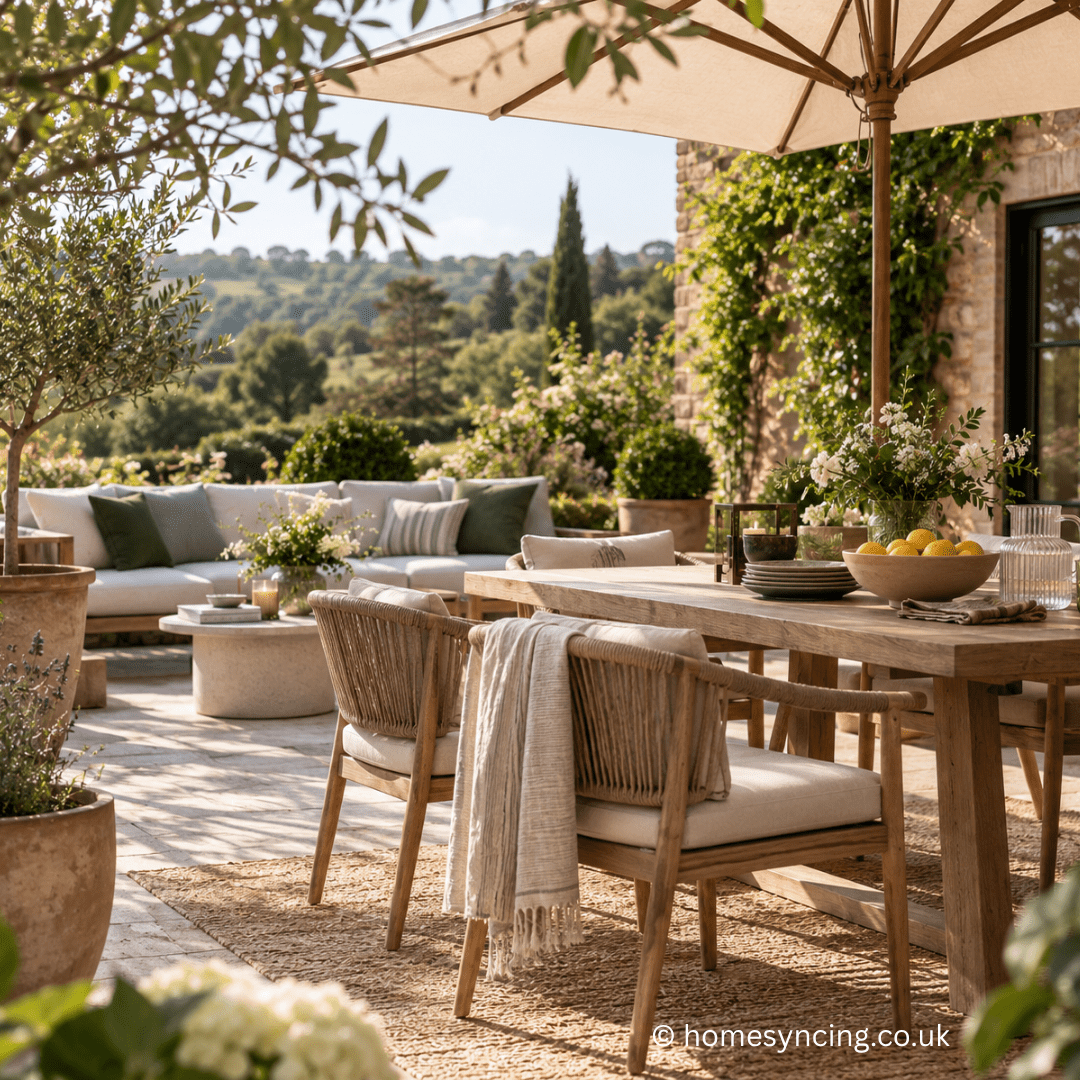
A garden is rarely used in quite the way we imagine when looking at an empty patio.
Once summer arrives, chairs migrate towards the last patch of evening sunshine. Children appear with games. Lunch stretches into the afternoon. Extra seats are pulled around the table and, as the temperature falls, somebody goes indoors in search of blankets.
Good garden furniture should accommodate all of this without making the garden feel as though it has been furnished like another room.
The best pieces belong comfortably in their surroundings. Timber gradually weathers, woven furniture softens hard paving and a well-positioned bench gives you a reason to sit somewhere you might otherwise have hurried past.
Whether you are furnishing a small courtyard, a family garden or a generous terrace, choosing the right garden furniture begins not with what is fashionable, but with how you want to use the space.
Begin with How You Use Your Garden
Before deciding between teak, aluminium or rattan garden furniture, think about what actually happens outside your home.
Do you regularly eat outdoors? Do you need somewhere for a family of four or a table capable of accommodating ten people at weekends? Is the garden primarily somewhere to relax with a book, or does it become the centre of family life whenever the weather permits?
A large dining set makes sense for enthusiastic hosts but can overwhelm a garden where meals are rarely eaten outside. Equally, an attractive pair of lounge chairs may prove frustrating if what you really need is somewhere for everyone to sit around supper.
Write down the activities that matter most.
For a family garden these might include outdoor dining, relaxed seating, children’s play, entertaining friends and somewhere quiet to sit with a cup of tea.
Once those priorities are clear, choosing the furniture becomes much easier.
Measure Before You Buy Garden Furniture
Garden furniture often looks deceptively small in a showroom or photograph.
A six-seater dining table can occupy a substantial area once the chairs are pulled out, while a deep outdoor sofa may extend much further into a terrace than its dimensions initially suggest.
Measure the available space carefully before buying anything.
Record the width and length of your patio, terrace or deck, but also note doors, steps, planting beds, paths, drains and other permanent features.
Then mark out the proposed furniture.
Garden canes, chalk or masking tape can help you visualise a table or sofa at full scale. Cardboard boxes are useful for understanding the bulk of larger pieces.
Don’t simply ask whether the furniture fits. Consider whether people can use it comfortably.
As a practical starting point, allow roughly 75–90cm behind dining chairs where possible so they can be pulled out without immediately meeting a wall, planter or another piece of furniture. Where the space also forms an important route through the garden, more room may be needed.
The same principle applies to outdoor sofas and coffee tables. There should be enough space to move around them without having to squeeze through narrow gaps.
Let the Garden Decide Where the Furniture Goes
One of the most useful things you can do before furnishing a garden is simply observe it.
Notice where the morning sun falls and which areas remain shaded in the afternoon. Look for the spot that catches the last light of the evening and pay attention to the prevailing wind.
A terrace immediately outside the kitchen may be the obvious place for a dining table because food and crockery can be carried outside easily.
But the best place for a bench may be entirely different.
Perhaps there is a sheltered corner overlooking a flower border, a sunny wall that remains warm into the evening or a view back towards the house that you rarely stop to appreciate.
Garden furniture can encourage you to use parts of the garden that would otherwise be passed by.
In that sense, choosing where to sit is as important as choosing what to sit on.
Choosing an Outdoor Dining Set
For many households, an outdoor dining table and chairs form the heart of the garden during warmer months.
Think carefully about capacity.
If four people use the table every day but eight regularly gather at weekends, an extendable garden table can be more practical than permanently filling the terrace with an oversized one.
Round tables are sociable and can work particularly well in square spaces. Rectangular tables generally make efficient use of long patios and are easier to position against the lines of a house.
The chairs matter just as much.
Armchairs are comfortable but require more room. Armless dining chairs can be positioned closer together, while benches provide flexible seating for children and unexpected guests.
If you intend to spend long evenings at the table, comfort is worth prioritising over appearance alone.
Creating a Garden Lounge Area
An outdoor sofa can change the way a garden is used.
Rather than sitting formally around a dining table, a garden lounge set creates somewhere for reading, talking and lingering outdoors after a meal.
Modular garden furniture is particularly useful for families because individual sections can be rearranged as requirements change.
A corner configuration might suit everyday life, while separate chairs and sofa sections can be moved into a more conversational arrangement when friends visit.
Consider the depth of the seats before buying. Some garden sofas are designed for upright conversation; others are deep enough for lounging.
Neither is necessarily better – it depends on how you prefer to sit.
And remember the cushions.
A beautifully upholstered outdoor sofa becomes rather less convenient if its cushions require an elaborate journey through the house every time rain threatens.
Don’t Overlook Garden Benches
There is something particularly appealing about a garden bench.
Unlike a full furniture set, it doesn’t demand an entire entertaining area. A bench can sit quietly beneath a tree, beside a path or against a sunny wall and gradually become part of the garden.
Position it somewhere with a reason to stop.
That might be opposite a favourite border, beneath a climbing rose or in a place that catches the evening sun.
Timber benches weather particularly gracefully and can look better once the garden has begun growing around them.
Small stools and occasional tables can also be useful. They are easy to move and can provide extra seating or somewhere to put a drink without cluttering the garden with permanent furniture.
Which Garden Furniture Material Is Best?
The best material for garden furniture depends on appearance, maintenance, weight, storage and how exposed the garden is.
No material is entirely maintenance-free, so it is worth understanding what you are buying.
Teak and Hardwood Garden Furniture
Timber has an obvious affinity with a garden.
Good-quality teak is particularly popular because its natural oils make it durable outdoors. Left untreated, teak gradually develops a soft silver-grey surface.
Some people love this weathered appearance; others prefer the warmer colour of newer timber and choose to maintain it accordingly.
Whatever your preference, follow the manufacturer’s care instructions rather than automatically applying oils or treatments. Different products and finishes require different maintenance.
Other hardwoods can also perform well outdoors, although durability varies considerably between species.
When buying new timber garden furniture, look for credible certification demonstrating that the wood has come from responsibly managed sources, such as FSC certification where appropriate.
Aluminium Garden Furniture
Aluminium works particularly well where furniture needs to be moved regularly.
It is relatively lightweight and does not rust in the same way as iron or ordinary steel, making it a practical choice for contemporary outdoor furniture.
Powder-coated aluminium is available in everything from muted greens and warm neutrals to dark charcoal finishes.
Check the quality of the coating and construction. Scratches and damaged finishes can shorten the life of poorly made pieces, while very lightweight furniture may be less suitable for exposed or windy gardens.
Rattan and Woven Garden Furniture
The appearance of woven furniture suits gardens particularly well because it introduces texture without feeling heavy.
Much of the furniture sold as rattan garden furniture for outdoor use is actually made from synthetic woven material designed to withstand the weather better than natural rattan.
Natural rattan is generally better suited to interiors, conservatories and well-protected spaces unless specifically designed and treated for outdoor conditions.
If choosing synthetic woven furniture, inspect the frame beneath it as well as the weave itself. A good-quality frame and UV-resistant material will usually prove a better investment than a cheaper set that becomes brittle or faded quickly.
Steel and Iron Garden Furniture
Metal furniture can bring wonderful structure to a garden.
Traditional painted ironwork suits cottage gardens and older properties particularly well, while slender steel designs can feel much more contemporary.
The disadvantage is weight and, depending on the metal and finish, the possibility of corrosion.
Look for appropriate protective finishes and deal with chips before rust has an opportunity to spread.
The weight can also be an advantage in an exposed garden where lighter furniture is easily moved by strong winds.
Plastic and Recycled Garden Furniture
Plastic garden furniture has changed considerably.
Contemporary moulded designs can be attractive, practical and easy to clean, while furniture made partly or wholly from recycled plastics provides another option for outdoor spaces.
Quality varies.
Look beyond the initial appearance and consider UV resistance, repairability and how the furniture can eventually be recycled or disposed of.
Buying something durable enough to use for many years is generally preferable to replacing inexpensive furniture every few seasons.
Think About British Weather
Few gardens in Britain enjoy predictable weather.
Furniture may experience strong sunshine, prolonged rain, frost, wind and occasionally all four within a surprisingly short period.
Consider how exposed your garden is.
A sheltered courtyard creates very different conditions from a coastal terrace or an open garden on higher ground.
Lightweight chairs that are perfectly practical in a protected city garden may be frustrating somewhere windy. Likewise, furniture that requires constant covering can become tiresome in a garden where rain showers are frequent.
Check whether cushions are water-resistant or genuinely designed to remain outdoors, and understand that ‘weather-resistant’ does not necessarily mean indestructible.
Even furniture intended for outdoor use generally lasts longer when it is looked after.
Plan for Shade
Comfort outdoors isn’t only about the chair.
A sunny terrace can become unpleasantly hot during the middle of the day, so consider shade at the same time as the furniture.
A large parasol is the simplest solution, but check whether there is enough room for the base and whether the canopy can be positioned effectively as the sun moves.
Pergolas, awnings and trees can provide more permanent shade.
If you are planning an outdoor dining area from scratch, incorporating shade from the beginning often produces a much more useful space than trying to add it afterwards.
Consider an Outdoor Fire Pit Carefully
Fire pits can extend the amount of time spent outside during cooler evenings and create a natural gathering point.
They do, however, require sensible planning.
Position any fire feature well away from buildings, fences, overhanging branches, dry planting and combustible furniture, and follow the manufacturer’s guidance regarding safe clearances and suitable surfaces.
Local restrictions may also apply to outdoor burning or smoke, so check the rules where you live.
For families with young children or pets, consider whether an open flame is appropriate for the way the garden is used.
Warm blankets and good outdoor lighting can sometimes achieve much of the atmosphere with considerably less complication.
Don’t Forget Storage
Storage is one of the least glamorous parts of choosing garden furniture and one of the most important.
Where will the cushions go when heavy rain is forecast?
Can the parasol be stored over winter?
Do the chairs stack?
Can the table remain outdoors throughout the year?
A weather-resistant cushion box can be useful, provided it is designed to keep its contents dry and has adequate ventilation.
Sheds, garages and outbuildings provide better winter protection for furniture that isn’t intended to remain permanently outside.
In a small garden, folding or stackable chairs can free up valuable space when they aren’t required.
Think about all of this before buying rather than discovering afterwards that six large chairs have nowhere to go in November.
Choose Garden Furniture That Suits the House
Outdoor furniture doesn’t have to match the architecture precisely, but it should feel comfortable beside it.
Against an old brick or stone house, timber, painted metal and woven textures often sit particularly naturally.
Contemporary extensions can take cleaner forms and powder-coated metals, although the contrast of an old timber table against modern glazing can be very effective.
Colour can help connect the furniture to the garden.
Soft greens, earthy reds, warm neutrals and natural timber tend to settle easily among planting. Stronger colours can work beautifully too, particularly when repeated in pots, cushions or flowers.
Avoid trying to coordinate everything perfectly.
Gardens are full of changing colours, irregular forms and different textures. Outdoor furniture can afford to be similarly relaxed.
Add Comfort with Outdoor Textiles
Cushions, seat pads and throws can make even simple garden furniture much more inviting.
They are also an easy way to introduce pattern.
Stripes, checks, botanical motifs and small-scale prints sit comfortably outdoors and can help bridge the gap between furniture and planting.
An outdoor rug can define a seating area on a large terrace, but choose one specifically made for exterior use and consider whether it can dry properly after rain.
Textiles are where you can afford to be more seasonal.
Furniture may remain for a decade or more; cushions are much easier to change.
Buy Less, but Buy Well
A large matching garden furniture set isn’t always necessary.
You may get more pleasure from one excellent table, comfortable chairs and a well-positioned bench than from filling every corner with furniture.
Look at how pieces are constructed.
Are the joints sound? Does the table wobble? Can damaged parts be repaired? Are replacement cushions available? Can the material be refinished?
Garden furniture lives a demanding life.
A piece that can be maintained, repaired and eventually passed on is often a better investment than something designed to last only a few summers.
Second-hand furniture is worth considering too. Good-quality timber and metal pieces can often be cleaned, repaired or refinished, gaining character in the process.
Allow the Garden to Remain a Garden
There is a temptation when creating an outdoor living space to reproduce an indoor sitting room almost exactly outside.
But gardens have qualities of their own.
Leaves fall onto tables. Birds visit. Flowers scatter petals across the paving. Timber changes colour and the position of the sun alters throughout the year.
The most successful garden furniture works with these changes rather than attempting to exclude them.
Choose pieces that are comfortable, durable and appropriate for the space. Give people somewhere to eat together, somewhere to stretch out and perhaps one quiet seat away from everything else.
Then allow the planting to grow around them.
Because ultimately, the best garden furniture doesn’t make you admire the furniture.
It makes you want to go outside and stay there.
Ready to get started? Browse our latest garden furniture collections and transform your outdoor space today!