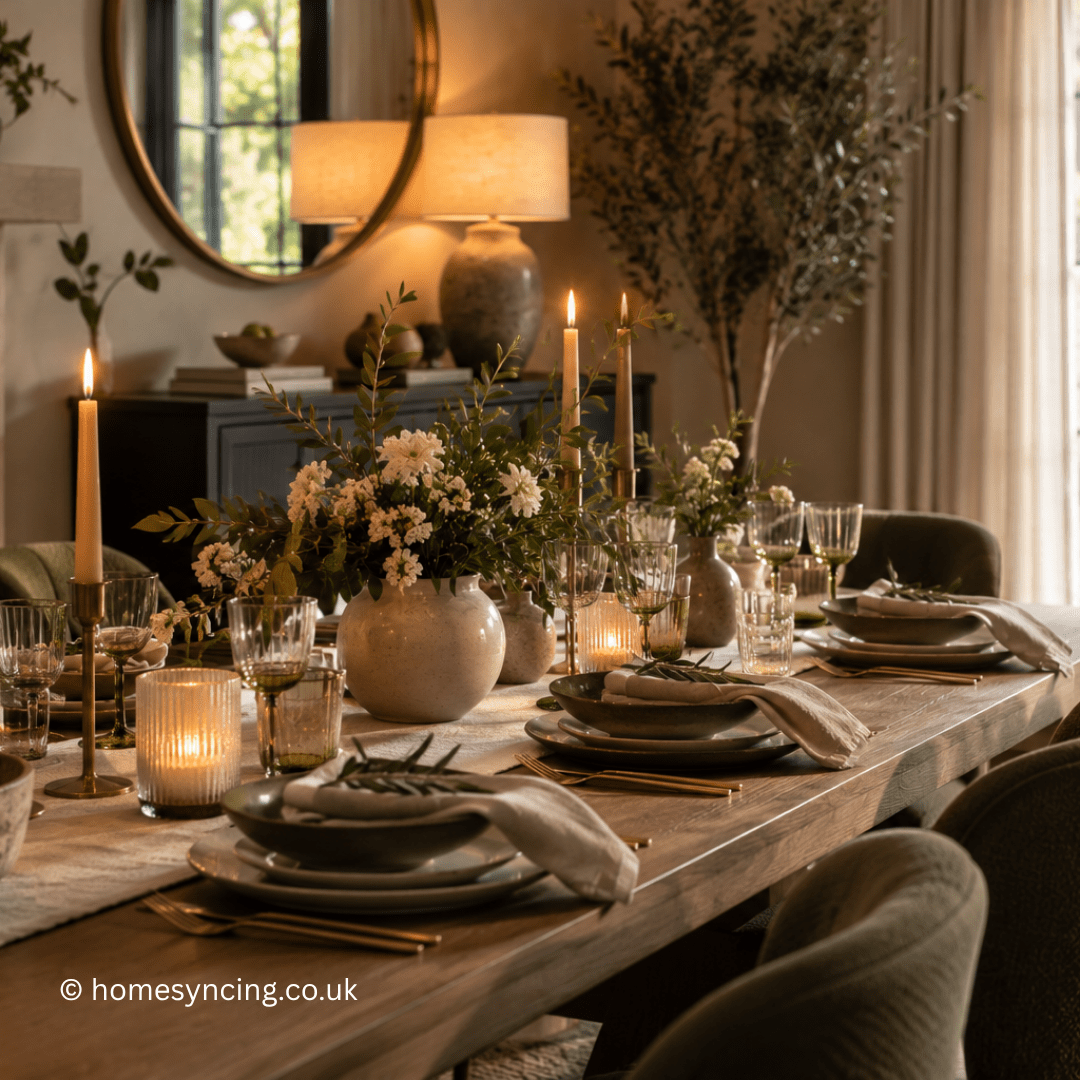
There is something rather special about a table laid in anticipation of a gathering.
Long before the first dish appears, it sets the mood for what is to come. The fold of a linen napkin, a few stems gathered from the garden, the gleam of glassware in candlelight – these small details signal that time and thought have been given to the occasion.
The tradition of dressing a dining table is centuries old. In grand houses, formal dinners might once have involved elaborate arrangements of silver, porcelain, flowers and carefully ordered place settings. Around humbler tables, the details were simpler, but the intention was much the same: to welcome people, share food and mark the pleasure of being together.
Thankfully, creating a beautiful table today needn’t involve an encyclopaedic knowledge of dining etiquette.
The most inviting tables are often those that feel collected rather than constructed. A favourite tablecloth, mismatched crockery, seasonal foliage and the warm glow of candles can be quite enough.
Whether you are preparing for Sunday lunch, an informal supper with friends or a larger celebration, here is how to dress a dining table with a little creativity and a light touch.
Begin with the Table Itself
Before reaching for a tablecloth, consider whether you need one at all.
A handsome timber dining table can provide a beautiful foundation in its own right. Leaving some or all of the wood visible brings warmth and informality to a setting, particularly for relaxed lunches and family gatherings.
For occasions that call for something softer, linen is difficult to beat.
A full tablecloth immediately changes the character of a dining room, creating a sense of occasion even when everything placed upon it is comparatively simple. White and ivory have enduring appeal, but natural flax, soft sage, muted blue and warm stone can be equally versatile.
Don’t worry if linen isn’t perfectly pressed. A few gentle creases can give the table a more relaxed, lived-in quality.
A runner offers another option, particularly on a table you would rather not completely conceal. Laid along its length, it creates a natural foundation for flowers, candles and serving dishes while allowing the character of the table beneath to remain visible.
Build the Setting in Layers
Much of the appeal of a well-dressed table comes from layering.
Begin with the practical pieces: plates, bowls, cutlery, glasses and napkins. Then stand back and look at the table as a whole before adding anything decorative.
Placemats can help define individual settings and introduce another texture. Woven natural fibres suit informal occasions, while linen or fabric mats create a softer effect.
Crockery needn’t match perfectly.
Indeed, a table assembled from pieces collected over time can have considerably more character than one where everything belongs to the same set. Plain dinner plates might be paired with patterned side plates, old serving bowls with contemporary glassware, or inherited pieces with everyday china.
The trick is to find a thread that connects them. It might be a recurring colour, material or shape rather than an exact match.
The result should feel harmonious, but not overly coordinated.
Let the Seasons Lead the Way
Some of the loveliest dining table ideas can be found just beyond the back door.
In spring, bowls of bulbs, blossom and fresh green stems bring a sense of the garden indoors. Summer offers herbs, abundant flowers and bowls piled with fruit. As autumn arrives, branches, seed heads, apples and richly coloured leaves introduce warmer tones.
Winter has a beauty of its own. Evergreen foliage, bare sculptural branches, dried hydrangeas and small pots of herbs can create an atmospheric table without relying on anything particularly elaborate.
You needn’t be an accomplished flower arranger.
A handful of stems in a favourite jug can be every bit as effective as a formal arrangement. Small bud vases dotted along the centre of a long table work particularly well, allowing each flower or branch to be appreciated individually.
There is also something appealing about using what is readily available. A few branches gathered during a garden tidy or herbs snipped from a pot on the windowsill can make a table feel connected to its surroundings and to the time of year.
Keep the Centrepiece Conversational
A magnificent arrangement may look impressive in a photograph, but if your guests have to peer through it to speak to one another, it has rather missed the point.
A dining table is, above all, a social place.
Keep flowers and dining table decorations low enough for conversation to pass comfortably across the table. Alternatively, choose tall, slender arrangements where the bulk of the foliage sits above eye level.
Several smaller vessels can be easier to arrange than one substantial centrepiece. Try grouping old glass bottles, ceramic jugs, small bowls and bud vases, varying their heights without allowing any one piece to dominate.
Odd numbers often work particularly well when arranging decorative objects. Groups of three or five tend to feel more natural than rigidly symmetrical pairs.
Remember, too, that food needs somewhere to go. If serving dishes will be placed on the table, leave generous gaps in your arrangement rather than creating a display that has to be dismantled the moment dinner arrives.
Use Candlelight Generously
Few things transform a dinner table as quickly as candles.
As daylight fades, their soft pools of light make glassware sparkle and create warmth around the table. They are particularly effective in dining rooms where overhead lighting can otherwise feel rather stark.
Tall dinner candles bring height and a little formality. Smaller candles in glass holders create a softer glow, while a mixture of the two can give the table a more collected appearance.
Again, there is no need for everything to match.
Brass candlesticks can sit alongside ceramic holders or old silver. Different heights help the arrangement feel as though it has evolved over time.
Unscented candles are usually the better choice at the dining table. Strongly perfumed varieties can compete with the aromas of the meal – and, after all, the food deserves its moment too.
Make Napkins Part of the Setting
Cloth napkins are one of the simplest ways to make an everyday table feel more considered.
Linen and cotton become softer with use and needn’t be folded into anything complicated. A loose fold laid across the plate or tucked beneath the cutlery often looks more inviting than an elaborate arrangement.
For a small decorative detail, tie a napkin loosely with ribbon or natural twine and tuck in a sprig of rosemary, lavender or seasonal foliage.
Napkins are also an easy place to introduce colour. If your crockery and tablecloth are neutral, a deeper green, ochre, rust or blue can provide just enough contrast to bring the table to life.
Add Details with Meaning
The finishing touches are an opportunity to make a table feel personal.
For a larger gathering, handwritten place cards remove the uncertainty over where to sit while adding something distinctly individual to each setting. They needn’t be formal: a simple piece of card with a name written by hand is quite enough.
Small objects can tell a story too.
Perhaps you have glasses inherited from a grandparent, a serving platter brought home from a holiday or a slightly imperfect ceramic jug made by a local potter. Objects with memories attached to them lend a table a richness that cannot easily be achieved by buying everything at once.
These are often the details guests remember.
Consider the Room Around the Table
When dressing a dining table, it is easy to concentrate so closely on the tabletop that the rest of the room is forgotten.
Take a few steps back.
Consider how the colours on the table sit alongside the walls, curtains, artwork and furniture. You don’t need to match them precisely, but repeating a colour or material already present in the room can make the setting feel naturally connected to its surroundings.
Lighting matters too.
Rather than relying entirely on a central pendant, combine it with lamps, wall lights and candles where possible. Pools of softer light around the room help create a more intimate atmosphere and prevent the dining table from feeling like a brightly lit stage.
If there is a sideboard nearby, use it as part of the occasion. A vase of flowers, decanters, serving dishes or a small lamp can extend the table setting into the room.
Know When to Stop
Perhaps the most useful lesson in dressing a dining table is knowing when it has enough.
Once the plates, glasses, napkins, flowers and candles are in place, pause before adding anything else.
There should be empty space.
Guests need somewhere to put their hands, glasses need to be reached without navigating an obstacle course, and serving bowls need to travel comfortably around the table.
A little restraint allows individual pieces to be noticed. It also makes the whole setting feel more relaxed.
The aim isn’t to create a table so immaculate that nobody wishes to disturb it. Quite the opposite.
A Table Made for Gathering
The art of dressing a dining table has less to do with rules than with hospitality.
The table can be grand or modest, carefully planned or assembled from whatever happens to be in the cupboard and garden. What matters is the sense that it has been prepared with people in mind.
Start with pieces that are useful. Add natural materials, seasonal flowers or foliage and a little candlelight. Mix old things with new ones. Leave room for serving dishes, elbows and conversation.
Most importantly, allow the table to change once everyone arrives.
Napkins will unfold. Glasses will move. Serving spoons will wander. Candle wax may drip and crumbs will inevitably appear on the cloth.
That isn’t the undoing of a beautifully dressed table. It is what the table was dressed for in the first place.
See our Range of Dining Tables here
Further Reading: Affordable Decorating Ideas That Will Transform Your Home, Sustainable Chic: A Beginner’s Guide to Circular Design
Daily Inspiration: Follow Us on Instagram, BlueSky, Threads , Pinterest, Twitter, TikTok