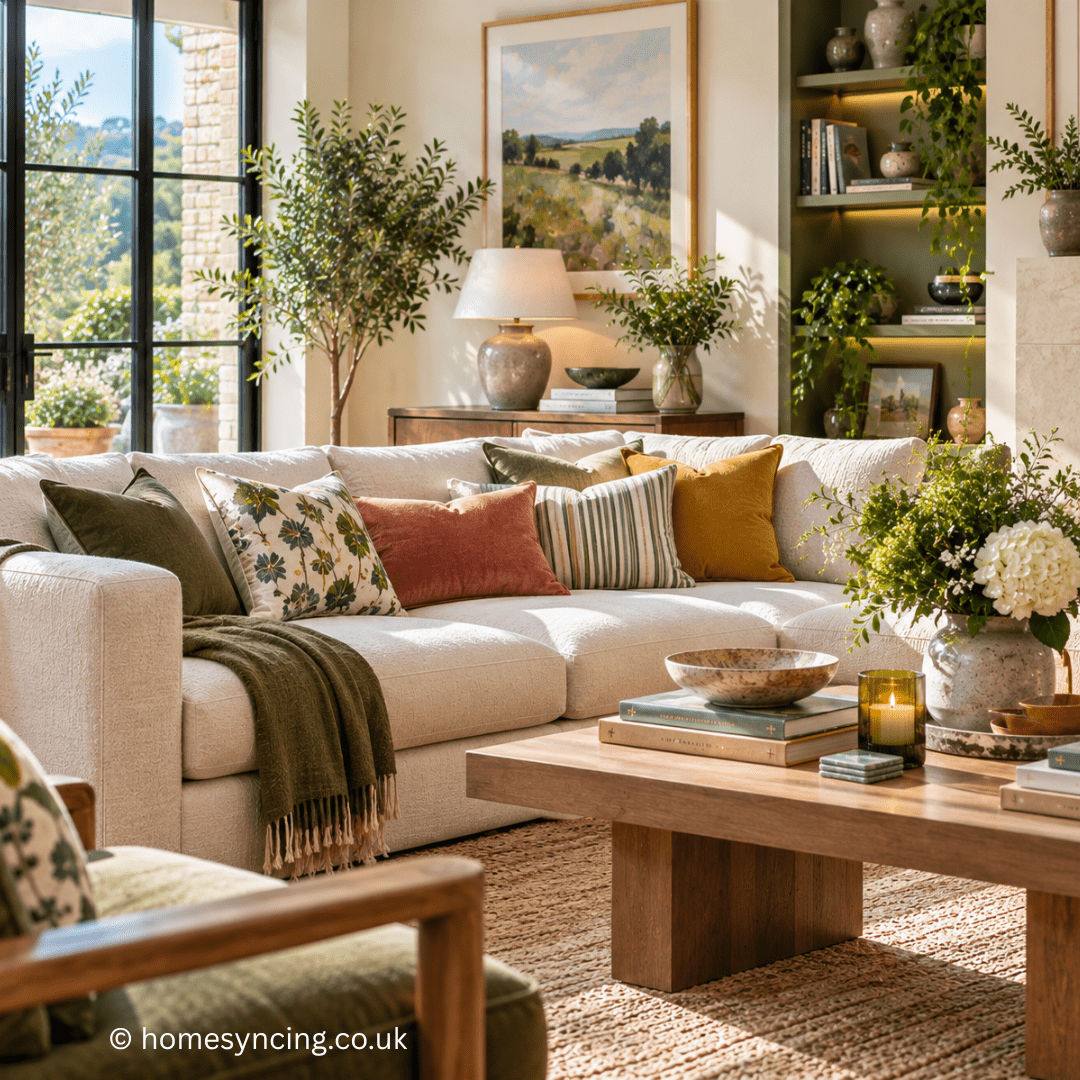
Few pieces of furniture are asked to do quite as much as a sofa.
It is where the household gathers at the end of the day, where guests are offered a seat and where books are read, films watched and Sunday afternoons occasionally disappear altogether. In many homes, the sofa is also one of the largest pieces of furniture in the room – and one of the more significant purchases.
Choosing one deserves a little thought.
Colour and shape matter, of course, but so do the things that aren’t immediately apparent in a photograph: the depth of the seat, the firmness of the cushions, the quality of the frame and whether the whole thing will actually fit through the front door.
So, how do you choose the perfect sofa for your home?
Begin not with the latest style, but with the way you live.
Think About How You Really Sit
People have surprisingly different ideas about what makes a comfortable sofa.
Some prefer to sit upright with both feet on the floor. Others curl their legs beneath them. Some want a deep sofa they can sink into; others find the same design difficult to get out of.
Think about how you and the rest of the household naturally relax.
For leisurely evenings and family film nights, a generous seat depth, soft cushions and perhaps a chaise or corner section can be particularly appealing.
For a sitting room used mainly for conversation and entertaining, a slightly shallower seat with a supportive back may prove more comfortable.
The height matters too.
Very low sofas can look beautifully contemporary but aren’t always the easiest choice for anyone with limited mobility. Likewise, an exceptionally deep seat can be uncomfortable for a shorter person without additional cushions behind the back.
Whenever possible, sit on a sofa before buying it.
And don’t perch politely on the edge for ten seconds. Sit as you would at home.
Measure the Room Before Choosing a Sofa
One of the most common mistakes when choosing a sofa is underestimating its size.
Furniture often appears smaller in a large showroom, while photographs online provide few reliable clues about scale.
Measure the area where the sofa will sit and record its maximum width, depth and height.
Then mark those dimensions on the floor using low-tack masking tape or sheets of newspaper.
Live with the outline for a little while.
Can you still walk comfortably through the room? Does it interfere with a doorway? Is there room for a side table and lamp? Does it leave enough space between the sofa and coffee table?
As a broad guide, aim for around 75–90cm for important walkways where space allows. You may need less between pieces of furniture that don’t form a main route through the room.
The important thing is to preserve the natural flow of the space.
A sofa should anchor a room, not barricade it.
Don’t Forget the Delivery Route
There is another measurement almost as important as the room itself: the journey into it.
Before ordering, measure:
- the front door
- internal doorways
- narrow corridors
- staircases and landings
- tight corners
- lifts in flats
- the final doorway into the room
Check the packaged dimensions provided by the retailer rather than relying solely on the sofa’s assembled measurements.
Find out whether the legs can be removed and whether larger sofas arrive in separate sections.
A beautiful sofa marooned in the hallway is considerably less useful than one in the sitting room.
Choose a Sofa That Suits the Scale of the Room
Scale is more subtle than simply asking whether a sofa fits.
A compact two-seater can look rather lonely against the wall of a large sitting room, while an enormous corner sofa may consume a modest room even if it technically fits within the measurements.
Look at the other elements of the room.
High ceilings, generous windows and substantial fireplaces can usually accommodate furniture with greater presence. Smaller rooms often benefit from sofas with slimmer arms, raised legs and a little visible floor beneath them.
The architecture can help guide the choice.
In an older house with beautiful mouldings or an imposing fireplace, a sofa that sits comfortably within the architectural proportions often feels more convincing than one selected solely because it is fashionable.
Two-Seater, Three-Seater or Corner Sofa?
The best sofa size depends on both the room and the household.
Two-Seater Sofas
A two-seater sofa is an obvious choice for a smaller sitting room, snug or bedroom.
It can also be useful as part of a larger arrangement, perhaps opposite another sofa or combined with a pair of armchairs.
Slim arms can make a considerable difference here. Two sofas of the same overall width may provide quite different amounts of actual sitting space.
Three-Seater Sofas
A three-seater sofa is one of the most versatile options for a family sitting room.
It provides generous seating without necessarily dominating the room and can be combined with an armchair, occasional chair or smaller sofa as the household changes.
Again, check the internal seat width rather than judging capacity from the description alone.
Corner and Chaise Sofas
A corner sofa can make excellent use of an awkward corner and provide plenty of space for relaxed family living.
But larger isn’t automatically better.
Consider whether everyone can converse comfortably when sitting around it and whether the shape restricts future changes to the room.
Chaise sofas offer something of a compromise, providing a place to stretch out without occupying as much floor space as a substantial corner arrangement.
Modular Sofas
A modular sofa is made from individual sections that can be combined in different ways.
This can be particularly useful in larger rooms, open-plan spaces or homes where requirements may change.
Check how the sections connect. A modular sofa is considerably more pleasant to live with when its individual pieces remain where they are supposed to.
Look Beyond the Upholstery
The fabric is what you see, but much of a sofa’s quality lies underneath.
A well-constructed frame provides the foundation.
Manufacturers use various materials and methods, so rather than assuming one type is automatically superior, look for clear information about how the sofa is made.
Ask whether the frame carries a guarantee and whether individual components can be repaired or replaced.
Turn your attention to the cushions too.
Foam tends to provide a firmer, more structured appearance and generally requires less plumping. Feather and down fillings can feel wonderfully soft but need regular attention to retain their shape. Many manufacturers use combinations of foam, fibre and feathers to balance comfort with resilience.
There is no universally ‘best’ filling.
The right choice is the one that provides the level of support you find comfortable and the amount of maintenance you are willing to undertake.
Choosing the Best Sofa Fabric
The best sofa fabric is not necessarily the most luxurious one in the showroom.
It is the fabric best suited to the life taking place around it.
A lightly used drawing room can accommodate a very different upholstery from the family sofa occupied daily by children, pets and the occasional plate of toast.
Before choosing, ask for a fabric sample.
Take it home and look at it in both daylight and artificial light. Colours can change dramatically between a showroom and your own room.
Place the sample beside the rug, curtains and wall colour too.
You may discover that the ‘perfect grey’ is unexpectedly blue, or that the green you dismissed in the shop sits beautifully beside the timber and artwork already in the room.
Linen and Linen Blends
Linen has a relaxed, natural appearance that works particularly well in informal interiors.
Its texture is part of its appeal, but pure linen can crease and behave differently depending on the weave and construction.
A linen blend may provide some of the character of linen with greater practicality for everyday use.
If you enjoy a slightly rumpled, lived-in appearance, linen can age very gracefully.
If every crease is likely to bother you, choose something else.
Velvet Sofas
A velvet sofa can bring wonderful depth to a room.
Colours often appear particularly rich because the pile responds differently as the light changes throughout the day.
Velvet is available in numerous fibres and constructions, however, so maintenance and durability vary.
Don’t assume all velvet is either delicate or hard-wearing. Check the manufacturer’s specific care instructions and suitability for the intended use.
Leather Sofas
Good leather develops character as it ages.
Rather than remaining perfectly uniform, it can acquire creases and changes in tone that become part of the piece.
That makes leather particularly appealing in homes where a little patina is welcomed.
Different types and finishes of leather behave very differently, so investigate exactly what you are buying.
Some are designed to withstand demanding family use, while softer, less heavily treated leathers may mark more readily.
Neither is necessarily preferable; they simply produce different results.
Choosing a Sofa for Children and Pets
A pristine pale sofa isn’t impossible in a family home, but it may require more vigilance than you want to give it.
For a family-friendly sofa, look for robust upholstery and check the manufacturer’s information on durability, cleaning and stain resistance.
Removable covers can be enormously useful, but don’t assume removable automatically means machine washable. Always check the care label.
Texture and pattern can also be forgiving.
A softly mottled weave or subtle pattern generally disguises everyday marks more effectively than a completely flat, uniform fabric.
Pet owners should consider claws and hair too. Very loose or highly textured weaves can sometimes snag more readily, while the visibility of pet hair varies enormously with fabric colour.
The aim isn’t to find an indestructible sofa.
It is to find one you can actually relax on without worrying about it constantly.
Think Carefully About Colour
Because a sofa occupies so much visual space, its colour has a significant influence on the room.
Neutral upholstery remains popular for good reason. Cream, oatmeal, stone and warm grey provide a flexible background for changing cushions, throws and artwork.
But neutral isn’t the only sensible option.
Deep olive green, earthy red, ochre, tobacco, soft blue and other nature-led shades can be surprisingly versatile. A coloured sofa may even be easier to decorate around than a neutral one if it gives the room a clear starting point.
Before choosing, consider the direction of the light.
A colour that looks warm and lively in a south-facing room may appear quite different in cooler north-facing light.
Large fabric samples are invaluable here.
Pattern Can Be More Practical Than You Think
Patterned upholstery has long had a place in British interiors.
Stripes, checks, florals and smaller repeating motifs can introduce character while disguising some of the inevitable signs of everyday use.
You needn’t cover an enormous sofa in a particularly assertive print.
Pattern can be introduced through a smaller sofa or armchair, while the main piece remains relatively quiet.
Equally, in the right room, a patterned sofa can be the starting point for the entire scheme.
Rooms are often more interesting when not every decision is made in the interests of playing safe.
Pay Attention to the Arms and Legs
Small design details can alter the character of a sofa considerably.
Rolled arms have a traditional generosity and work naturally in many period interiors. Neat, square arms produce a more architectural shape, while slim arms maximise the available seat width.
Low arms can encourage lounging but may provide less support when sitting upright.
Legs affect both appearance and practicality.
Raised timber legs expose more floor and can make a substantial sofa feel lighter. A skirted sofa has a softer, more traditional appearance, while very low designs can feel contemporary and grounded.
If you use a robotic vacuum cleaner, the clearance beneath the sofa may suddenly become rather important.
Consider the View from Every Angle
Sofas were once commonly placed against walls, but open-plan living has changed this.
If your sofa will sit in the middle of a room, look carefully at the back.
Is it neatly upholstered? Does the shape look attractive from behind?
The same applies to the sides.
A sofa that looks magnificent head-on may appear surprisingly bulky when viewed from the doorway.
Try to consider it as a three-dimensional object within the architecture rather than simply something positioned against a wall.
Sofa Beds Need to Work Twice as Hard
A sofa bed can be invaluable where there is no dedicated guest room.
But it has two jobs to perform, so assess both.
Sit on it as a sofa and, if possible, examine the bed mechanism fully extended. Check the mattress dimensions and think about where nearby furniture will go when the bed is open.
Measure that configuration at home too.
A sofa bed that fits perfectly during the day may suddenly encounter the coffee table, radiator or opposite wall at bedtime.
Don’t Choose Comfort from a Photograph
Online shopping makes it possible to compare hundreds of sofas without leaving home, but comfort remains stubbornly personal.
Seat depth, cushion filling, back angle and seat height all affect how a sofa feels.
If you can visit a showroom, do.
If you can’t, study the measurements of a sofa you already find comfortable and compare them with the proposed new one.
Customer reviews can provide useful clues about firmness and durability, but remember that one person’s ‘wonderfully supportive’ is another person’s ‘far too hard’.
Measurements are objective.
Comfort isn’t.
Look for a Sofa That Can Age Gracefully
A sofa is unlikely to remain immaculate.
Cushions soften. Fabrics relax. Timber legs acquire small marks. Leather develops creases.
Rather than expecting furniture to remain permanently new, consider how its materials are likely to age.
Natural textures, good-quality fabrics, timber and leather can become more characterful with use when properly cared for.
It is also worth asking whether replacement covers, cushion interiors or individual components are available.
Furniture that can be repaired and refreshed has a much better chance of remaining part of the home for many years.
Live with the Fabric Before You Decide
If there is one stage worth slowing down for, it is the final fabric choice.
Order samples of your favourites and leave them in the room for several days.
Look at them in morning light and on a grey afternoon. Switch the lamps on in the evening. Put the samples beside the curtains and beneath the cushions.
Colours that appear almost identical on a screen can behave very differently once they encounter the particular light of your home.
There is no prize for choosing quickly.
A Sofa to Live With
The perfect sofa for your home isn’t necessarily the one that makes the greatest impression in a showroom.
It is the one that feels right after three hours rather than three minutes.
It fits through the door and into the proportions of the room. Its fabric suits the household. Its cushions offer the right support. There is enough room to walk around it, and it doesn’t demand that everyone behave differently simply to keep it looking pristine.
Style matters, certainly.
But the best sofas acquire something that can’t be chosen from a fabric swatch: familiarity.
Over the years, they become the place where people instinctively sit, where the dog isn’t really supposed to sleep and where somebody always seems to leave the newspaper.
Choose carefully enough, and a sofa stops feeling like a piece of furniture you bought.
It simply becomes part of home.
Take a Look at our Sofas here 🙃
Further Reading: History of the Chesterfield Sofa, See our Instagram Feed for Inspiration