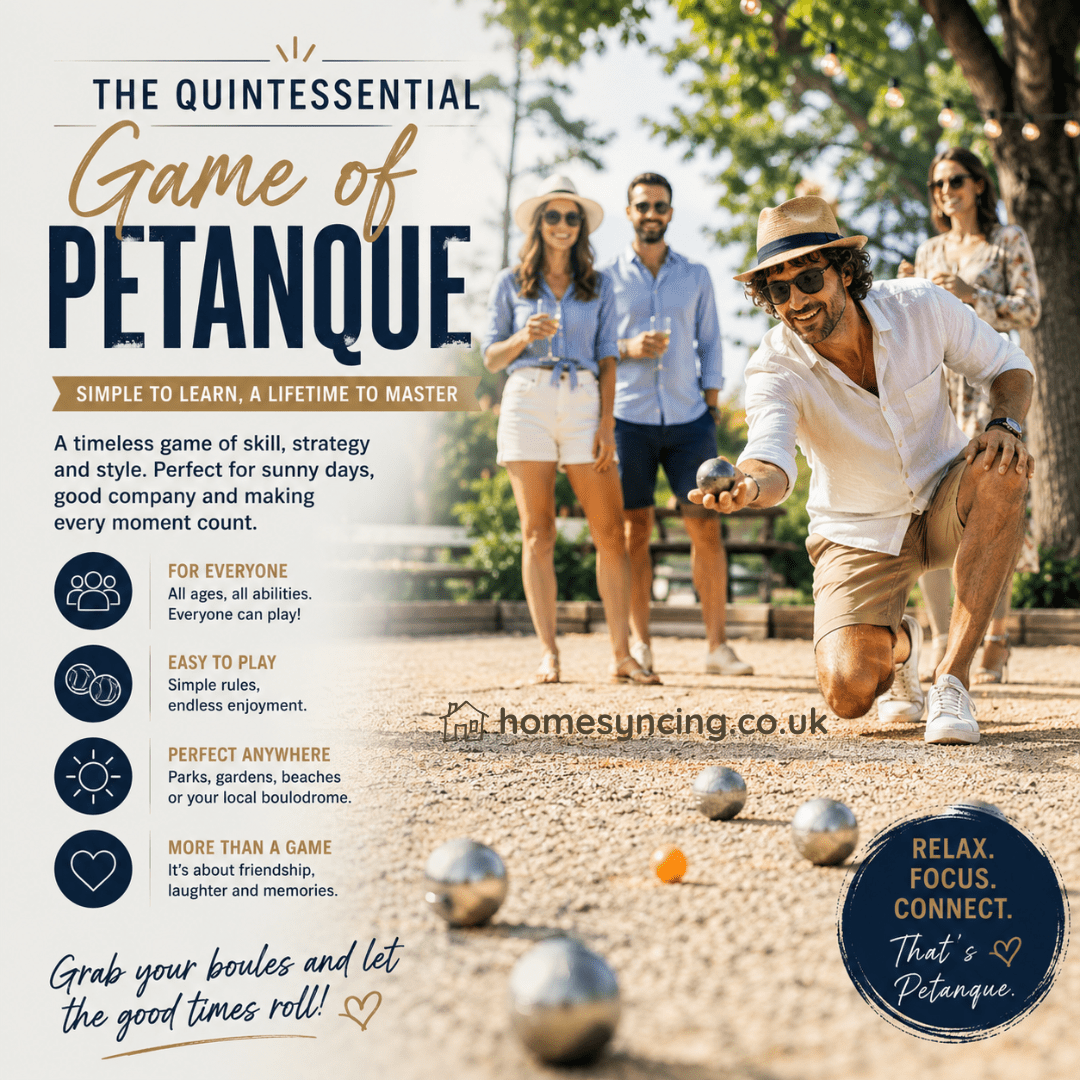
As the afternoon sun settles over a village square in southern France, life begins to slow. Beneath the dappled shade of plane trees, conversations drift lazily through the warm air. Glasses clink on café terraces. Somewhere nearby, the unmistakable sound of steel meeting steel rings out across the gravel.
A game of pétanque is underway.
To an onlooker, it may appear wonderfully simple: a handful of players, a dusty patch of ground and a collection of polished metal boules glinting in the sunlight. Yet beneath this unassuming scene lies a game rich in tradition, skill and social connection — a pastime that has been woven into the fabric of French life for more than a century.
Born in the sun-soaked landscapes of Provence, pétanque is much more than a sport. It is a celebration of friendship, patience and the pleasure of being outdoors. It invites players to pause, observe and enjoy the moment, whether competing fiercely for victory or simply sharing laughter with friends on a summer afternoon.
Today, pétanque has travelled far beyond its Provençal roots. From village greens and community parks to family gardens and coastal promenades, people across the world have embraced its easy-going charm. It is a game that welcomes everyone, regardless of age or ability, and one that proves some of life’s greatest pleasures require very little at all.
What Is Pétanque?
At its heart, pétanque is a game of accuracy.
Players take turns throwing hollow steel boules, aiming to land as close as possible to a small wooden target ball known as the cochonnet, or jack. Each throw presents a choice: gently place a boule beside the target, knock an opponent’s shot away, or alter the course of the game with a bold tactical move.
The name pétanque comes from the Provençal phrase pès tancats, meaning “feet together” or “feet anchored”. Unlike its cousin boules, players stand still within a marked circle while throwing, relying on technique and judgement rather than movement.
Simple to learn yet endlessly strategic, the game rewards patience as much as precision. A single boule can transform the outcome of an entire round, turning apparent defeat into unexpected triumph.
A Game Shaped by Provence
Pétanque’s story begins in 1907 in the Mediterranean town of La Ciotat, near Marseille.
Legend tells of a local player named Jules Lenoir, whose rheumatism made it difficult for him to run before throwing. To allow him to continue playing, a variation of the traditional Provençal game was created in which players remained stationary inside a circle. The adaptation proved so enjoyable that it quickly gained popularity and evolved into the game we know today.
Yet pétanque feels older than its official history suggests.
Perhaps it is because the game captures something timeless: the pleasure of gathering outdoors, sharing friendly competition and enjoying the landscape around us. It belongs naturally among olive groves, village squares and shaded gardens, where life unfolds at a gentler pace.
Even now, to watch a game in Provence is to witness a living tradition. Generations gather together, offering advice, debating tactics and celebrating particularly skilful shots. The game forms part of the rhythm of daily life, as familiar as the scent of lavender carried on a summer breeze.
Why Pétanque Continues to Captivate
In a world increasingly defined by speed and distraction, pétanque offers something refreshingly different.
It asks us to slow down.
There is no rushing between plays, no frantic pace to maintain. Instead, players take time to assess the terrain, consider their options and savour the unfolding drama of each round. The result is a game that feels both competitive and calming.
Its appeal lies partly in its accessibility. There are no expensive facilities required and no steep learning curve. A set of boules and a patch of open ground are enough to begin.
But perhaps its greatest strength is its ability to bring people together.
Grandparents play alongside grandchildren. Friends gather for informal tournaments. Strangers become teammates. Conversation flows naturally between throws, creating a social atmosphere every bit as important as the score itself.
In many ways, pétanque reminds us that sport can be about more than winning. It can be about connection, laughter and shared experiences.
How to Play Pétanque
One of the reasons pétanque has endured for generations is its simplicity.
The game begins when a player throws the cochonnet several metres ahead onto the playing surface. Standing within a small circle, players then take turns throwing their boules towards the target.
Once all boules have been played, the team or player with the closest boule scores points. Additional points are awarded for every boule that lies nearer to the cochonnet than the opponent’s closest boule.
A match continues over several rounds until a team reaches the agreed score, traditionally 13 points.
While the rules are straightforward, the possibilities are endless. Players quickly discover that pétanque is a game of tactical choices: whether to place, defend, attack or take a calculated risk.
The best players learn not only how to throw accurately, but when to do so.
More Than a Game
There is a reason pétanque remains beloved more than a century after its creation.
It offers gentle exercise without feeling strenuous. It sharpens concentration while encouraging relaxation. It provides opportunities for friendly competition while strengthening social bonds.
Most importantly, it creates moments worth remembering.
A perfectly placed boule. A dramatic last throw. A shared laugh beneath the summer sun.
These small moments accumulate, becoming part of the stories we tell long after the game has ended.
Perhaps that is the true magic of pétanque. It transforms an ordinary patch of ground into a place where friendships grow, memories are made and time seems, if only briefly, to slow down.
So whether you discover it on a village square in Provence or on a lawn closer to home, pétanque offers an invitation worth accepting: step into the circle, take aim and let the simple pleasure of the game unfold.
Further Reading: Fancy a Game of Pickleball, The Game of Kings Croquet