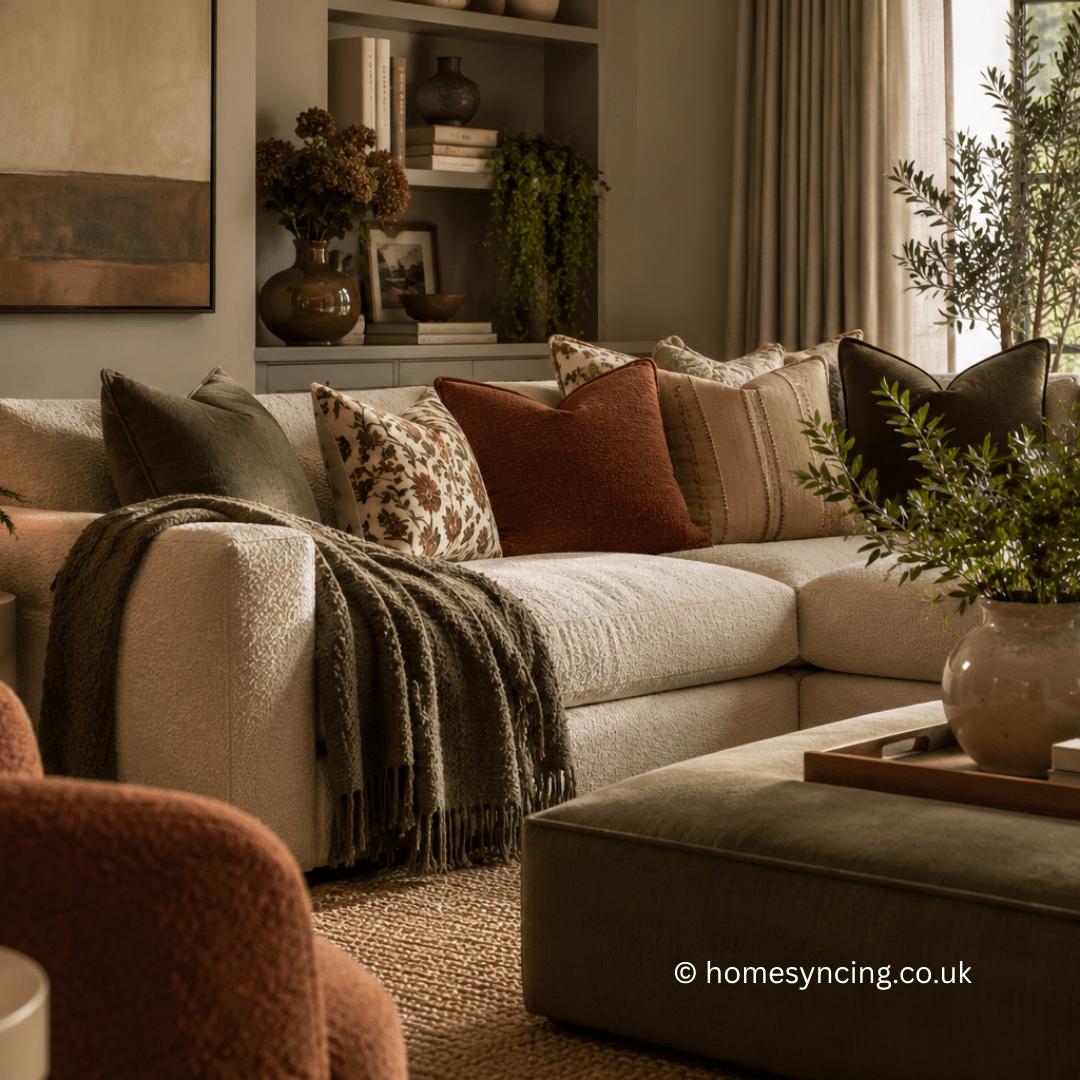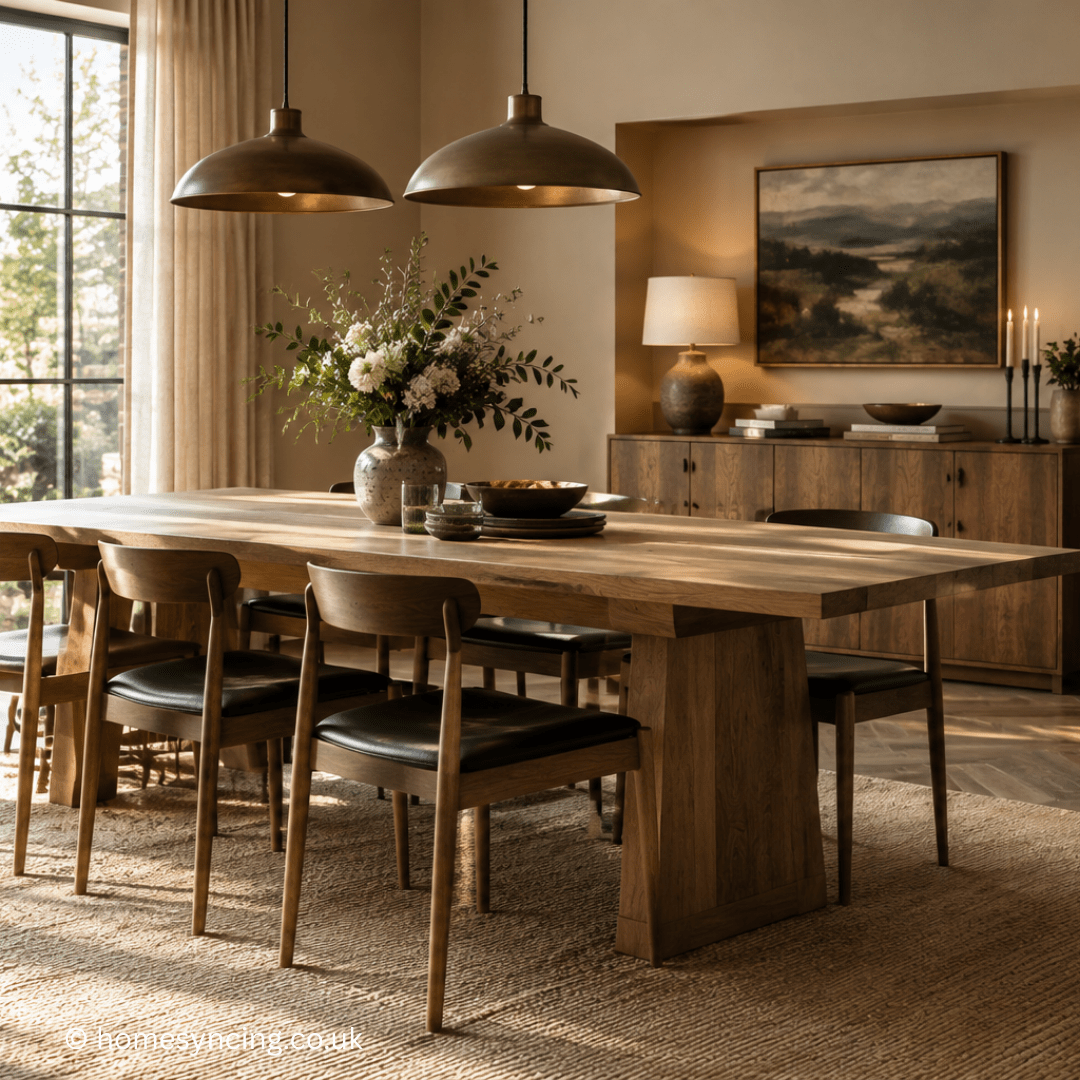
Some pieces of furniture simply occupy a room. A good dining table becomes part of the life lived within it.
It might host a hurried breakfast on Monday morning and a leisurely Sunday lunch a few days later. Homework, newspapers and half-finished cups of tea find their way onto it. At Christmas, chairs are borrowed from other rooms and squeezed around its edges; on quieter evenings, it may be occupied by just one or two people.
Perhaps this is why choosing a dining table deserves more thought than simply finding one that fits.
Size matters, of course, but so do proportion, shape and the way people move around the room. A beautiful table that leaves no room to pull out a chair will soon become frustrating, while one that is too small can feel rather lost in a generous dining room.
From taking the first measurements to deciding between round, rectangular and extendable designs, here’s how to choose the right dining table for your space and the way you live.
Measure the Room Before the Table
When measuring for a dining table, begin with the room rather than the furniture.
Measure the length and width of the area in which the table will stand, taking note of anything that reduces the usable space. Radiators, fireplaces, alcoves, doorways and substantial pieces of furniture such as sideboards all need to be considered.
In older houses especially, don’t assume the room is perfectly square. Walls have a habit of wandering slightly over the centuries, so take measurements at several points if space is tight.
Then consider how people will move through the room.
A dining table doesn’t merely have to fit between four walls. Chairs must be pulled out, people need to sit down comfortably and someone should ideally be able to walk behind a seated guest without requiring the entire table to shuffle sideways.
As a useful guide, aim to leave around 90cm between the edge of the dining table and a wall or other furniture. Where the space behind the chairs is also an important walkway, 100–120cm is more comfortable.
There is no need to regard these figures as absolute rules. Every room and household is different, but they provide a useful starting point when working out which dining table size will actually function in the space.
Mark Out the Dining Table Before You Buy
Measurements written on a piece of paper can be surprisingly difficult to visualise.
One simple trick is to mark the dimensions of your prospective table directly onto the floor using masking tape. You could also lay out sheets of newspaper or an old bedsheet folded to the approximate size.
Then place the dining chairs around the outline, if you already have them.
Walk around it. Open nearby doors and cupboards. Pull a chair backwards as though you were sitting down. Imagine carrying a serving dish from the kitchen or walking behind someone already seated.
This little experiment often reveals far more than a floor plan.
A table that appeared perfectly sensible from its measurements may suddenly feel enormous, while a larger design than you had originally considered might prove to fit surprisingly well.
How Much Space Does Each Person Need?
The next consideration is how many people the dining table needs to accommodate.
As a general rule, allowing around 60cm of table width for each person provides comfortable everyday seating. A little more room feels generous, particularly if you use broad dining chairs or tend to serve food in dishes placed on the table.
Remember that the number of chairs shown around a table in a photograph doesn’t necessarily indicate how many people will sit there comfortably.
Look at the position of the table legs too.
Chunky legs positioned close to the corners can restrict where chairs are placed, while pedestal and trestle designs may provide considerably greater flexibility.
Think about your household on an ordinary Tuesday rather than only imagining Christmas lunch. A table should work comfortably for the people who use it every day; occasional guests can be accommodated through an extension leaf or an extra chair when necessary.
Choosing the Right Dining Table Shape
The shape of a dining table can alter both the appearance of a room and the way people gather within it.
Rectangular Dining Tables
A rectangular dining table is perhaps the most familiar choice and works particularly well in longer dining rooms and open-plan spaces.
Its proportions can help anchor a large room, while the long surface provides plenty of space for serving dishes, flowers and candles.
Rectangular tables are also well suited to larger households. Designs seating six, eight or more people are widely available, and many can be extended when required.
If you have a long, narrow room, however, be careful not to choose a table so broad that circulation becomes difficult.
Round Dining Tables
There is something inherently sociable about a round dining table.
Without a head or foot, everyone sits on relatively equal terms, and conversation can travel easily around the table. This makes round tables particularly appealing for informal dining.
They can also work beautifully in square rooms, kitchen corners and smaller dining areas.
A pedestal base is especially useful because there are no corner legs to dictate where chairs must sit. An extra guest can often be accommodated simply by moving the chairs slightly closer together.
Bear in mind that very large round tables become less practical. Once the diameter grows substantially, reaching the centre becomes difficult and conversation across the table less intimate.
Oval Dining Tables
An oval table offers something of a compromise between round and rectangular designs.
It provides much of the surface area of a rectangular table but without hard corners, helping it sit more gently within a room. This can be particularly useful where people regularly walk past the ends of the table.
Oval tables also have a certain elegance that works particularly well in traditional dining rooms and period properties.
Square Dining Tables
Square tables can be wonderfully intimate for four people and often make good use of a square dining room.
Larger versions require more thought. As a square table grows, so does the distance across its centre, which can make conversation and serving food rather less convenient.
For compact households, however, a modest square table can be an excellent choice.
Consider an Extendable Dining Table
Few dining rooms are used in exactly the same way throughout the year.
This is where an extendable dining table earns its keep.
For most of the week, it can remain compact enough to suit everyday life. When friends arrive for supper or the family descends for Christmas, an additional leaf creates the extra places needed.
Before buying, check the measurements of the table both closed and fully extended.
It is easy to establish that an unextended table fits beautifully, only to discover that opening it blocks a doorway or leaves guests pinned against the sideboard.
Look at the extension mechanism too. If you expect to use it frequently, it should be straightforward enough for one or two people to operate without an elaborate rearrangement of the room.
It is also worth deciding where separate extension leaves will be stored. A beautifully made leaf is considerably less useful if it has nowhere practical to live for eleven months of the year.
Think About the Dining Chairs at the Same Time
The table and chairs need to work as a pair.
Dining tables vary in height, as do chairs, so check that there is sufficient space between the chair seat and the underside of the tabletop for people to sit comfortably.
Armchairs require particular attention. The arms may prevent the chair from sliding beneath the table, increasing the amount of floor space needed when it isn’t in use.
The width of the chairs matters too. Six slender dining chairs may fit easily where six generous upholstered ones will not.
If you already own chairs you love, measure them before choosing the table. If you’re buying everything together, consider the overall proportions rather than viewing each piece in isolation.
A substantial farmhouse table, for example, can comfortably hold visually stronger chairs, whereas a fine-legged table may be overwhelmed by something too heavy.
Choose Materials That Improve with Age
A dining table is expected to tolerate rather more than many pieces of furniture.
Hot plates appear. Wine is spilt. Children draw, craft and occasionally miss the paper altogether. Keys are dropped and serving dishes dragged from one end to the other.
Materials that can accommodate ordinary life are therefore worth seeking out.
Solid wood dining tables remain enduringly popular for good reason. Oak, ash and other hardwoods offer strength and natural character, while their grain and colour tend to become richer with age.
Reclaimed timber brings another layer of interest. Existing knots, marks and variations mean that a new scratch rarely feels disastrous; it simply becomes part of an already characterful surface.
Other woods, including mango and sheesham, can offer distinctive grain and warmer tones, although it is worth asking about responsible sourcing and certification when buying any timber furniture.
Stone can make a striking dining surface but tends to be exceptionally heavy and requires appropriate care. Glass can give a room a lighter visual appearance and is useful where you don’t want a substantial table to dominate, though fingerprints and marks inevitably become part of daily maintenance.
Whatever material you choose, look beyond the surface finish. Examine the joints, legs and supporting structure. A table designed to last should feel stable and reassuringly well made.
Let the Architecture Have a Say
The right dining table should feel connected to its surroundings without necessarily matching them.
In a cottage or country house, an oak or painted timber table may sit naturally alongside old floorboards, stone and plaster. In a converted industrial building, reclaimed timber and metal can respond to the architecture without turning the room into a pastiche.
Period houses don’t always require period-style furniture, either.
A restrained contemporary table can look wonderful against old panelling or beneath decorative plasterwork precisely because of the contrast. Equally, an antique farmhouse table can introduce warmth and history to a modern kitchen extension.
Rather than asking whether a table is fashionable, consider whether its materials, proportions and construction feel at ease with the room.
Think About Everything Else the Table Does
For many households, the dining table stopped being reserved solely for dining a long time ago.
It may become a desk during the day, a place for children’s homework after school and somewhere to wrap presents, arrange flowers, tackle a jigsaw or spread out the Sunday papers.
Those activities should influence your choice.
If the table doubles as a workspace, you may appreciate a generous surface and comfortable chairs. Families with young children might prefer a forgiving timber finish to something that requires constant protection. Keen hosts may value an extendable design, while someone who rarely entertains could devote more of the room to other purposes.
Choose for the life you actually lead rather than the life depicted in an interiors photograph.
Before You Buy: Measure Once More
Once you think you’ve found the right dining table, return to your measurements.
Check the table’s:
- length and width
- height
- dimensions when fully extended
- position and width of the legs or pedestal
- number of people it can seat comfortably
- clearance around the table with chairs in place.
There is one further measurement that is easily forgotten: the route into the room.
Measure doorways, hallways, staircases and any tight turns between the entrance to your home and the dining room. Check whether the tabletop separates from its base for delivery.
There are few things more frustrating than discovering that the perfectly proportioned table for your dining room cannot actually reach it.
A Table to Live Around
Perhaps the best dining tables aren’t the ones we remain precious about.
Over time, a well-used table acquires its own history: a faint mark from a hot serving dish, the occasional scratch, perhaps a small dent whose origins nobody quite remembers. Meals are eaten, birthdays celebrated and ordinary conversations unfold around it.
So while choosing and measuring for a dining table begins with centimetres, the final decision is really about something less precise.
Measure the room carefully. Allow space for chairs and movement. Choose a shape that suits the proportions of the space and a material capable of living alongside you. Think about everyday breakfasts as well as occasional celebrations.
Then choose a table you won’t mind using.
After all, the real measure of a good dining table isn’t how immaculate it remains, but how often people want to gather around it.
Click here to see our great range of dining tables.
Further Reading: Affordable Decorating Ideas That Will Transform Your Home, Sustainable Chic: A Beginner’s Guide to Circular Design
Daily Inspiration: Follow Us on Instagram, BlueSky, Threads , Pinterest, Twitter, TikTok