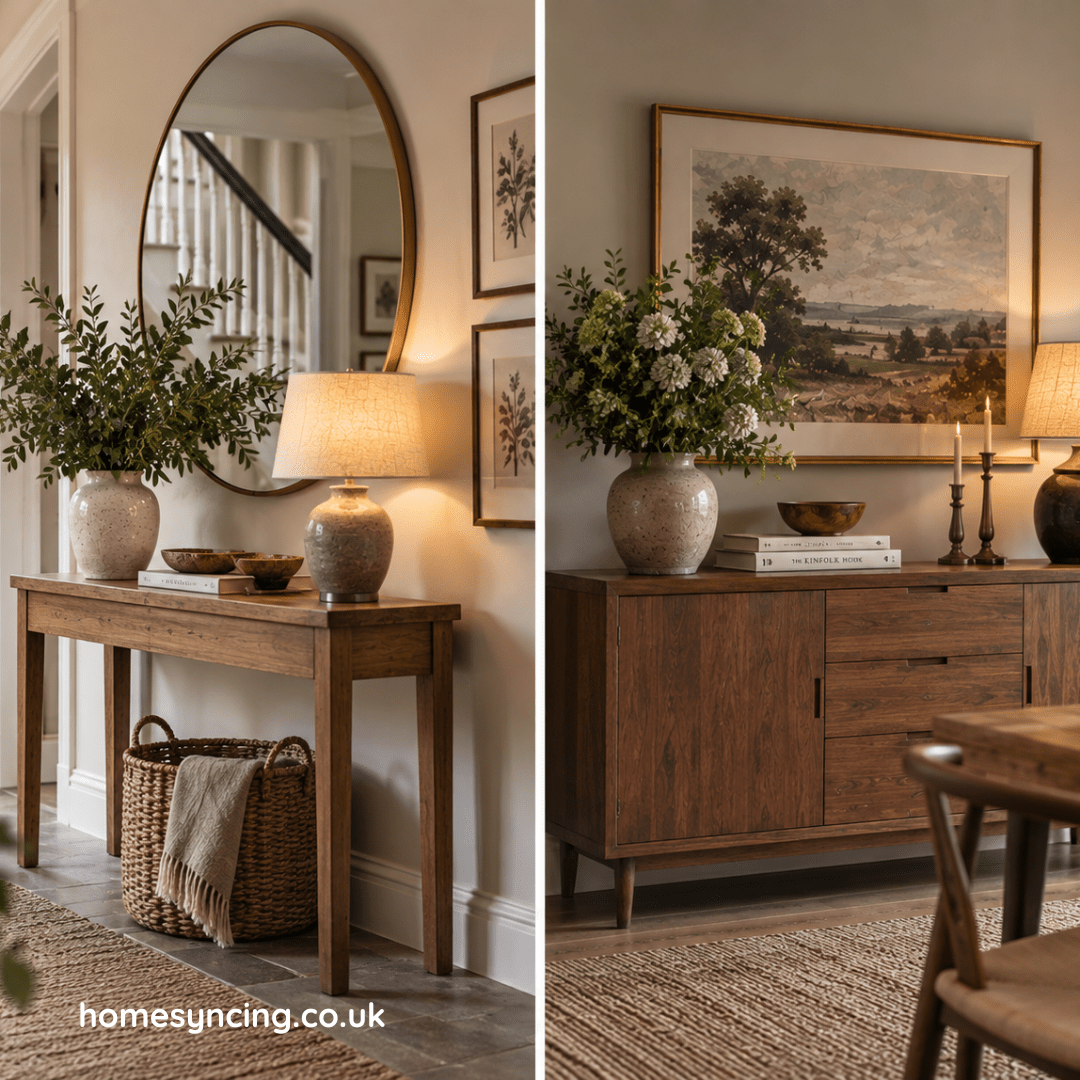
There are some pieces of furniture whose purpose is immediately obvious. A dining table gathers people for meals. An armchair offers somewhere to settle with a book. A bed, thankfully, requires very little explanation.
Then there are those pieces that seem to overlap.
The console table and the sideboard are a case in point.
Both can sit rather handsomely against a wall. Both provide a surface for lamps, flowers, photographs and all the small things we gather around us. Both can bring character to an otherwise forgotten stretch of a room.
Yet they are not quite the same.
One is light-footed and remarkably adaptable; the other brings storage, substance and a reassuring sense of permanence. Choosing between a console table and a sideboard is therefore less about which one you prefer and more about understanding what you need that particular part of your home to do.
And, as is so often the case with furniture, the answer begins with the room itself.
What is a console table?
A console table is typically a long, relatively narrow table designed to stand against a wall.
Its slender proportions are what make it so useful. Where a deeper piece of furniture might intrude into a hallway or make a small room feel crowded, a console table can occupy the same stretch of wall while leaving plenty of space around it.
Today, we tend to think of consoles as practical pieces for hallways and sitting rooms, but their story is rather grander.
Early console tables became fashionable in European interiors during the seventeenth and eighteenth centuries. Many were decorative pieces supported against, or even fixed to, a wall rather than the freestanding tables we know today. Elaborately carved bases, gilding and marble tops turned them into opportunities for display.
Modern console tables are generally rather more accommodating.
They may be made from timber, metal, glass or a combination of materials, and some incorporate drawers or shelves. Yet the essential idea remains: a console provides a useful surface without taking up too much of the room.
That makes it one of the great problem-solvers of the furniture world.
What is a sideboard?
A sideboard has rather more weight to it — both visually and practically.
Usually lower and deeper than a console table, a sideboard combines a broad surface with enclosed storage beneath. Cupboards, drawers and sometimes open shelving provide room for everything from table linen and crockery to paperwork, games and the collection of things for which no sensible home ever seems to have quite enough cupboards.
The sideboard has traditionally been associated with the dining room.
Its predecessors were practical tables used for serving food and displaying valuable plate. Over time, storage was incorporated and the sideboard developed into something closer to the form we recognise today.
Its role has expanded considerably since then.
You’ll now find sideboards in sitting rooms, kitchens, bedrooms, hallways and home offices. We may no longer need somewhere to display the family silver, but the need for useful, attractive storage has certainly not disappeared.
Console table vs sideboard: what’s the difference?
The simplest distinction is this:
A console table gives you a surface. A sideboard gives you a surface and substantial storage.
There are exceptions, of course. Some console tables have useful drawers and shelves, while particularly slender sideboards can resemble consoles at first glance.
But their proportions usually tell the story.
Console tables tend to be narrower and more open, often with visible legs and space beneath. This gives them a lighter appearance and makes them particularly suitable for smaller or busier areas of the home.
Sideboards tend to be deeper, more enclosed and visually substantial. They occupy more floor space but repay it with considerably more storage.
So, which should you choose?
It depends on where it is going.
For the hallway: usually a console table
There are few places where a console table earns its keep quite as well as a hallway.
Hallways are often narrow, awkward spaces. They must accommodate people coming and going, coats, bags, shoes and the daily muddle of keys and post, while somehow also providing the first impression of the home beyond.
A slim console table can do a surprising amount here.
Place a lamp on top and the hallway becomes warmer and more welcoming after dark. Add a mirror above and it can bounce light around a narrow space. A bowl or small tray provides somewhere for keys, while drawers can keep less picturesque necessities out of sight.
Most importantly, there is still room to walk past it.
A sideboard can work beautifully in a generous entrance hall, particularly if you need storage for shoes, scarves, dog leads and other outdoor paraphernalia. In a narrow hallway, however, its extra depth can quickly become noticeable.
Before choosing either, measure the space and leave a comfortable route through it. Furniture should make everyday life easier, not create a small obstacle course between the front door and the kitchen.
For the dining room: the sideboard comes into its own
If there is one room where the sideboard feels completely at home, it is the dining room.
Here, its storage becomes genuinely useful.
Plates, serving dishes, glasses, tablecloths and placemats can all live close to where they are needed rather than occupying precious kitchen cupboards. The top provides additional serving space when the table is full — particularly useful when Christmas dinner seems to require every dish in the house.
A sideboard also gives a dining room something it can otherwise lack: a focal point away from the table.
A pair of lamps, a large mirror or picture, a vase of garden flowers and a few favourite objects can soften what might otherwise be a very functional room.
A console can still work in a small dining space, especially when storage isn’t a priority. Its narrower depth makes it a useful place for a lamp or drinks tray without crowding the table.
But if you have the room and the things to store, the sideboard usually wins.
For the sitting room: think about what is missing
The sitting room is where the decision becomes more interesting.
Look around before deciding what furniture to buy.
Is there a long empty wall that feels unfinished, but the room already has enough storage? A console table might be all it needs.
Does the room suffer from the familiar collection of cables, games, paperwork, toys and assorted objects that never seem to have a proper home? A sideboard may be a far better investment.
A sideboard can also help balance a large room. Its visual weight makes it particularly effective opposite a sofa or beneath a large piece of artwork.
A console is gentler.
It can sit behind a sofa, beneath a window or along a wall without demanding too much attention. In an open-plan room, a console positioned behind a sofa can even create a subtle division between living and dining areas.
The question isn’t simply, Which looks better?
Ask instead, What does this room need?
Small room? Don’t automatically choose small furniture
It is tempting to assume that a small room always requires the smallest possible furniture.
Not necessarily.
Several little pieces scattered around a room can sometimes make it feel more cluttered than one well-proportioned piece.
If storage is the problem, a sideboard may actually make a small sitting or dining room feel calmer. By giving numerous smaller objects somewhere to disappear, it reduces visual clutter.
The important consideration is depth.
Measure from the wall and mark the proposed depth of the furniture on the floor. Masking tape is useful for this. Then walk around it.
Can doors still open comfortably? Can you move between pieces of furniture without turning sideways? Does it encroach upon a natural route through the room?
A few minutes spent measuring can prevent years of edging around a piece of furniture that was just slightly too large.
If you love displaying things, choose accordingly
Our homes tell their stories through the things we choose to keep.
A piece of pottery found on holiday. A framed photograph. An inherited clock. Books that have followed us through several houses. A vase that looks particularly good filled with branches from the garden.
Both console tables and sideboards provide a stage for these things, but in rather different ways.
The open structure of a console tends to make displays feel lighter. It is particularly good for a lamp, a few books and one or two decorative pieces.
A sideboard provides a broader canvas and can carry larger objects comfortably. A substantial lamp, artwork, ceramics and flowers can all sit together without looking as though they are balancing precariously on a narrow ledge.
Whichever you choose, resist the temptation to fill every inch.
Objects need a little breathing room.
A handful of things you genuinely enjoy seeing will usually create far more character than a surface crowded with things bought simply to fill it.
Consider what’s happening underneath
One of the often-overlooked advantages of a console table is the space beneath it.
A stool or small bench can tuck underneath. Baskets can provide extra storage. In a hallway, shoes can be placed below rather than left in the middle of the floor.
Or you can simply leave the space empty.
That glimpse of floor beneath the furniture helps a room feel open, which can be particularly valuable in smaller spaces.
With a sideboard, the opposite is true. Its enclosed form gives a room solidity.
Neither approach is better. They simply create different effects.
If your room already contains several heavy pieces of furniture, a console may provide welcome contrast. If everything is raised on slender legs and the room feels slightly insubstantial, a solid sideboard might be exactly what is missing.
Think beyond the obvious rooms
One of the pleasures of both console tables and sideboards is that neither needs to remain in the room for which it was supposedly intended.
A console table can make a lovely dressing table in a bedroom. Add a mirror and a chair or stool that slips underneath and it becomes a useful place to get ready without the bulk of a traditional dressing table.
It can also become a compact desk.
A sideboard, meanwhile, can provide excellent bedroom storage, particularly for folded clothes, bedding or towels. In a home office, it can conceal files, stationery and the less attractive necessities of working life.
On a large landing, either can transform an area that previously felt like little more than a route between rooms.
Good furniture should be able to move with us.
The piece bought for a hallway today might live in a sitting room in the next house and a bedroom several years after that.
Choosing a style that will last
Once you have decided between a console table and a sideboard, there is still the question of how it should look.
It is easy to be distracted by whatever happens to be fashionable, but larger pieces of furniture tend to stay with us for a long time.
Natural materials and relatively simple forms are often easier to live with because they can adapt as the room around them changes.
Consider what is already in your home, but don’t feel obliged to match everything.
Different woods can sit together beautifully. Old furniture can work alongside new. Painted pieces can soften a room containing a great deal of timber, while metal details can introduce contrast to more traditional interiors.
A home assembled gradually tends to have greater character than one where every item belongs to the same range.
Look for something that feels as though it could have a life beyond your current decorating scheme.
So, do you need a console table or a sideboard?
If you’re still undecided, come back to what you need the furniture to do.
Choose a console table when space is limited, you primarily need a surface rather than storage, or you want something visually lighter. It is particularly well suited to hallways, behind sofas, smaller dining rooms and those awkward stretches of wall that need just a little something.
Choose a sideboard when storage matters. It is ideal for dining rooms and sitting rooms, as well as larger hallways and bedrooms where its cupboards and drawers can help bring order to everyday life.
And if you have the space?
There is no rule saying a home cannot make good use of both.
Furniture for the way you live
Perhaps the best furniture is not the piece we notice first, but the piece we gradually discover we couldn’t do without.
The console table where the keys are always left. The sideboard drawer containing the tablecloth brought out every Christmas. The lamp switched on each evening as you come through the door. The cupboard that quietly swallows all the things you would rather not have on display.
These small acts become part of the rhythm of a home.
So when choosing between a console table and a sideboard, don’t begin with trends or rules about what a particular room ought to contain.
Begin with the room.
Notice how you move through it, what tends to gather there, what you would like to hide and what you would like to display.
Then choose the piece that earns its place.
Chances are, that is the one you’ll still be pleased to see many years from now.
Take a look at our Console Tables and Sideboards 🙃
Further Reading: Affordable Decorating Ideas That Will Transform Your Home, Sustainable Chic: A Beginner’s Guide to Circular Design, The Psychology of Colour in the Home, How to Choose and Measure for a Dining Table
Daily Inspiration: Follow Us on Instagram, BlueSky, Threads , Pinterest, Twitter, TikTok