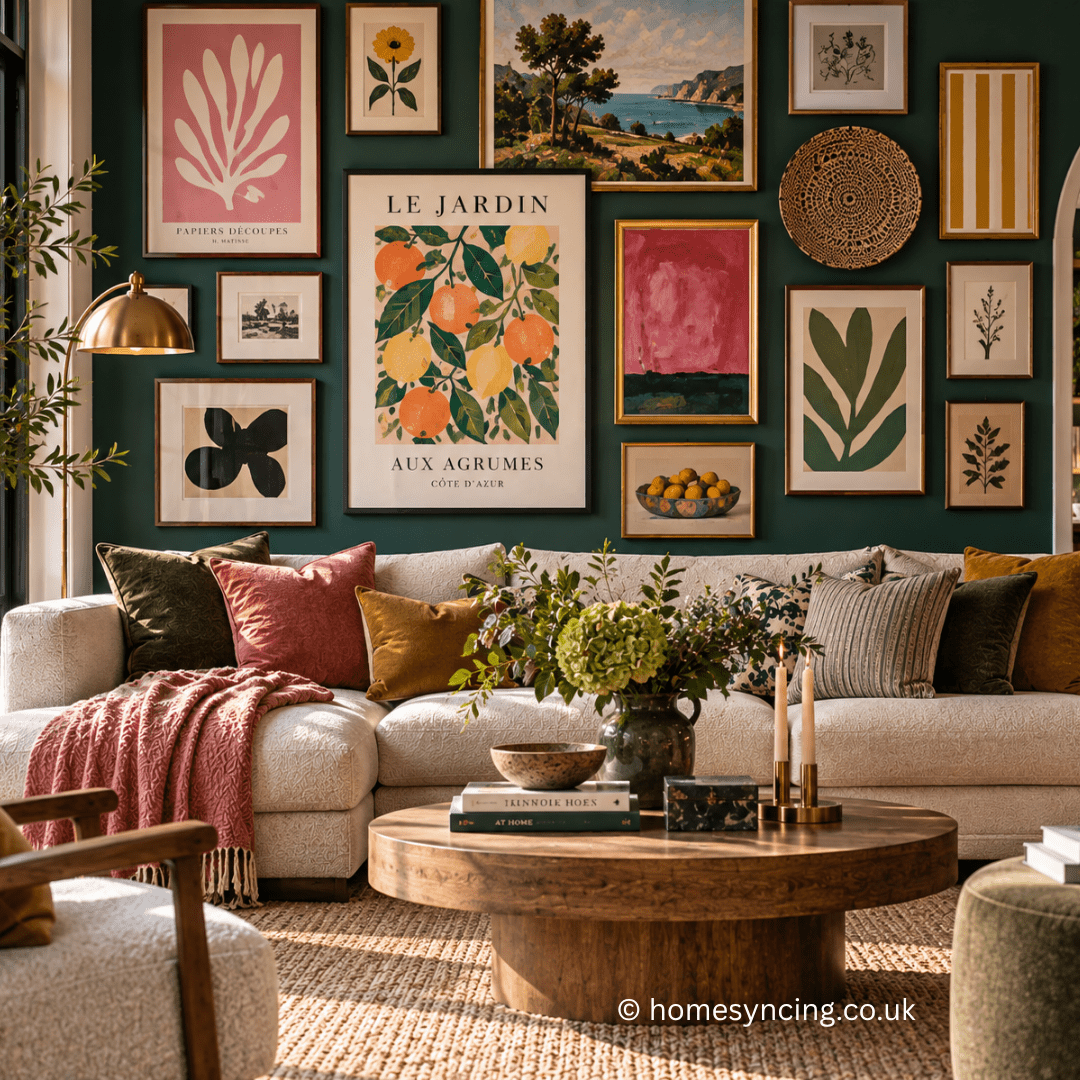
There is something irresistible about a wall covered with things somebody has chosen because they genuinely love them.
An old landscape found in a market sits beside a botanical print. A tiny family photograph occupies a gilt frame that is rather grander than necessary. Perhaps there is a piece of embroidery, a ceramic plate or a drawing brought home from a holiday.
Nothing quite matches, and that is precisely why it works.
For several years, the gallery wall became an interiors formula: matching frames, carefully measured gaps and prints arranged into an immaculate grid. There is still a place for that ordered approach, but increasingly the most interesting gallery walls feel rather less obedient.
They borrow something from the way pictures have accumulated in houses for generations – gradually, instinctively and with little concern for whether every frame belongs to the same collection.
The result is a wall that feels less decorated and more collected.
And that is where its real character begins.
Gallery Walls Have Always Been About Collecting
The idea of filling a wall with pictures is hardly new.
Historic houses, galleries and private collections have long displayed paintings in groups, sometimes extending upwards towards the ceiling. Pictures of different subjects, periods and sizes might sit remarkably close together.
Domestic collections were often similarly personal.
Portraits joined landscapes, prints, maps and drawings as families inherited, bought and rearranged things over generations.
The lesson for today’s home isn’t to recreate a historic picture hang.
It is that an engaging wall doesn’t necessarily need perfect uniformity.
Allowing pictures to differ in scale, frame, subject and age can produce something far richer.
Start with Art You Actually Want to Look At
Before thinking about layouts, begin with the pictures.
A gallery wall shouldn’t exist simply because a large wall needs filling.
Look for art that makes you stop.
It might be an original painting, an inexpensive print, a child’s drawing, a photograph, an old map or a botanical study. Exhibition posters, sketches and pieces of textile can be just as interesting when thoughtfully framed.
Second-hand shops, markets and auctions can be wonderful places to look because the search itself becomes part of the pleasure.
You needn’t understand why everything works together immediately.
Collections often become interesting precisely because they weren’t bought all at once.
Find One Piece to Begin the Story
A successful gallery wall often has an anchor.
This doesn’t necessarily mean placing the largest picture exactly in the middle. Instead, choose one piece with enough presence to establish the composition.
A colourful landscape, large abstract work, botanical print or portrait might do the job.
Then begin adding smaller pieces around it.
This creates a more natural rhythm than starting with an imaginary grid and trying to find artwork to fit each predetermined rectangle.
Let the collection determine the arrangement rather than the arrangement determining the collection.
Forget Perfect Symmetry
One of the easiest ways to give a modern gallery wall more character is to loosen the geometry.
Perfect rows and identical frames create order, which can be useful in contemporary interiors or for a collection of closely related photographs.
But if you want the wall to feel collected and expressive, allow the edges to wander.
Hang a tall picture beside a landscape-format work. Place a circular plate or mirror among rectangular frames. Let smaller pictures occupy the gaps between larger ones.
The arrangement should still feel balanced, but balance doesn’t require symmetry.
Think of it more like arranging flowers.
Different heights, shapes and colours can work together without being identical.
Mix Frame Styles
Frames are an important part of a gallery wall, but they don’t all have to match.
In fact, mixing them can be one of the simplest ways to introduce character.
Warm timber might sit beside aged brass, dark-painted wood and a fine contemporary frame. An ornate gilt frame can make a wonderful contrast with something deliberately plain.
The trick is repetition.
If one brass frame appears alone, it can look accidental. Repeat a similar warm metallic tone elsewhere and it begins to feel intentional.
The same applies to timber and darker frames.
Aim for relationships rather than uniformity.
And don’t overlook mounts. A generous mount can give a small drawing more presence, while an older painting may look perfectly at home without one.
Put More Than Pictures on the Wall
Some of the most memorable gallery wall ideas move beyond framed art altogether.
A decorative plate can introduce a circular shape. A small mirror catches light. A piece of embroidery brings texture. Woven objects, shallow ceramics and sculptural pieces can all break up the procession of rectangular frames.
The important thing is that they have a reason to be there.
An inherited plate, something made by a local craftsperson or an object brought home from travelling will usually add more character than something bought simply because a gap needed filling.
This is where a gallery wall can become genuinely personal.
It stops being a collection of pictures and becomes a collection of memories.
Introduce Colour with Confidence
A gallery wall is a wonderful place to be braver with colour.
A deep green, warm blue or earthy painted wall can make artwork appear remarkably vivid, particularly when combined with timber and gilt frames.
Alternatively, a pale wall allows colourful paintings and prints to provide the energy.
Look within the artwork itself for connections.
A mustard yellow in one botanical print might reappear in an abstract painting. A coral detail could be picked up by a cushion elsewhere in the room. Olive green might travel from a landscape into upholstery or painted furniture.
These connections needn’t be obvious.
When colours quietly recur around a room, the eye recognises the relationship even when we don’t consciously notice it.
Mix Large and Small Artwork
Scale creates energy.
A wall covered entirely with similarly sized pictures can become visually repetitive, no matter how beautiful the individual pieces are.
Instead, introduce contrast.
Allow one or two larger works to command attention and use smaller pictures around them to create movement.
Tiny pieces can be particularly effective.
A miniature painting or photograph surrounded by larger works encourages you to move closer and inspect it. These changes in scale make the wall more engaging because the eye doesn’t take everything in at once.
Avoid making every gap identical too.
Some variation in spacing can help a more informal collection feel natural, provided the overall composition remains connected.
How High Should You Hang a Gallery Wall?
There is no single measurement that works in every house.
Ceiling height, furniture and the proportions of the artwork all matter.
As a broad starting point, galleries often position the centre of an individual artwork at roughly eye level. At home, however, the relationship with nearby furniture can be more important than a particular number.
A gallery wall above a sofa should feel visually connected to the sofa rather than floating somewhere near the ceiling.
The same applies above a sideboard, console or fireplace.
Stand back frequently while planning.
The wall should belong to the entire room, not exist independently from everything beneath it.
Plan the Layout Before Reaching for a Hammer
An informal gallery wall may look spontaneous, but a little preparation can save a great many unwanted holes.
Begin by arranging the pieces on the floor.
Move them around until the balance feels right. Take a photograph once you’re happy so you have something to refer to.
For a larger arrangement, cut paper templates corresponding to the dimensions of the frames and attach them temporarily to the wall.
This allows you to experiment with spacing and position at full scale.
Look at the composition from different parts of the room.
Then leave it overnight.
Something that seemed perfect after an hour of rearranging can look surprisingly different the following morning.
Work with the Architecture
Before deciding where your gallery wall should go, look at the room itself.
A staircase naturally lends itself to an arrangement that rises with the steps. An alcove might suit a tighter group of smaller pictures. A large wall above a sofa can accommodate a more expansive collection.
Architectural features can become part of the composition too.
A gallery wall surrounding a doorway can be wonderfully effective, while artwork arranged around a wall light or above panelling can feel as though it has gradually accumulated with the house.
Don’t automatically choose the largest uninterrupted wall.
Sometimes the more unexpected position has considerably more charm.
Gallery Walls Can Work in Small Spaces
You don’t need a grand sitting room to create one.
In fact, gallery walls can be particularly effective in the overlooked parts of a house.
A collection of small landscapes can enliven a hallway. Family photographs can follow the staircase. Botanical prints might fill a kitchen corner, while a handful of tiny paintings can transform the wall beside a bed.
Even a downstairs cloakroom can become an opportunity for art.
Small rooms often give you greater freedom because you aren’t viewing the wall from a great distance.
A close arrangement of unusual pictures can turn a previously forgettable space into one of the most characterful corners of the house.
Light Your Artwork Thoughtfully
Good lighting allows a gallery wall to change character after sunset.
Picture lights can create pools of warm illumination, while a wall light incorporated into the arrangement can become part of the composition itself.
Floor and table lamps positioned nearby can be equally effective and often produce a softer atmosphere.
Be mindful of the artwork itself.
Strong direct sunlight can fade works on paper, photographs, textiles and some pigments over time. Particularly treasured or valuable pieces may benefit from conservation-quality framing and appropriate glazing.
If you’re unsure about preserving an important work, advice from a professional framer or conservator is worth seeking.
Give Old Frames Another Look
Old frames are worth seeking out in their own right.
A slightly worn gilt frame can bring richness to a contemporary print. Dark timber can give a botanical drawing more weight, while a painted frame might provide exactly the note of colour a composition needs.
Markets, second-hand shops and auctions often contain frames whose contents are less interesting than the frames themselves.
Small scratches and signs of age needn’t always be restored away.
Patina can give a gallery wall the sense that it has evolved rather than been installed.
Just make sure older frames and hanging fittings are structurally sound before putting them on the wall.
Don’t Buy a Gallery Wall All at Once
Perhaps the easiest way to make a gallery wall look contrived is to buy the entire thing in an afternoon.
Allow it to develop.
Hang five pieces now and leave room for another.
You may find a little landscape six months later or rediscover a photograph in a drawer. Perhaps a print comes home from an exhibition or somebody gives you a small painting.
Add it.
Move something else if necessary.
There is no reason a gallery wall ever needs to be declared finished.
Avoid Styling Away the Personality
There is a point at which carefully curated can become overly curated.
If every picture shares precisely the same colours as the cushions, rug and curtains, the room can begin to feel more like a showroom than a home.
Let something be unexpected.
Keep the painting that doesn’t quite match because you love it.
Hang the peculiar little drawing that makes you smile. Give the inherited picture a place even if its frame is more elaborate than everything around it.
Individuality usually comes from the things that resist the scheme slightly.
Those are often the things people remember.
A Wall That Tells Your Story
The enduring appeal of a gallery wall isn’t really about filling an empty space.
It is about bringing together things that would otherwise remain scattered through drawers, cupboards and memories.
Pictures bought on holidays. Family photographs. Art discovered in markets. A child’s drawing that deserved a proper frame. Something inherited whose history is only partly remembered.
Individually, these objects may be modest.
Together, they can transform a room.
So don’t worry too much about creating the perfect gallery wall. Start with something you love, add another piece when you find it and allow the arrangement to change as the years pass.
Eventually, the wall will become something no interiors trend can reproduce.
A portrait, in fragments, of the people who live there.
Further Reading: How to Choose Wall Art for your Home
For Daily Inspiration Follow us on Instagram