An Ethical Look at Why Fair Trade Matters

Consumers today have more power than ever to make a difference with their purchasing choices. One growing trend is fair trade, which seeks to level the playing field for farmers and workers in the developing world. But what does fair trade actually mean, and why should we care about it? The reasons why fair trade matters and why ethical consumption is worth considering.

Fair Trade is a movement that seeks to promote sustainability, ethical production, and transparency in the market. By certifying products as “fair trade,” organizations like the Fairtrade Foundation ensure that farmers and workers in places such as Africa, Asia, and Latin America are paid a fair wage and work in safe and healthy conditions. This not only benefits individuals but also empowers communities to invest in their own development.

One of the key issues in conventional trade is the lack of regulation and transparency in pricing. Often, producers in the developing world are paid far less than what their products are worth, while middlemen and corporations take the lion’s share of the profits. According to the World Fair Trade Organization, fair trade aims to eliminate this exploitation by ensuring that prices paid to farmers and workers are “fair” and transparent. This means that they receive prices that are above the fair trade minimum price and premiums when they organize in cooperatives for social, economic or environmental development projects. Ultimately, this fosters stronger, more sustainable relationships between producers and buyers, and it helps to promote a more equitable global economy.

But fair trade goes beyond just price regulations. It also promotes ethical production practices such as protecting workers’ rights and preventing child and forced labour. Fairtrade International, the organisation behind the fair trade certification, has a rigorous set of standards that companies must meet in order to earn the label. This includes ensuring that workers receive adequate breaks, protection against discrimination and harassment, and access to training and education. By investing in fair trade, consumers can know that the products they are buying are coming from ethical and socially responsible sources.

There are numerous benefits to fair trade that extend beyond the producers themselves. Fair Trade products are often produced more sustainably, with an emphasis on environmentally-friendly techniques such as organic or shade-grown farming. This means that fewer harmful chemicals are used and ecosystems are protected. Additionally, fair trade offers a more direct and transparent supply chain, which enables consumers to know more about where their products come from. By purchasing products with a fair trade label, consumers can play a role in promoting accountability and transparency in global supply chains.

Overall, there are many reasons why fair trade matters. Ethical consumption is an ever-growing movement, showcasing the impact that everyday purchases can make in shaping a more socially and environmentally just world. By choosing to buy fair trade products, consumers can support producers in the developing world and contribute to a more equitable global economy. As consumers continue to demand transparency and sustainability from the products they buy, fair trade certification is becoming increasingly vital as a way to ensure these values are being upheld.

Fair Trade is more than just a buzzword – it’s a movement that seeks to promote equity, sustainability, and transparency in a global market. By investing in fair trade products, consumers can help to ensure that farmers and workers in the developing world are paid fairly and work in safe and healthy conditions. Additionally, fair trade promotes ethical production practices and environmental sustainability. By making the choice to support fair trade, consumers are playing an active role in shaping a more socially just and environmentally conscious global economy.

We have a great range of Fair Trade items – take a look!

For Daily Inspiration, Follow Us on Instagram

How to Choose the Perfect Picnic Hamper

Picnics are a great way to spend quality time with your loved ones while enjoying the great outdoors. However, to make the experience even more enjoyable, you need to have the perfect picnic hamper. A good picnic hamper should be functional, attractive, and able to hold all the essentials you need for your outdoor feast. We have some great tips on how to choose the perfect picnic hamper for your next outdoor adventure, so you can make the most out of your picnic!

Size & Capacity
The first thing to consider when choosing a picnic hamper is its size and capacity. You’ll need to think about how many people are going to attend the picnic, and how much food and drinks you need to bring. A hamper with a larger capacity may be suitable for a large group, but if you’re going for a more intimate setting, a smaller hamper may suffice. Keep in mind that you want a hamper that’s not too heavy or too bulky to carry around.

  1. Construction & Material
    The construction and material of the picnic hamper is another factor to consider. You want a hamper that is durable, sturdy, and able to withstand the elements. Wicker baskets are a popular choice as they’re lightweight, easy to carry, and provide a classic and rustic look. However, there are also picnic hampers made of materials such as canvas, leather, and even metal. Whichever material you choose, make sure that it’s easy to clean and maintain.
  2. Design & Style
    Picnic hampers come in a variety of designs and styles, from traditional to modern and everything in between. You should choose a design that you’re fond of, and that complements your personal style. For example, if you’re a fan of vintage pieces, you may want to opt for a classic wicker hamper with leather accents. Alternatively, if you prefer a more contemporary look, a sleek and modern picnic backpack may be more up your alley.
  3. Accessories
    Picnic hampers often come with various accessories such as plates, cups, utensils, blankets, and wine glasses. Be sure to check what accessories come with the picnic hamper you’re considering, and whether they meet your needs. This will not only save you money but will also ensure that you have all the essentials for a perfect picnic.
  4. Price Point
    Finally, consider the price point of the picnic hamper you’re interested in. While you don’t need to spend a fortune on a hamper, it’s always worth investing in a quality and well-made product. Inexpensive picnic hampers may be tempting, but they may not last long or survive adverse weather conditions. On the other hand, an expensive hamper may not necessarily provide you with the functionalities you require.

Choosing the perfect picnic hamper is not an easy task, but with the right considerations, you can get one that suits your needs. Remember to consider the size and capacity of the hamper, the construction and material, its design and style, any accessories it comes with, and your price point. At the end of the day, a quality picnic hamper is not only functional but also adds an element of style and sophistication to your outdoor adventures. So get ready to pack your picnic basket and hit the great outdoors with the perfect hamper!

We have a great range of picnic hampers – find them here!

Ways to Style Your Coffee Table So It Always Looks Good

A coffee table occupies an interesting place in the home.

It is rarely the largest or most valuable piece of furniture in a sitting room, yet it often finds itself right at the centre of things. Cups of tea are put down upon it, newspapers accumulate, books are left half-read and feet occasionally find their way there too.

It is a working surface, but also an opportunity.

Styled thoughtfully, a coffee table can help pull a room together, introducing colour, texture and objects that say something about the people who live there. The trick is to avoid making it look so carefully arranged that nobody dares actually use it.

The best coffee table styling ideas combine beautiful things with useful ones – a favourite book, a bowl for odds and ends, flowers gathered from the garden and somewhere sensible to put a cup.

So, how do you style a coffee table so that it always looks good? Begin by resisting the urge to fill every inch.

Start with a Clear Table

Before adding anything, take everything away.

It is much easier to understand the proportions of a coffee table when you can see its entire surface. Notice its shape, material and relationship to the furniture around it.

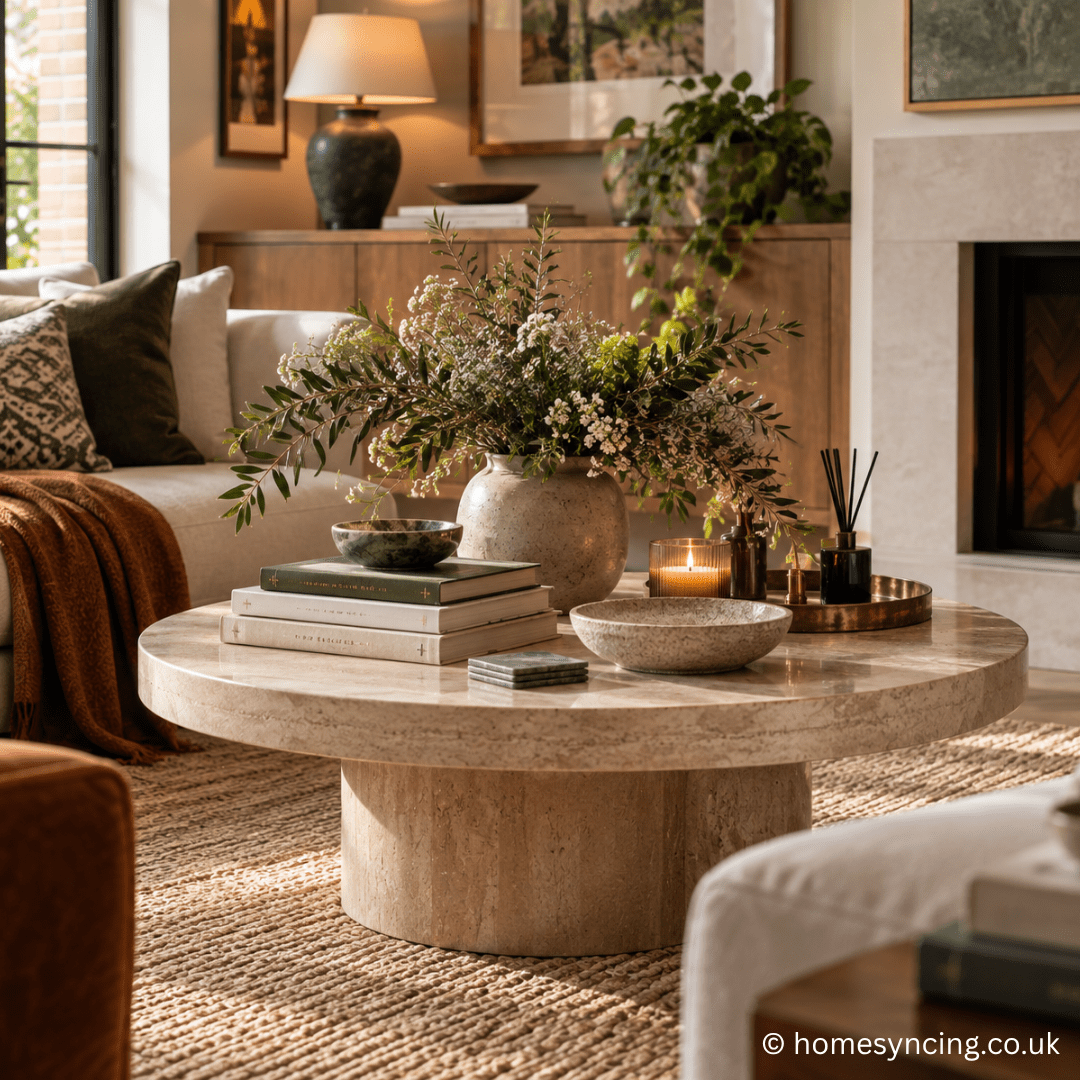
A handsome timber table may need very little decoration because the grain itself provides warmth and texture. Stone, marble and travertine tables also benefit from allowing some of their surface to remain visible.

Then return only the things you genuinely want or need.

A good coffee table arrangement often consists of surprisingly few objects.

Think in Groups, Not Individual Objects

One candle here, a coaster there and a remote control somewhere in between can quickly make a coffee table look untidy.

Grouping objects gives them greater purpose.

A tray is particularly useful for this. It can gather together candles, matches, a small dish and other everyday objects, turning several unrelated items into a single composition.

Bowls work in much the same way.

A small ceramic or timber bowl provides somewhere for the little things that inevitably arrive in a sitting room, while adding colour and texture of its own.

Groups of three often work particularly well, although there is no need to treat this as a strict decorating rule. What matters is that the arrangement feels relaxed rather than regimented.

Use Books to Create Height

Coffee-table books are useful for more than reading.

A short stack creates a platform upon which smaller objects can be placed, allowing you to vary the height of a display without adding unnecessary clutter.

Choose books because you are interested in them rather than because their spines happen to match the cushions.

Gardens, architecture, photography, art, interiors, natural history and travel all lend themselves particularly well to browsing. A book that someone actually wants to pick up will always be more interesting than one chosen purely as a prop.

Two or three books are usually enough.

Place a small bowl, interesting stone or other object on top and the stack immediately feels more deliberate.

Bring in Something Living

Few things refresh a coffee table as easily as flowers or foliage.

They needn’t be elaborate.

A handful of garden flowers in spring, a loose branch of blossom, summer herbs, autumn seed heads or a few stems of winter greenery can all bring life and movement to the room.

The seasons provide an endless supply of inspiration.

If you have a low coffee table, choose a relatively low arrangement so that it doesn’t interrupt conversation between people sitting opposite one another. A broad ceramic bowl, squat vase or small collection of bud vases can work beautifully.

Houseplants are another option, particularly smaller varieties that won’t overwhelm the table.

And if there is nothing suitable growing outside, a single leafy branch in a favourite vessel can be surprisingly effective.

Vary the Height

A successful coffee table display rarely sits entirely on one level.

Imagine the arrangement as a small landscape.

A vase or plant provides height. Books create a middle level. A shallow bowl, candle or small object sits closer to the table itself.

This variation encourages the eye to move around the arrangement and prevents everything from appearing flat.

Be careful not to take the idea too far, however.

A towering arrangement of flowers may look wonderful from one angle but become rather irritating when you are trying to speak to somebody sitting on the other side of it.

The coffee table belongs to the room, not the other way around.

Mix Materials and Textures

A room becomes more interesting when different materials sit alongside one another.

If you have a smooth stone coffee table, introduce the warmth of timber, paper, ceramic or woven materials. On a rustic wooden table, glass and metal can provide a pleasing contrast.

Try combining something rough with something smooth, something matt with something reflective.

A glazed ceramic bowl beside old books and a small brass object, for example, creates subtle contrast without requiring much colour.

This approach is particularly effective in neutral interiors, where texture often does more work than pattern.

Add Something with a Story

The most interesting coffee tables don’t look as though their contents were purchased together.

They contain objects accumulated over time.

It might be a small piece of pottery brought home from a holiday, a curious object found in an antiques shop, a shell picked up on a favourite beach or something inherited from a relative.

These are the things that give a room individuality.

There is no requirement for the object to be valuable. In fact, its appeal may be entirely personal.

A smooth stone from a memorable walk can have considerably more meaning than an expensive decorative object bought simply to fill a space.

Don’t Be Afraid of Colour

A coffee table is a relatively small area, which makes it an excellent place to experiment with colour.

If your sitting room is largely neutral, introduce a deep green ceramic bowl, an amber glass vase or books with colourful covers. Fresh fruit can provide colour too – a bowl of lemons, pears or seasonal apples is both useful and decorative.

Look around the wider room for inspiration.

A colour appearing in a painting or patterned cushion can be repeated quietly on the coffee table, helping to connect different parts of the scheme.

There is no need for an exact match.

In fact, colours that are related rather than identical tend to produce a more natural, collected effect.

Use a Tray to Tame Everyday Clutter

Coffee tables attract small objects.

Remote controls, reading glasses, coasters and matches have to live somewhere, and pretending otherwise rarely makes for a practical room.

A tray provides an elegant solution.

Choose one that contrasts slightly with the table beneath it. Timber can warm a stone surface, while metal or lacquer can provide definition against wood.

The tray also has a practical advantage: when you need the whole table for drinks or food, the contents can be moved in one go.

That is particularly useful when entertaining.

Introduce Candlelight

Candles bring another layer to a coffee table as evening arrives.

A low candle in a glass or ceramic vessel provides a gentle glow without blocking sightlines. A pair or small group can be effective on a larger table.

If the candle is scented, exercise a little restraint.

A fragrance that is pleasant for half an hour can become overwhelming over an entire evening, particularly when several scented products are used in the same room.

One carefully chosen fragrance is generally enough.

And, of course, never leave a burning candle unattended or position it beneath foliage, shelves or anything that could catch fire.

Style a Round Coffee Table Differently

The shape of the table should influence the arrangement.

On a round coffee table, avoid lining objects up as though they were sitting on a shelf. Instead, arrange them more loosely around the centre.

A vase, a stack of books and a shallow bowl can form a simple triangle, leaving plenty of empty surface around them.

Round trays and bowls naturally echo the table’s shape, but contrast can be effective too. A rectangular book introduces a useful straight line against all those curves.

For a particularly large round table, several small groupings may work better than one substantial centrepiece.

Styling a Rectangular Coffee Table

A rectangular coffee table offers different possibilities.

One approach is to imagine the surface divided loosely into thirds. Perhaps books occupy one section, flowers another and a tray the third.

You don’t need to fill all three.

Leaving one section relatively clear creates breathing space and somewhere practical to put drinks.

On a long table, avoid placing everything in the exact centre. An arrangement positioned slightly off-centre often feels more relaxed and leaves more usable surface.

Nesting Tables Need Less

Nesting and overlapping coffee tables have become useful choices for flexible sitting rooms.

Because the furniture itself already provides different shapes and levels, the decoration can be simpler.

Rather than styling every surface, allow one table to carry the main arrangement while another remains almost empty.

A lamp or vase on the taller table and a couple of books on the lower one may be all that is required.

The different heights provide much of the visual interest for you.

Change Things with the Seasons

Coffee table styling needn’t remain unchanged throughout the year.

Small seasonal adjustments can subtly alter the atmosphere of an entire sitting room.

In spring, bring in blossom, bulbs and fresh greens. Summer lends itself to garden flowers and brighter colour. Autumn offers branches, seed heads, richly coloured leaves and bowls of apples or pears.

In winter, evergreens, candles and a few sculptural bare branches can be particularly atmospheric.

There is no need to turn the table into a seasonal display.

Often one small change is enough.

Know When to Remove Something

Editing is one of the most useful skills in how to style a coffee table.

Once you have arranged everything, take a step back.

If the first thing you notice is the sheer quantity of objects, remove one or two.

There should be space between things. The table itself should remain visible and, importantly, usable.

Try the practical test: could two people comfortably put down cups of tea without rearranging the entire display?

If not, you probably have too much.

Make It Work for Your Life

There is little point creating a perfectly styled coffee table that becomes inconvenient the moment you sit down.

A household with young children will have different requirements from a formal sitting room used mainly when guests visit. Someone who spends evenings reading may want books and a good place for glasses, while a family film night requires somewhere for drinks, snacks and remote controls.

Style around those realities rather than fighting them.

Beautiful homes work because they accommodate the lives taking place within them.

A Coffee Table That Feels Collected, Not Styled

Perhaps the secret to a coffee table that always looks good is to avoid making it look too good.

Allow the book you are actually reading to remain there. Keep the coasters within reach. Put garden flowers in the slightly imperfect jug you love rather than searching for a perfectly coordinated vase.

Combine something tall with something low, something old with something new and something decorative with something useful.

Then leave some empty space.

Over time, the arrangement will inevitably change. Flowers fade, books are picked up, candles burn down and new objects find their way home.

That is no bad thing.

A coffee table should never feel like a display behind glass. It sits at the heart of a living room and ought to look as though people really do live around it.

Take a Look at our Coffee Tables

Further Reading: How to Create a Bedroom Retreat, Affordable Decorating Ideas That Will Transform Your Home, Sustainable Chic: A Beginner’s Guide to Circular Design, Small Room, Big Impact

Daily Inspiration: Follow Us on Instagram, BlueSky, Threads , Pinterest, Twitter, TikTok
How to Choose the Perfect Wall Clock

A Timeless Touch for Your Home

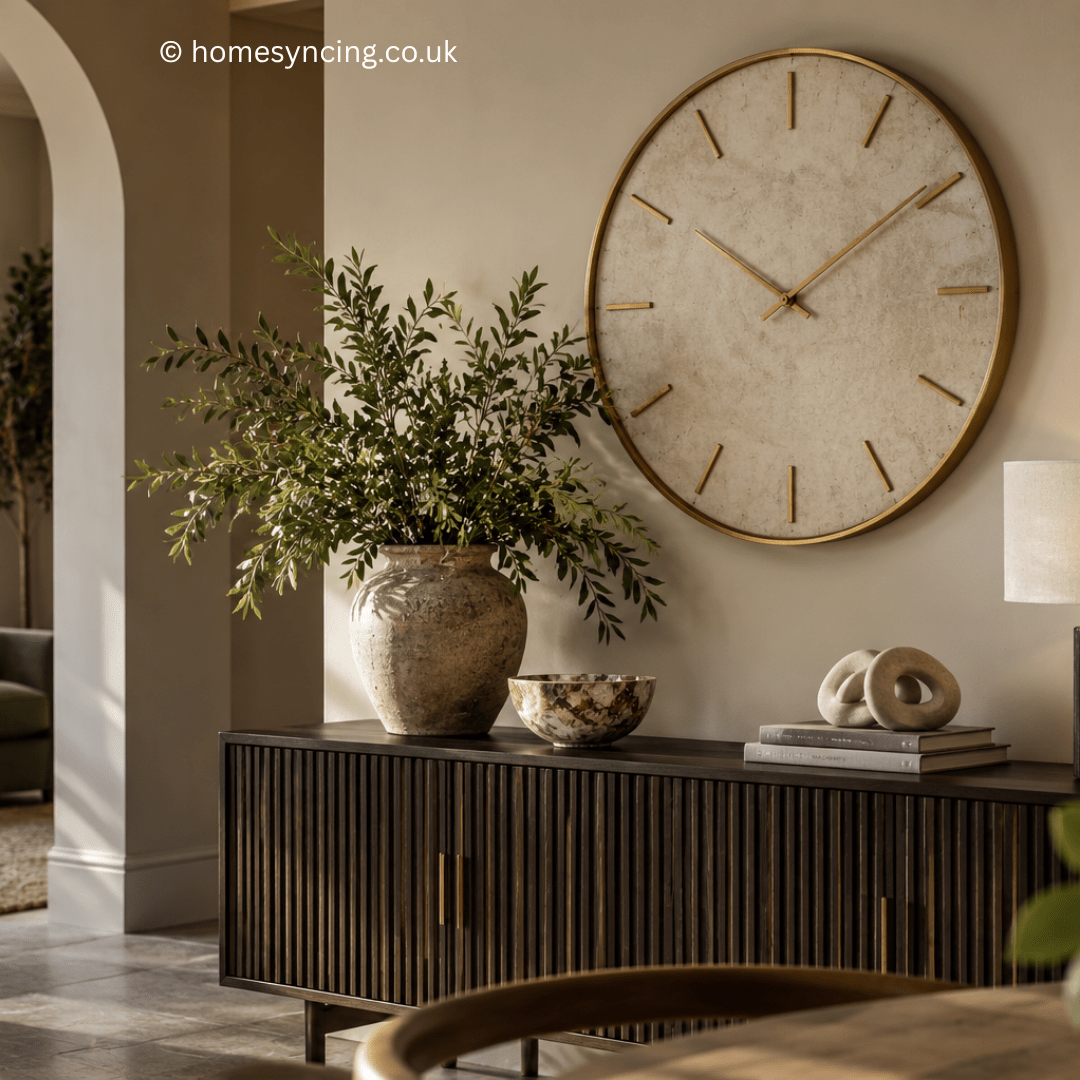
A wall clock does far more than mark the passing of hours. It brings rhythm to a room, offers a sense of order, and can quietly anchor a space. Chosen with care, it becomes part of the fabric of your home – familiar, dependable and pleasing to the eye.

With so many styles and finishes available, selecting the right clock can feel daunting. Yet by taking a thoughtful approach, you can find a piece that feels as though it has always belonged.

Consider the Character of Your Home

Every home has its own story, shaped by age, architecture and the lives lived within it. When choosing a wall clock, take a moment to reflect on that character. A sleek, contemporary design may suit a modern interior, while a clock with traditional detailing can sit comfortably among period features or well-loved furnishings.

Look at the materials already present in the room. Painted wood, natural stone, metal or glass can all help guide your choice. Colour, too, plays a part. A clock may blend gently into its surroundings or provide a quiet contrast, drawing the eye without demanding attention.

Choose a Size That Feels Balanced

Scale is key. A generously sized clock can work beautifully as a focal point in a living room or kitchen, particularly on a large, uninterrupted wall. In smaller spaces – a hallway, study or bathroom – a more modest design will feel in keeping and avoid crowding the room.

Consider how the clock will be viewed. High ceilings may allow for something larger, while lower ceilings benefit from a lighter visual presence. The aim is balance: a clock that feels settled rather than imposed.

Think About the Movement

The mechanism behind the clock face will influence both its character and how it fits into your daily life. Quartz clocks are practical and reliable, requiring little attention beyond the occasional battery change. They suit busy households and spaces where accuracy is paramount.

Mechanical clocks, often wound by hand, carry a sense of tradition. Their gentle ticking and visible craftsmanship can add warmth and depth, though they do ask a little more of their owner. For some, this quiet ritual becomes part of the pleasure.

Consider Additional Details

Some clocks offer extra features, such as chimes or additional displays. While these can be useful, it is worth considering whether they add to the atmosphere of the room or distract from it. A softly chiming clock may suit a hallway or kitchen, while a simpler, silent design might be better suited to a bedroom or study.

As with any object in the home, restraint often brings the greatest pleasure.

Set a Thoughtful Budget

Wall clocks are available at many price points, and value is not always tied to cost. A well-made clock, chosen with care, can give years of quiet service regardless of its price. Decide what feels comfortable for you, and focus on quality, materials and craftsmanship rather than trends.

A Piece to Live With

A wall clock is something you will glance at countless times a day. It should feel reassuring, familiar and right for its place. By considering style, scale, movement and purpose, you can choose a clock that not only tells the time but also enriches your home.

Explore our collection of wall clocks, thoughtfully designed in a range of styles and sizes, and find a piece that will become part of your home’s story for years to come.

See our range of Wall Clocks here

Further Reading: Affordable Decorating Ideas That Will Transform Your Home, Sustainable Chic: A Beginner’s Guide to Circular Design, How to Choose Wall Art for your Home

Daily Inspiration: Follow Us on Instagram, BlueSky, Threads , Pinterest, Twitter, TikTok

How to Choose Wall Art for Your Home

A blank wall can be an appealing thing.

It offers the possibility of a much-loved painting, a collection of family photographs, an old map of somewhere significant or perhaps a picture found unexpectedly in an antiques shop and carried home because you simply couldn’t leave it behind.

What we hang on our walls can tell us a surprising amount about the people who live among them.

In houses assembled over generations, pictures rarely appear to have been chosen according to a single decorating scheme. Portraits sit beside landscapes, botanical studies mingle with family photographs and contemporary works find a place alongside inherited pieces. It is this mixture – of periods, subjects and memories – that gives a room its individuality.

Choosing wall art for your home, then, needn’t begin with what happens to be fashionable. A better starting point is the room itself, followed closely by the question of what you actually enjoy looking at.

Here is how to choose and hang wall art in a way that feels considered, personal and entirely at home.

Begin with What You Love

It is tempting to choose artwork because it matches the sofa.

Colour certainly matters, but it needn’t be the reason you bring a picture into your home.

Art is something you may look at every day for years. Choose pieces that provoke a response – perhaps because the subject is familiar, the colours are particularly beautiful or the picture reminds you of somewhere you have been.

This doesn’t require a considerable budget or knowledge of art history.

Original paintings and limited-edition prints can be wonderful, but so too can old exhibition posters, family photographs, maps, children’s drawings, botanical studies and inexpensive prints discovered at markets and second-hand shops.

You might even frame something that was never intended as wall art at all: an old letter, a fragment of interesting fabric, a pressed plant or a beautifully illustrated page from a damaged book.

A home becomes more interesting when the things within it have stories.

Look at the Room as a Whole

Before deciding what to hang, spend some time looking at the wall from across the room.

Consider the architecture surrounding it. Where are the doors and windows? Is there a fireplace, panelling or an alcove nearby? What furniture sits beneath the space?

The best wall art ideas tend to work with these features rather than ignoring them.

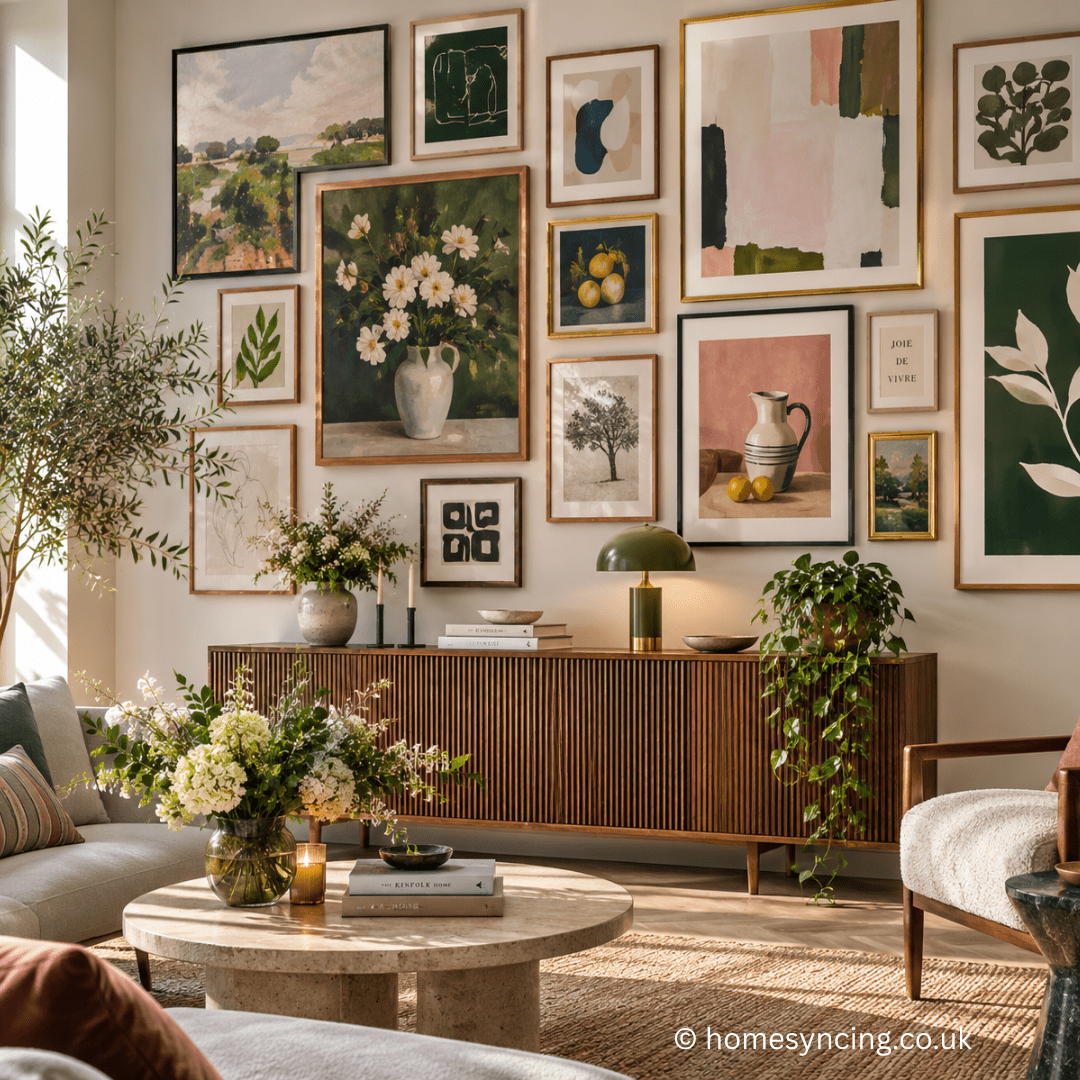
A tall, narrow piece might echo the proportions of a window. A horizontal landscape can work beautifully above a long sideboard. A collection of smaller pictures may bring life to an awkward stretch of wall beside a staircase.

It is also worth considering the character of the room.

A bedroom might call for quieter imagery, while a kitchen or hallway can be an opportunity for something more playful. A sitting room used for conversation can comfortably accommodate a collection of pictures that reward closer inspection.

Don’t feel that the style of the artwork must match the age of the property. Contemporary art can look particularly striking against old plasterwork or panelling, just as an antique landscape can bring warmth and depth to a modern room.

Contrast often creates far more interest than perfect coordination.

Get the Scale Right

If there is one practical consideration that can make an immediate difference, it is scale.

Artwork that is too small can look stranded on a large wall. This is particularly noticeable when hanging a picture above substantial furniture such as a sofa, bed or sideboard.

As a starting point, a picture or group of pictures measuring approximately two-thirds to three-quarters of the width of the furniture beneath it will often feel well proportioned.

This is a guide rather than a rule.

A very large painting can look magnificent in a modest room, while a tiny artwork can be captivating when deliberately positioned in a small alcove or between architectural details.

What matters is that the scale looks intentional.

For a particularly large wall, don’t assume you need one enormous piece. A pair of paintings, a group of prints or a gallery wall can occupy the space just as successfully.

Before committing to a position, cut sheets of paper to the dimensions of your pictures and temporarily fix them to the wall. It is a remarkably effective way of judging proportion without making unnecessary holes.

Hang Art at a Comfortable Height

Pictures have a tendency to creep upwards.

Perhaps it is the expanse of wall above them, but one of the most common mistakes when hanging artwork is positioning it too high.

As a broad guide, the centre of a picture should sit at approximately eye level. In many rooms, this means placing the centre somewhere around 145–150cm from the floor.

But, as ever, the room should have the final say.

Artwork above a sofa or sideboard needs to relate visually to the furniture beneath it. Leave too great a gap and the two elements can appear disconnected.

In rooms where people are mostly seated – a dining room, for example – pictures can often sit a little lower than expected. The result feels more intimate and allows the artwork to become part of the room rather than floating above it.

Old houses provide their own challenges. Sloping ceilings, dado rails, panelling and uneven walls may make conventional rules irrelevant. Work with the architecture rather than forcing symmetry where it doesn’t naturally exist.

Choosing Wall Art for a Living Room

The sitting room is often where artwork has the greatest opportunity to make an impression.

When choosing wall art for a living room, first identify the natural focal points. The space above a fireplace, sofa or sideboard will usually command attention, making it a good place for a substantial picture or carefully arranged group.

Not every wall needs something on it.

Leaving some areas relatively quiet gives the eye somewhere to rest and allows important pieces to have greater presence.

If the room already contains patterned upholstery, colourful rugs or decorative wallpaper, artwork doesn’t necessarily need to compete. Something quieter may provide balance.

Conversely, in a restrained room of plain walls and neutral furniture, art can introduce much-needed colour and personality.

A particularly good painting can even provide the starting point for an entire room. A small shade of green within a landscape might reappear in a cushion or lampshade; a warm ochre might inspire the colour of a chair.

The connection can be subtle. There is no need to match everything exactly.

Let Colour Connect the Room

Artwork can be a wonderful way of bringing seemingly unrelated colours together.

Look closely at a painting and you may find dozens of shades rather than the two or three that initially catch the eye.

Picking up one of these quieter colours elsewhere in the room can create a satisfying sense of connection. It might appear in a cushion, a vase, a painted piece of furniture or simply a bunch of flowers.

Alternatively, use artwork to introduce something unexpected.

A vivid painting in a largely neutral room can completely alter its energy. Deep red, cobalt blue, acid green or ochre can all be enormously effective when there is enough quieter space around them.

Don’t become too preoccupied with whether art ‘matches’.

A picture that disappears perfectly into the colour scheme may ultimately be less interesting than one that introduces a little tension.

Give the Frame Some Thought

The frame is part of the picture.

A good one should protect the artwork while complementing both the piece and its surroundings.

Natural timber frames bring warmth and work particularly well with landscapes, botanical art and prints. Slim black frames offer greater definition and can lend traditional subjects a more contemporary appearance.

Gilt frames have an enduring appeal, especially when their surface has softened with age. They needn’t be reserved for grand interiors. A small, slightly timeworn gilt frame can look wonderful against an informal painted wall.

And there is no requirement for every frame in a room to match.

In fact, a mixture of timber, black, painted and gilt frames can make a collection feel as though it has developed gradually. If there is some consistency in the artwork or overall palette, different frames often add rather than detract from the display.

When framing valuable, original or delicate works, seek advice on conservation-quality materials and suitable glazing to help protect them from damage over time.

Creating a Gallery Wall

A gallery wall offers an opportunity to bring together pictures that might not command an entire wall individually.

The most interesting examples often mix subjects and formats: photographs beside paintings, small prints next to larger works and perhaps an unexpected object among them.

There are two broad approaches.

A formal gallery wall follows a grid, using consistent spacing and often matching frames. It creates a calm, ordered effect and works particularly well with sets of botanical prints, photographs or architectural studies.

A more informal arrangement can grow organically. Begin with one or two substantial pieces and gradually position smaller works around them, keeping the gaps between frames reasonably consistent.

If you are nervous about getting it right, arrange everything on the floor first.

Start with the largest piece and build outwards. Take a photograph of the arrangement once you are happy with it, then transfer it to the wall.

Don’t feel obliged to finish the gallery wall in a single afternoon. Collections often become more interesting when there is space for future discoveries.

Look Beyond Paintings and Prints

Walls can hold much more than conventional framed artwork.

Decorative plates have been displayed in homes for centuries and can create wonderful arrangements in kitchens and dining rooms. Old textiles bring pattern and softness, while tapestries and woven pieces are particularly effective on larger walls.

Maps can have enormous personal significance, especially when they depict a childhood home, favourite landscape or much-visited part of the country.

Pressed botanicals, vintage signs, architectural fragments and small sculptural pieces can all become part of a display too.

Mirrors can also be incorporated among artwork, reflecting light and providing contrast to flat framed surfaces.

The aim isn’t to find unusual objects simply for the sake of being different. Rather, it is to recognise that anything you find beautiful or meaningful has the potential to earn a place on the wall.

Protect Art from Light and Heat

Where you hang a picture matters for reasons beyond appearance.

Strong, direct sunlight can cause pigments, photographs, textiles and paper to fade over time. Particularly valuable or delicate works are best positioned away from prolonged direct sunlight.

Heat and moisture should also be considered.

Avoid placing vulnerable works directly above radiators or in areas prone to damp. Kitchens and bathrooms can be challenging environments for original works on paper because of changing levels of heat, humidity and moisture.

For anything especially precious, professional framing using appropriate conservation materials is worth considering.

After all, part of the pleasure of owning something beautiful is ensuring that it can continue to be enjoyed.

Allow Your Collection to Evolve

There is no need to finish every wall.

Homes are rarely at their most interesting when every surface has been decorated at once. Leaving a little space allows room for something you haven’t found yet.

Perhaps it will be a small landscape spotted in an antiques shop, a print bought on holiday or a photograph you finally decide deserves to be framed.

Move pictures around occasionally too.

An artwork that has become almost invisible through familiarity can feel completely new in another room. Changing the pictures on a landing or moving a painting from a bedroom into the sitting room can alter the character of both spaces without buying anything new.

Walls That Tell a Story

Ultimately, choosing wall art for your home is less about following decorating rules and more about deciding what deserves your attention.

The pictures and objects we choose to live with become part of the backdrop to everyday life. We pass them on the stairs, notice them while sitting with a cup of tea and gradually associate them with particular rooms, people and periods of our lives.

So measure carefully and consider scale. Think about colour, frames and where the light falls. But don’t allow practicalities to remove the pleasure from choosing.

Hang the landscape that reminds you of somewhere you love. Frame the photograph that makes you stop for a moment. Give the peculiar little painting from the antiques shop pride of place simply because it makes you smile.

A beautifully decorated wall doesn’t need to tell visitors that you understand interiors.

It should tell them something about you.

Further Reading: Affordable Decorating Ideas That Will Transform Your Home, Sustainable Chic: A Beginner’s Guide to Circular Design, Small Room, Big Impact

Daily Inspiration: Follow Us on Instagram, BlueSky, Threads , Pinterest, Twitter, TikTok

Take a Look at our great range of Wall Art here

Translate »