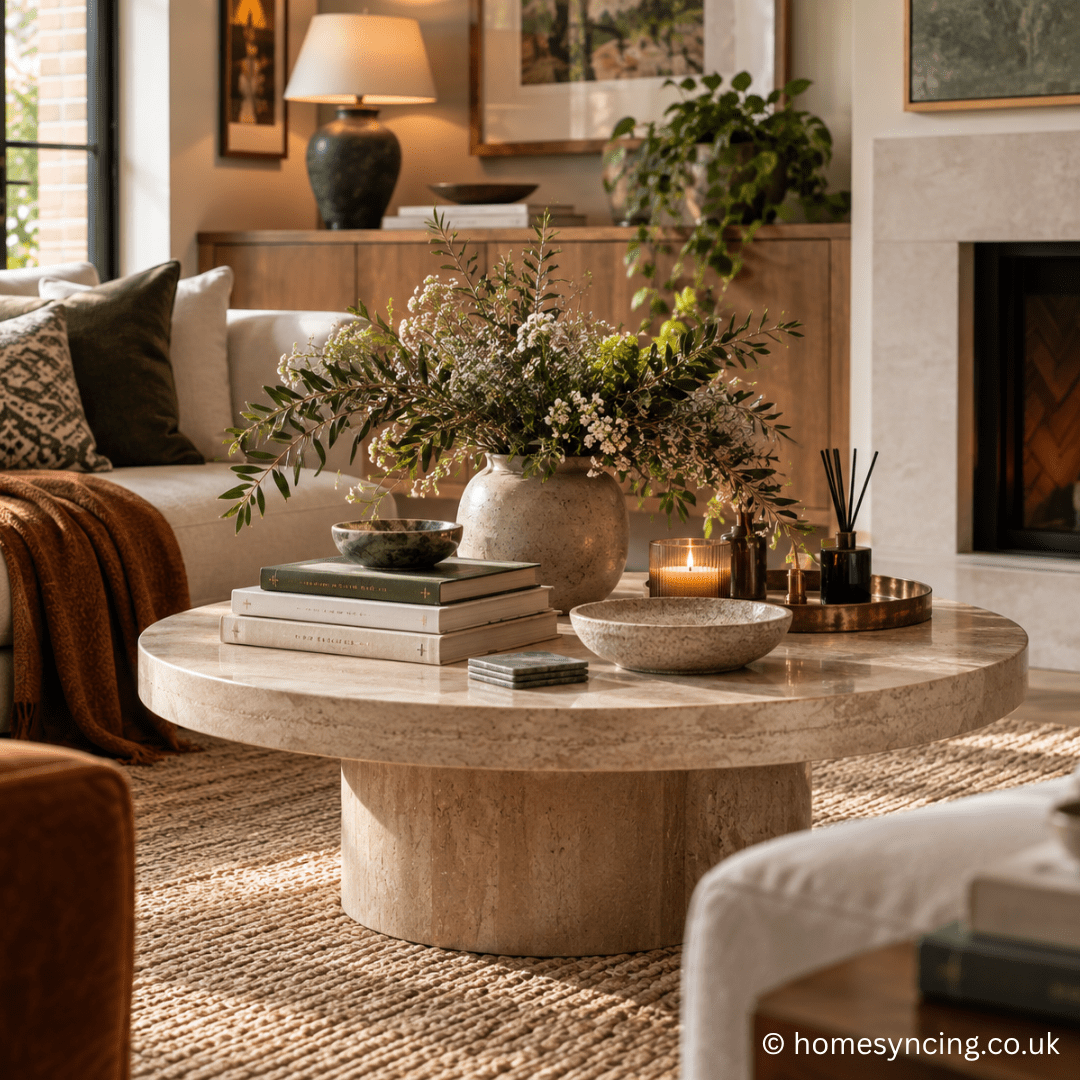
A coffee table occupies an interesting place in the home.
It is rarely the largest or most valuable piece of furniture in a sitting room, yet it often finds itself right at the centre of things. Cups of tea are put down upon it, newspapers accumulate, books are left half-read and feet occasionally find their way there too.
It is a working surface, but also an opportunity.
Styled thoughtfully, a coffee table can help pull a room together, introducing colour, texture and objects that say something about the people who live there. The trick is to avoid making it look so carefully arranged that nobody dares actually use it.
The best coffee table styling ideas combine beautiful things with useful ones – a favourite book, a bowl for odds and ends, flowers gathered from the garden and somewhere sensible to put a cup.
So, how do you style a coffee table so that it always looks good? Begin by resisting the urge to fill every inch.
Start with a Clear Table
Before adding anything, take everything away.
It is much easier to understand the proportions of a coffee table when you can see its entire surface. Notice its shape, material and relationship to the furniture around it.
A handsome timber table may need very little decoration because the grain itself provides warmth and texture. Stone, marble and travertine tables also benefit from allowing some of their surface to remain visible.
Then return only the things you genuinely want or need.
A good coffee table arrangement often consists of surprisingly few objects.
Think in Groups, Not Individual Objects
One candle here, a coaster there and a remote control somewhere in between can quickly make a coffee table look untidy.
Grouping objects gives them greater purpose.
A tray is particularly useful for this. It can gather together candles, matches, a small dish and other everyday objects, turning several unrelated items into a single composition.
Bowls work in much the same way.
A small ceramic or timber bowl provides somewhere for the little things that inevitably arrive in a sitting room, while adding colour and texture of its own.
Groups of three often work particularly well, although there is no need to treat this as a strict decorating rule. What matters is that the arrangement feels relaxed rather than regimented.
Use Books to Create Height
Coffee-table books are useful for more than reading.
A short stack creates a platform upon which smaller objects can be placed, allowing you to vary the height of a display without adding unnecessary clutter.
Choose books because you are interested in them rather than because their spines happen to match the cushions.
Gardens, architecture, photography, art, interiors, natural history and travel all lend themselves particularly well to browsing. A book that someone actually wants to pick up will always be more interesting than one chosen purely as a prop.
Two or three books are usually enough.
Place a small bowl, interesting stone or other object on top and the stack immediately feels more deliberate.
Bring in Something Living
Few things refresh a coffee table as easily as flowers or foliage.
They needn’t be elaborate.
A handful of garden flowers in spring, a loose branch of blossom, summer herbs, autumn seed heads or a few stems of winter greenery can all bring life and movement to the room.
The seasons provide an endless supply of inspiration.
If you have a low coffee table, choose a relatively low arrangement so that it doesn’t interrupt conversation between people sitting opposite one another. A broad ceramic bowl, squat vase or small collection of bud vases can work beautifully.
Houseplants are another option, particularly smaller varieties that won’t overwhelm the table.
And if there is nothing suitable growing outside, a single leafy branch in a favourite vessel can be surprisingly effective.
Vary the Height
A successful coffee table display rarely sits entirely on one level.
Imagine the arrangement as a small landscape.
A vase or plant provides height. Books create a middle level. A shallow bowl, candle or small object sits closer to the table itself.
This variation encourages the eye to move around the arrangement and prevents everything from appearing flat.
Be careful not to take the idea too far, however.
A towering arrangement of flowers may look wonderful from one angle but become rather irritating when you are trying to speak to somebody sitting on the other side of it.
The coffee table belongs to the room, not the other way around.
Mix Materials and Textures
A room becomes more interesting when different materials sit alongside one another.
If you have a smooth stone coffee table, introduce the warmth of timber, paper, ceramic or woven materials. On a rustic wooden table, glass and metal can provide a pleasing contrast.
Try combining something rough with something smooth, something matt with something reflective.
A glazed ceramic bowl beside old books and a small brass object, for example, creates subtle contrast without requiring much colour.
This approach is particularly effective in neutral interiors, where texture often does more work than pattern.
Add Something with a Story
The most interesting coffee tables don’t look as though their contents were purchased together.
They contain objects accumulated over time.
It might be a small piece of pottery brought home from a holiday, a curious object found in an antiques shop, a shell picked up on a favourite beach or something inherited from a relative.
These are the things that give a room individuality.
There is no requirement for the object to be valuable. In fact, its appeal may be entirely personal.
A smooth stone from a memorable walk can have considerably more meaning than an expensive decorative object bought simply to fill a space.
Don’t Be Afraid of Colour
A coffee table is a relatively small area, which makes it an excellent place to experiment with colour.
If your sitting room is largely neutral, introduce a deep green ceramic bowl, an amber glass vase or books with colourful covers. Fresh fruit can provide colour too – a bowl of lemons, pears or seasonal apples is both useful and decorative.
Look around the wider room for inspiration.
A colour appearing in a painting or patterned cushion can be repeated quietly on the coffee table, helping to connect different parts of the scheme.
There is no need for an exact match.
In fact, colours that are related rather than identical tend to produce a more natural, collected effect.
Use a Tray to Tame Everyday Clutter
Coffee tables attract small objects.
Remote controls, reading glasses, coasters and matches have to live somewhere, and pretending otherwise rarely makes for a practical room.
A tray provides an elegant solution.
Choose one that contrasts slightly with the table beneath it. Timber can warm a stone surface, while metal or lacquer can provide definition against wood.
The tray also has a practical advantage: when you need the whole table for drinks or food, the contents can be moved in one go.
That is particularly useful when entertaining.
Introduce Candlelight
Candles bring another layer to a coffee table as evening arrives.
A low candle in a glass or ceramic vessel provides a gentle glow without blocking sightlines. A pair or small group can be effective on a larger table.
If the candle is scented, exercise a little restraint.
A fragrance that is pleasant for half an hour can become overwhelming over an entire evening, particularly when several scented products are used in the same room.
One carefully chosen fragrance is generally enough.
And, of course, never leave a burning candle unattended or position it beneath foliage, shelves or anything that could catch fire.
Style a Round Coffee Table Differently
The shape of the table should influence the arrangement.
On a round coffee table, avoid lining objects up as though they were sitting on a shelf. Instead, arrange them more loosely around the centre.
A vase, a stack of books and a shallow bowl can form a simple triangle, leaving plenty of empty surface around them.
Round trays and bowls naturally echo the table’s shape, but contrast can be effective too. A rectangular book introduces a useful straight line against all those curves.
For a particularly large round table, several small groupings may work better than one substantial centrepiece.
Styling a Rectangular Coffee Table
A rectangular coffee table offers different possibilities.
One approach is to imagine the surface divided loosely into thirds. Perhaps books occupy one section, flowers another and a tray the third.
You don’t need to fill all three.
Leaving one section relatively clear creates breathing space and somewhere practical to put drinks.
On a long table, avoid placing everything in the exact centre. An arrangement positioned slightly off-centre often feels more relaxed and leaves more usable surface.
Nesting Tables Need Less
Nesting and overlapping coffee tables have become useful choices for flexible sitting rooms.
Because the furniture itself already provides different shapes and levels, the decoration can be simpler.
Rather than styling every surface, allow one table to carry the main arrangement while another remains almost empty.
A lamp or vase on the taller table and a couple of books on the lower one may be all that is required.
The different heights provide much of the visual interest for you.
Change Things with the Seasons
Coffee table styling needn’t remain unchanged throughout the year.
Small seasonal adjustments can subtly alter the atmosphere of an entire sitting room.
In spring, bring in blossom, bulbs and fresh greens. Summer lends itself to garden flowers and brighter colour. Autumn offers branches, seed heads, richly coloured leaves and bowls of apples or pears.
In winter, evergreens, candles and a few sculptural bare branches can be particularly atmospheric.
There is no need to turn the table into a seasonal display.
Often one small change is enough.
Know When to Remove Something
Editing is one of the most useful skills in how to style a coffee table.
Once you have arranged everything, take a step back.
If the first thing you notice is the sheer quantity of objects, remove one or two.
There should be space between things. The table itself should remain visible and, importantly, usable.
Try the practical test: could two people comfortably put down cups of tea without rearranging the entire display?
If not, you probably have too much.
Make It Work for Your Life
There is little point creating a perfectly styled coffee table that becomes inconvenient the moment you sit down.
A household with young children will have different requirements from a formal sitting room used mainly when guests visit. Someone who spends evenings reading may want books and a good place for glasses, while a family film night requires somewhere for drinks, snacks and remote controls.
Style around those realities rather than fighting them.
Beautiful homes work because they accommodate the lives taking place within them.
A Coffee Table That Feels Collected, Not Styled
Perhaps the secret to a coffee table that always looks good is to avoid making it look too good.
Allow the book you are actually reading to remain there. Keep the coasters within reach. Put garden flowers in the slightly imperfect jug you love rather than searching for a perfectly coordinated vase.
Combine something tall with something low, something old with something new and something decorative with something useful.
Then leave some empty space.
Over time, the arrangement will inevitably change. Flowers fade, books are picked up, candles burn down and new objects find their way home.
That is no bad thing.
A coffee table should never feel like a display behind glass. It sits at the heart of a living room and ought to look as though people really do live around it.
Take a Look at our Coffee Tables
Further Reading: How to Create a Bedroom Retreat, Affordable Decorating Ideas That Will Transform Your Home, Sustainable Chic: A Beginner’s Guide to Circular Design, Small Room, Big Impact
Daily Inspiration: Follow Us on Instagram, BlueSky, Threads , Pinterest, Twitter, TikTok