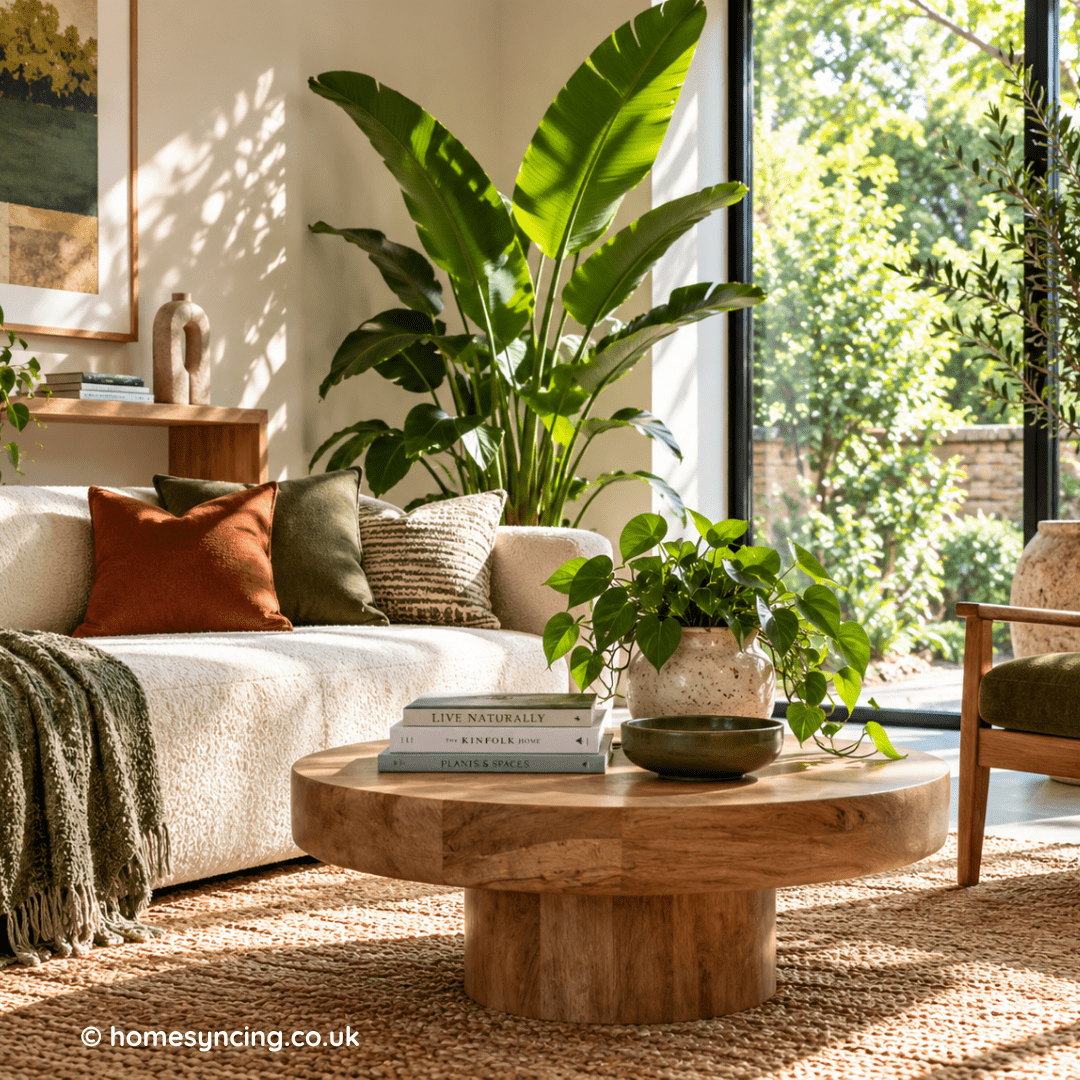
There are rooms that seem to make us feel better almost as soon as we enter them.
Perhaps sunlight is moving slowly across a timber floor. A window frames the branches of an old tree outside. There is linen at the window, wool beneath our feet and the reassuring grain of wood beneath a hand. The room feels peaceful without being empty; natural without being rustic.
We may not immediately understand why.
This is the idea at the heart of biophilic design: creating homes that strengthen our connection with the natural world.
And despite what countless photographs of enormous houseplants might suggest, it is about much more than greenery.
A truly nature-connected home considers daylight and views, natural materials and texture, fresh air, colour, shape and even the way we move from one part of a room to another.
The potted plant can stay. It simply doesn’t have to do all the work.
What Is Biophilic Design?
The word biophilia describes our affinity with the natural world. In interior design, that idea has developed into an approach that brings aspects of nature into the places where we spend our time.
The most obvious interpretation is literal nature: plants, flowers, water and views of the garden.
But biophilic interior design goes considerably further.
Timber whose grain is still visible, stone that feels cool beneath the fingertips, daylight that changes from morning to evening and fabrics made from linen or wool can all contribute.
So can curved forms, irregular patterns and rooms arranged to provide both open views and quieter, more sheltered places.
It is less about decorating with nature than allowing a home to behave a little more like the natural world.
Begin With the View Outside
Before bringing nature into the room, look through the window.
What can you already see?
It might be a mature tree, the changing colour of a hedge, rooftops beneath an enormous sky or simply a small patch of garden. Even an ordinary view changes with the weather and the seasons, and that movement is something no wallpaper or artwork can quite reproduce.
Try arranging furniture so that a good view becomes part of the room.
An armchair turned slightly towards the garden can make a surprisingly large difference. Keeping a windowsill relatively uncluttered allows the eye to travel beyond it. A dining table positioned where you can see outside makes the changing landscape part of everyday meals.
And where there is a particularly lovely view, resist the temptation to compete with it.
Sometimes the window is the artwork.
Make More of Natural Light
Daylight is one of the most powerful elements in any interior — and one of the few that changes constantly without us doing anything at all.
Morning light is quite different from the low glow of late afternoon. Winter light enters a room differently from summer sunshine. Clouds pass, shadows move and colours subtly alter as the day progresses.
Biophilic design embraces those changes rather than attempting to make a room look identical at every hour.
Keep windows as open to daylight as privacy allows. Linen curtains and other light-filtering fabrics can soften strong sunshine without shutting it out completely.
Mirrors can also be particularly useful. Place one where it catches light from a window and it can reflect natural light into a darker part of the room, as well as repeating an attractive outdoor view.
The effect can be wonderful: a glimpse of leaves or sky appearing unexpectedly on another wall, almost as though the room has acquired another window.
After dark, use several softer sources of light rather than relying entirely on a bright central fitting. Table lamps, floor lamps and wall lights create pools of illumination and a gentler transition into evening.
Let Sunlight Create Its Own Decoration
Not every visual effect in a room needs to come from an object.
Light itself can decorate.
Sun passing through woven blinds, shutters or foliage outside can create shifting patterns across walls and floors. These changing shadows bring movement to an interior in much the same way that sunlight filters through branches outdoors.
It is fleeting, which is precisely what makes it beautiful.
Rather than trying to illuminate every corner evenly, allow a little contrast. Bright areas make shaded ones feel more restful, while shadows give depth to natural textures.
A home need not be uniformly bright to feel filled with light.
Choose Materials That Feel Good to Touch
Nature is wonderfully inconsistent.
Wood has knots. Stone has veins. Linen creases. Wool has texture. Clay carries subtle variations from one piece to another.
These imperfections are part of their appeal.
Introducing natural materials into your home can therefore be as much about touch as appearance. A solid timber table has a different presence from a perfectly smooth synthetic surface. A wool rug changes the way a room sounds as well as how it feels beneath your feet.
There is no need to turn the house into a catalogue of natural finishes. A few well-chosen materials are often enough.
Timber furniture, a linen curtain, a woven rug, a stone-topped table or handmade pottery can introduce warmth and variation without making a room feel overly styled.
Better still, many natural materials become more interesting with age.
The marks of everyday life gradually become part of them.
Look Beyond Green
Biophilic interiors are often presented as a sea of green, but nature’s palette is far richer.
Think of chalk cliffs and winter skies, moss and lichen, wet pebbles, russet leaves, pale sand, heather, bark and the deep blue-green of the sea.
These colours can create a connection with nature without requiring a single botanical print.
Muted olive and soft sage remain particularly easy to live with, but they work beautifully alongside warm clay, ochre, chalky neutrals, earthy reds and deeper browns.
Blue deserves a place too. Used thoughtfully, it can bring the sense of openness we associate with water and sky.
The aim is not to reproduce a landscape literally. Instead, borrow the relationships between colours that occur naturally and allow them to inform the room.
Follow Nature’s Curves
Our houses inevitably contain plenty of straight lines. Walls meet at corners, doors are rectangular and cupboards tend to arrive in orderly grids.
Furniture and accessories provide an opportunity to soften all that geometry.
A round coffee table, curved sofa, oval mirror or gently arched doorway introduces a more organic rhythm. Even the irregular outline of a handmade bowl can provide contrast against a very ordered room.
You do not need everything to undulate.
In fact, curves are often more effective when surrounded by straighter architectural lines. It is the contrast that allows them to be noticed.
Bring in Plants — But Give Them a Purpose
Houseplants certainly belong in biophilic design. They simply shouldn’t be treated as compulsory decoration for every available surface.
One well-positioned plant can have considerably more presence than a dozen little pots scattered around a room.
Choose plants according to the conditions you actually have. A dark corner is not going to become hospitable simply because a photograph suggests that a large tropical plant would look good there.
Think about scale, too.
A substantial plant can soften the junction between a window and a wall or bring life to an otherwise awkward corner. Smaller plants work well where their shape can be appreciated up close.
And if keeping houseplants alive is not your particular gift, don’t worry. A vase containing a few seasonal branches, flowers from the garden or even a beautifully shaped bare twig can provide that connection with the outdoors.
Biophilic design is not a test of horticultural ability.
Create Places of Prospect and Refuge
Some of the most interesting ideas in biophilic design have little to do with materials or colour.
They are about how a space makes us feel.
In nature, we often enjoy places where we can see what is around us while still feeling protected: sitting beneath a tree looking across a landscape, for example, or standing at the edge of woodland looking towards an open field.
Interior designers sometimes describe these qualities as prospect and refuge.
We can create something similar at home.
A window seat gives us a view while providing a sense of enclosure. An armchair tucked beside a bookcase can feel more comforting than one floating in the middle of a large room. A dining nook can provide intimacy within an open-plan space.
This is one reason why rooms containing both open areas and smaller, sheltered corners often feel particularly comfortable.
We like somewhere to look out from.
Remember Sound and Air
A nature-connected home isn’t experienced only through the eyes.
Open a window and the room changes.
There may be birdsong, rain, distant leaves moving in the wind or simply the sensation of fresh air passing through the house.
Where it is practical, natural ventilation can help a room feel less sealed off from the world beyond it.
Materials affect sound too. Timber, cork, wool, curtains and upholstered furniture soften the hard echoes that can make very sparsely furnished rooms feel less comfortable.
These are subtle things, but biophilic design is largely made from subtle things.
It is the accumulation of small sensory experiences that creates the overall atmosphere.
Allow the Seasons Indoors
One of the loveliest ways to connect a home with nature costs very little.
Allow it to change.
In spring, that might mean a few flowering branches on the table. Summer brings open windows and lighter fabrics. Autumn offers seed heads, richly coloured leaves and warmer textures, while winter can be celebrated with bare branches, evergreens and pools of soft lamplight.
You don’t need to redecorate four times a year.
Simply allowing a few elements of the home to respond to what is happening outside prevents an interior from feeling frozen in time.
It also gives us reason to notice the seasons rather than merely passing through them.
A More Natural Way to Live at Home
The most successful biophilic homes do not necessarily look overtly botanical.
They simply feel connected.
There is daylight where daylight can reach. Materials invite touch. Windows make something of the view. Furniture provides places both to gather and retreat. Colours have a relationship with the landscape, and the home changes gently as morning becomes evening and one season gives way to another.
That is why biophilic design is much more enduring than a decorating trend.
You can begin without buying anything at all.
Open the curtains fully tomorrow morning. Move a favourite chair towards the window. Clear something unnecessary from the windowsill and notice what lies beyond it. Watch where the afternoon sunlight falls.
Then consider what your home might need next.
Perhaps it is a timber table that will improve with age, a wool rug beneath your feet, linen at the windows or a mirror positioned to send daylight further into the room.
Or perhaps it simply needs fewer distractions between you and the world outside.
Because bringing nature into our homes isn’t always about adding more.
Sometimes, it is about noticing what was there all along.
Further Reading: Affordable Decorating Ideas That Will Transform Your Home, Sustainable Chic: A Beginner’s Guide to Circular Design
Daily Inspiration: Follow Us on Instagram, BlueSky, Threads , Pinterest, Twitter, TikTok