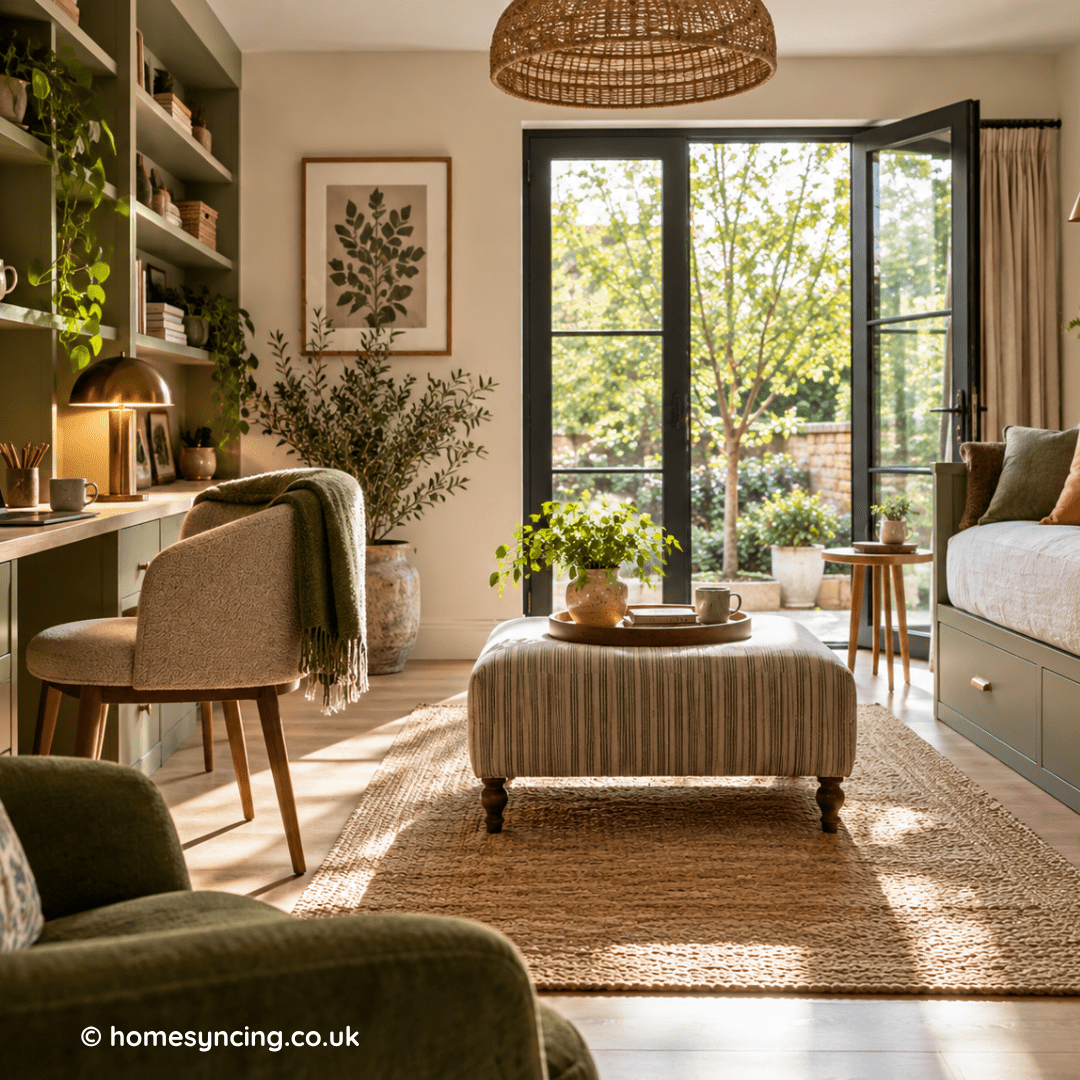
There is a corner in many homes that has quietly acquired another life.
Perhaps the dining table becomes a desk each morning. A spare bedroom doubles as a study, the landing has gained a reading chair, or an overlooked alcove now contains a small workspace. Come the evening, laptops disappear, lamps are switched on and the same rooms return to family life.
Our homes have always evolved with us, but the way we use them is changing particularly quickly. Working from home, entertaining, hobbies, exercise and family life increasingly happen beneath the same roof. The traditional idea of giving every room a single purpose no longer suits the way many of us live.
The answer is not necessarily a larger house.
Thoughtful multifunctional interior design can help an existing home do considerably more — without making every room feel as though it is trying to do everything at once.
The best multifunctional spaces are clever but unobtrusive. A desk disappears at the end of the working day. A window seat conceals useful storage. A guest room earns its keep for the other 360 days of the year.
It is less about squeezing more into a room and more about making better use of what is already there.
What Is a Multifunctional Space?
A multifunctional space is simply a room or part of a room designed to accommodate more than one activity.
But there is an important distinction between a room that has several uses and one that merely contains lots of things.
Putting a desk beside the sofa does not automatically create a successful living room and home office. Nor does adding a sofa bed necessarily make a comfortable guest room.
The different uses need to coexist.
A good multifunctional room changes character with surprisingly little effort. During the day, one corner might be a calm place to work. In the evening, the desk is cleared and that same area becomes part of the living room again.
This sense of transformation is what makes flexible interiors so useful.
The room should know when the working day has ended, even if technically you have not gone anywhere.
Begin With How You Actually Live
Before moving furniture or buying clever storage, consider what really happens in the room.
Not what you imagine might happen. What actually happens.
Where does the post accumulate? Where do children naturally sit to do homework? Which chair receives the clothes that haven’t quite made it back to the wardrobe? Where do you instinctively take your laptop when you need to concentrate?
These everyday habits often reveal far more about the right layout than a floor plan.
Then consider which activities need permanent space and which need only temporary space.
If you work from home five days a week, a proper desk and supportive chair deserve more consideration than an occasional craft table. If guests stay twice a year, the room does not need to spend the remaining months arranged entirely around them.
Good flexible design follows real life rather than asking real life to fit around the furniture.
Create Rooms Within Rooms
One of the most effective ways to make a room multifunctional is to give each activity a recognisable place.
Interior designers often call this zoning.
No walls are required.
A rug can establish the boundaries of a sitting area. A pendant light above a dining table creates a natural focal point. An armchair and floor lamp can transform an empty corner into somewhere to read.
Colour can be equally effective. Painting an alcove or the back of built-in shelving in a deeper shade subtly separates it from the rest of the room.
Even the direction of furniture matters.
A sofa positioned with its back towards a dining area can create a gentle boundary between the two, while an open bookcase can divide a larger room without blocking the light.
The aim is to create definition without making the space feel fragmented.
Turn an Overlooked Corner Into a Home Office
The home office does not always need a room of its own.
An alcove beside a chimney breast, a generous landing, the space beneath the stairs or one end of a guest bedroom can all become useful small home office spaces.
The key is to make the workspace feel intentional.
A properly proportioned desk, a comfortable chair and good task lighting immediately make a small study area feel more permanent than a laptop balanced on the dining table.
Built-in cabinetry can be particularly useful. A desktop incorporated into shelving gives books, paperwork and equipment somewhere to live, while cupboards below can hide the less attractive necessities of working from home.
And think about the view from the desk.
Where possible, position it near natural light rather than facing a blank wall. A glimpse through a window can make even a compact workspace considerably more pleasant.
Just as importantly, think about what happens at five o’clock.
Design Work Out of Sight
One of the difficulties of working from home is that work has a habit of remaining visible.
The laptop sits waiting. Papers stay on the desk. A charging cable trails towards the plug. Even when the working day is over, the room can continue to feel like an office.
This is where concealed storage becomes invaluable.
A desk inside a cupboard — sometimes called a concealed office or cloffice — can be closed away completely. A fold-down desk takes up little space once the working day is finished. Even a conventional desk feels calmer when stationery and paperwork can disappear into drawers.
If hiding the desk itself isn’t possible, develop the simple habit of clearing it at the end of the day.
Close the laptop. Put papers away. Switch off the task light and turn on the softer lamps elsewhere in the room.
Small rituals help a multifunctional room move from one purpose to another.
Choose Furniture That Earns Its Place
In a flexible home, furniture works hardest when it does more than one job.
An ottoman can provide somewhere to put your feet, occasional seating and useful hidden storage. A window seat can conceal drawers beneath it. A console table might provide an occasional workspace before returning to its usual role.
Extendable dining tables are particularly useful. Kept compact for everyday life, they can expand when friends and family arrive without requiring a permanently oversized table.
The same principle applies to guest accommodation.
A well-designed sofa bed or daybed allows a study, snug or hobby room to become a bedroom when needed. In a child’s room, a bed with drawers beneath can reduce the need for another bulky piece of furniture.
But multifunctional furniture does not have to perform a spectacular transformation.
Sometimes a beautifully made chest that provides storage, a surface and occasional seating is more useful than an elaborate piece of furniture with half a dozen mechanisms.
Versatility should make life simpler, not give you another instruction manual.
Look Up for More Storage
When floor space is limited, walls become particularly valuable.
Vertical storage allows a room to accommodate more without becoming crowded at eye level.
Floor-to-ceiling shelving can hold books, storage boxes and decorative objects while using relatively little floor space. Built-in cupboards above a desk can provide office storage without requiring a separate filing cabinet.
Use the most accessible shelves for things needed regularly and allow higher levels to hold less frequently used possessions.
Closed storage is worth including too.
Open shelves are wonderful for books, ceramics and objects you enjoy looking at. They are less successful for printer paper, cables, board games and all the miscellaneous things that make a home function.
A combination of open and closed storage usually creates the happiest balance.
Let Lighting Change the Mood
Lighting is one of the easiest ways to signal that a room has changed purpose.
A desk needs clear, focused task lighting. A sitting room wants something gentler.
Rather than relying on a single ceiling light, build several layers.
A desk lamp can define the working area during the day. A floor lamp beside an armchair creates somewhere inviting to read. Table lamps provide softer pools of light in the evening, while dimmable wall or ceiling lights allow the overall atmosphere to change.
This is especially important in open-plan multifunctional spaces, where different members of the household may be doing different things at the same time.
Lighting allows each zone to develop its own atmosphere without needing a physical barrier.
Make a Guest Room Useful Every Day
A dedicated guest bedroom is a luxury, but it is also a room that can spend much of the year waiting for someone to arrive.
There is no reason it cannot have another purpose in the meantime.
A guest room can become a home office, reading room, sewing room or quiet retreat. A daybed dressed with cushions feels more like a sofa when nobody is staying, while a desk can double as a dressing table.
The trick is to make the transformation easy.
Guests should not require you to dismantle an office before they can put down a suitcase. Equally, you shouldn’t have to store an entire room’s contents elsewhere whenever somebody stays.
Provide cupboards or drawers that allow everyday equipment to be put away quickly, leaving some storage free for visitors.
The room can then genuinely belong to both purposes.
Divide a Space Without Losing the Light
Sometimes a visual boundary is not quite enough.
If two activities are likely to disturb one another, introducing a physical division can make a larger room much easier to live in.
Open shelving is particularly effective because it creates separation while allowing daylight to pass through. Slatted timber screens can achieve something similar.
Curtains provide a softer alternative and have the advantage of disappearing almost completely when open. They can conceal a workspace, divide a sleeping area in a studio flat or simply make one part of a large room feel more intimate.
Folding screens are useful where the division needs to move.
Whichever approach you choose, avoid making a flexible room feel permanently chopped into small sections. The great advantage of multifunctional living is that boundaries can change when you need them to.
Don’t Forget Sound
A room may look beautifully zoned and still fail if everybody can hear everything.
Hard floors, large windows and bare walls allow sound to travel surprisingly easily through open spaces.
Soft furnishings help.
Curtains, upholstered furniture, rugs and cushions all absorb some sound and reduce echo. A large rug beneath a dining table can soften the noise of chairs moving across the floor, while curtains make a home office feel more comfortable acoustically as well as visually.
Bookcases are useful too. Filled shelves create an irregular surface that can help break up sound while also providing storage.
If several people regularly work or study at home, consider acoustics alongside the furniture plan from the beginning rather than discovering the problem during somebody else’s video call.
Allow for a Little Privacy
Multifunctional living works beautifully until everyone needs the same space for a different purpose at precisely the same moment.
A teenager doing homework, someone working from home and another person trying to relax may have rather different ideas about what the room should be doing.
Where possible, create at least one quieter retreat elsewhere in the home.
It does not need to be large.
An armchair on a landing, a window seat, a small desk in a bedroom or even a particularly comfortable corner can provide somewhere to withdraw when the main living space is busy.
A flexible home should offer togetherness without demanding it constantly.
Make Tidying Away Effortless
The success of a multifunctional room often comes down to one surprisingly mundane question:
How quickly can you put everything away?
If converting your dining table from office to dinner requires twenty minutes and three trips upstairs, you will quickly tire of doing it.
Storage should therefore be close to where things are used.
Office supplies belong in drawers beside the workspace. Children’s toys need baskets or cupboards within the living area. Exercise equipment should have somewhere nearby to disappear.
The easier the reset, the more successfully a room can move between different parts of the day.
This is one occasion when convenience should triumph over elaborate organisation.
A Home That Changes With You
Perhaps the greatest advantage of designing multifunctional spaces is not simply that they save room.
They allow a home to evolve.
The desk used for working from home today might become somewhere for homework in a few years. A playroom can gradually turn into a snug. A nursery may eventually become a study, while a guest room can take on a new life between visits.
Furniture moves. Families change. Habits change.
A home designed with flexibility in mind has space for those changes to happen without requiring everything to be started again.
So begin by looking at the rooms you already have.
Notice the corners that are rarely used, the furniture that takes up more space than it earns and the activities that have never quite found a home of their own.
Perhaps an alcove could become a study. A window could gain a seat beneath it. A spare room might finally become somewhere you enjoy spending time even when there are no guests.
The best multifunctional homes don’t necessarily look clever.
They simply feel easy to live in — changing quietly from work to rest, from solitude to company, and from one chapter of life to the next.
Further Reading: Affordable Decorating Ideas That Will Transform Your Home, Sustainable Chic: A Beginner’s Guide to Circular Design
Daily Inspiration: Follow Us on Instagram, BlueSky, Threads , Pinterest, Twitter, TikTok