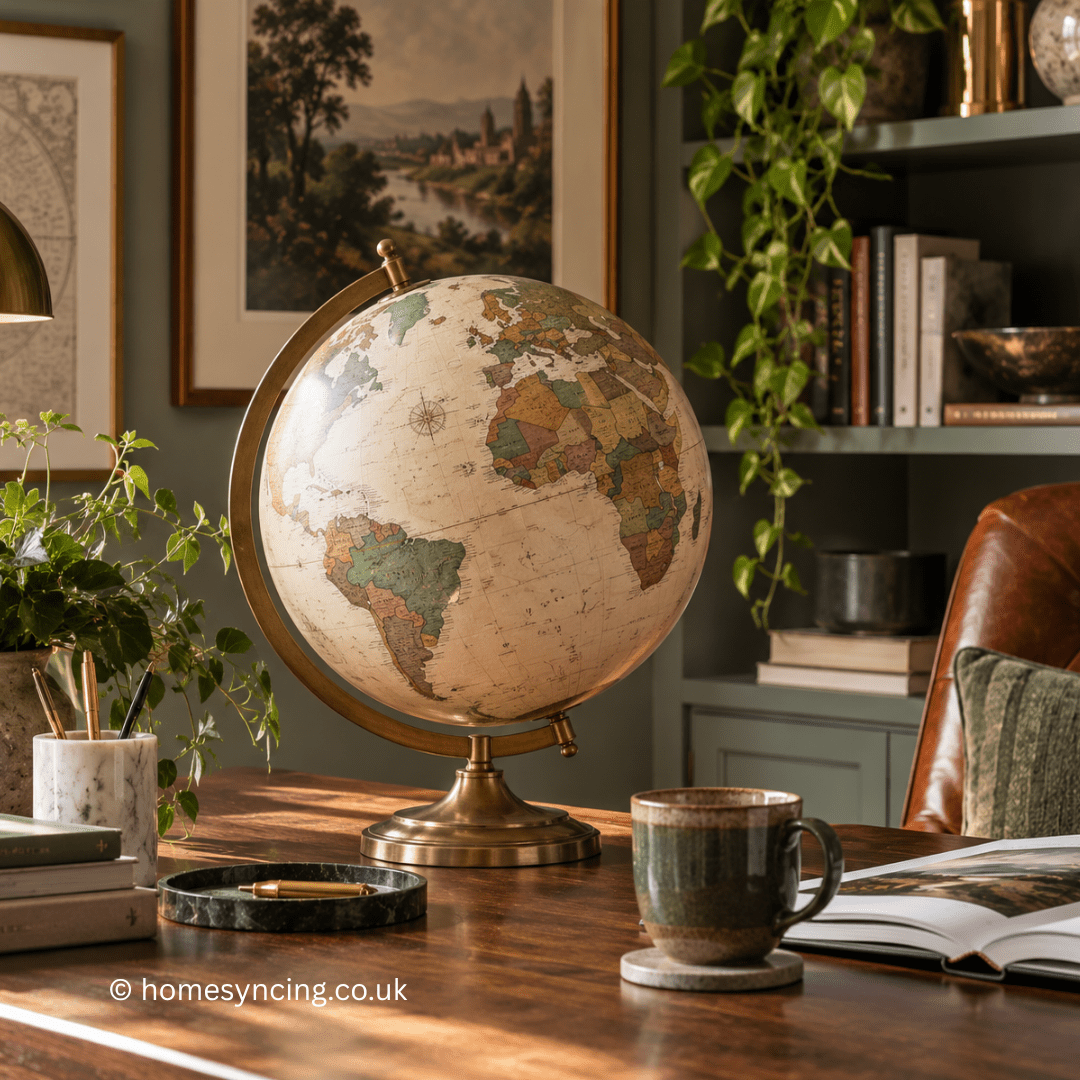
There are few objects that can contain the whole world and still sit comfortably on a desk.
Long before maps could be summoned onto a screen, globes offered people a remarkable way of understanding the Earth. Countries, oceans, mountain ranges and distant cities could be studied at home, while a gentle turn of the sphere could carry the imagination thousands of miles in a matter of seconds.
They were practical objects, certainly, but they also represented something larger: curiosity.
That appeal has never entirely disappeared.
Today, a globe may no longer be needed to plan a journey, but it remains an intriguing object to live with. In a study it invites closer inspection; among books it suggests a fascination with places beyond the doorstep; and in a child’s bedroom it can turn an unfamiliar country mentioned at breakfast into somewhere that can immediately be found.
From traditional desk globes with timber and brass stands to illuminated, educational and contemporary designs, there is an enormous variety to choose from.
So, how do you choose the right globe for your home? It helps to begin with the fascinating history of how we came to put the world on a sphere.
A Brief History of the Globe
The understanding that the Earth is spherical stretches back well over two thousand years.
Greek thinkers were discussing a spherical Earth in antiquity, and by the third century BC Eratosthenes had made a remarkably sophisticated calculation of its circumference. Ancient writers also refer to globes being constructed, although none of these early terrestrial examples is known to have survived.
The oldest surviving terrestrial globe is considerably younger.
Made in Nuremberg by Martin Behaim in 1492, the Erdapfel – or ‘earth apple’ – presents a fascinating picture of European geographical knowledge immediately before news of Christopher Columbus’s first Atlantic voyage reached Europe. Unsurprisingly, its geography looks rather different from a modern map.
That is part of what makes historic globes so interesting.
A globe is not simply a picture of the world; it is a picture of what its maker understood the world to be at a particular moment in time.
As European voyages expanded during the sixteenth and seventeenth centuries, cartographers incorporated newly recorded coastlines and geographical information into maps and globes. Earlier assumptions were corrected, while new names and territories appeared.
By the seventeenth and eighteenth centuries, pairs of terrestrial and celestial globes could be found in libraries, schools and the homes of wealthy collectors. They were instruments of learning, but also handsome demonstrations of scholarship and craftsmanship.
Look closely at an old globe today and it becomes something of a historical document. Borders change. Countries appear and disappear. Place names alter.
The world stays the same shape; our description of it does not.
How Is a Globe Made?
The construction of a traditional globe involves solving an interesting problem: how do you wrap a flat map around a sphere?
The answer lies in gores.
These are long, tapered sections of a map, rather like narrow pointed leaves, which can be carefully applied around a spherical form. When correctly designed and aligned, they meet to create a continuous map of the world.
Historically, globe making involved several skilled processes, from cartography and engraving to printing and careful assembly.
Modern methods vary considerably. Many contemporary globes use printed or moulded surfaces and spheres made from plastics or other manufactured materials, while more specialist makers continue to employ traditional techniques and hand-finishing.
The stand deserves attention too.
The meridian – the ring or partial ring running around the globe – supports the sphere and allows it to rotate. Depending on the design, this might be made from metal, timber or a modern composite.
On a particularly fine globe, these practical elements become part of its decorative appeal.
Why Have a Globe in the Age of Digital Maps?
A digital map can tell you precisely how to reach almost anywhere.
A globe does something different.
Because it presents the Earth as a sphere, it gives an immediate impression of the relationship between continents and oceans. There is no edge to scroll beyond and no need to zoom in or out.
You see the planet as a whole.
That can be especially valuable for children. A country encountered in a story, a place mentioned on the news or the destination of a forthcoming holiday can be found and understood in relation to home.
But there is also a pleasure that has little to do with education.
A globe is tactile. You can turn it. Trace coastlines with a finger. Follow the route of an imagined journey. Notice islands you had never thought about before.
It invites the sort of idle curiosity that can lead somewhere unexpected.
Choosing the Right Type of Globe
Before choosing a globe for your home, consider whether it will primarily be used for reference, education or decoration.
Many designs combine all three, but knowing what matters most will make the choice considerably easier.
Political Globes
A political globe emphasises countries and their boundaries, usually using contrasting colours to distinguish neighbouring territories.
Capitals, significant cities and national borders are typically prominent, making this one of the most useful choices for general geographical reference.
If the globe is intended for children, family use or a home office, a clear political globe with legible labelling is often a sensible starting point.
Because international borders and place names change, check that a globe intended for reference uses reasonably current cartography.
Physical Globes
A physical globe places greater emphasis on the natural landscape.
Mountain ranges, deserts, rivers, oceans and other geographical features are given greater prominence, often using colour and shading to suggest variations in terrain.
Some include raised relief, allowing major mountain ranges to be felt as well as seen.
These globes can be particularly engaging for anyone interested in landscapes, geology, travel or the natural world.
Antique and Vintage Globes
An old globe carries an entirely different appeal.
It might show political boundaries that no longer exist, use unfamiliar country names or bear the gentle signs of decades of handling.
For that reason, a genuinely antique or vintage globe should generally be appreciated as a historical and decorative object rather than relied upon for current geographical information.
Condition varies enormously. Fading, small areas of wear and an aged surface can be part of the charm, but substantial lifting of the paper gores, serious cracks or an unstable stand may require specialist conservation.
There is also an important distinction between an antique globe and an antique-style globe. The latter is newly made but uses colours, typography or illustrations inspired by historic cartography.
Both can be attractive; they simply serve different purposes.
Illuminated Globes
An illuminated globe contains an internal light source, allowing the sphere to glow when switched on.
Some models reveal additional information when illuminated, while others simply provide a soft atmospheric light.
They can work particularly well in children’s bedrooms, studies and reading corners, where the globe serves as both an educational object and a source of gentle illumination.
If choosing one for regular use, consider how easily the light source can be replaced and whether the electrical components meet the relevant UK safety standards.
Celestial Globes
Not every globe depicts the Earth.
Celestial globes map the heavens, showing stars and constellations across the celestial sphere. They have a long history as astronomical and educational instruments and can make particularly intriguing objects for a study or library.
Historic examples can be extraordinarily decorative, populated with illustrations of the figures and creatures associated with traditional constellations.
For anyone fascinated by astronomy, a celestial globe offers a different way of bringing the wider universe into the home.
Contemporary and Decorative Globes
Modern globe design can be surprisingly inventive.
There are restrained monochrome versions, sculptural metal designs and globes with bold contemporary colour palettes. Some dispense with the traditional timber stand altogether in favour of cleaner architectural forms.
These can work beautifully in modern interiors, but don’t allow appearance to be the only consideration if you also want to use the globe as a reference.
A beautifully minimalist map isn’t necessarily an especially informative one.
What Size Globe Should You Choose?
Scale can make the difference between a globe that looks purposeful and one that seems slightly lost.
A small desktop globe can sit comfortably among books, photographs and other objects on shelving. It is also a practical choice for a desk where surface space is limited.
Medium-sized globes have more presence and generally allow room for clearer geographical detail. They work particularly well on a console table, substantial desk or sideboard.
Then there are floor-standing globes.
These demand considerably more space but can become striking pieces of furniture in their own right. Traditionally mounted on timber or metal stands, they suit libraries, studies, large hallways and generous sitting rooms particularly well.
Before buying, look at the globe’s complete dimensions rather than simply the diameter of the sphere.
A wide meridian or substantial base may require considerably more room than expected.
Look Closely at the Cartography
If you intend to use your globe for more than decoration, the quality of the map matters.
Check whether country names and borders are current and whether the typography is sufficiently clear to read comfortably.
Think about the level of information you actually want.
A globe covered with hundreds of place names may be fascinating at close quarters but visually busy from across a room. A simpler map is easier on the eye but less useful for detailed reference.
There is inevitably a compromise between decorative simplicity and geographical detail.
For educational use, clarity should generally win.
Choose Materials That Suit Your Home
The stand and meridian can dramatically change the character of a globe.
Timber bases have a warmth that sits naturally alongside books, old furniture and traditional interiors. Oak and lighter woods can feel relatively informal, while dark timber creates the atmosphere often associated with libraries and studies.
Brass and bronze-toned metal introduce warmth and a sense of permanence. Blackened or dark metal can produce a cleaner, more contemporary appearance.
The sphere itself deserves scrutiny too.
Look for crisp printing, carefully aligned map sections and smooth rotation. On a well-made globe, the stand should feel stable and the mechanism should turn without excessive wobbling or resistance.
If you are choosing a globe because you hope to keep it for many years, these small details matter.
How to Style a Globe at Home
One of the pleasures of decorating with a globe is that it rarely needs much help.
On a desk, allow it enough space to be turned and examined rather than surrounding it with too many objects.
On shelving, try placing a globe alongside books of different heights rather than centring it rigidly on an otherwise empty shelf. The slightly informal arrangement often feels more natural.
A globe can also sit beautifully on a sideboard or console table alongside a lamp, a small collection of books and perhaps a plant or ceramic vessel.
There is no need to create an overtly ‘travel-themed’ display.
Suitcases, model aeroplanes, maps and globes all grouped together can quickly become theatrical. A globe is interesting enough to stand among the ordinary possessions of a home.
In a child’s room, make sure it is somewhere accessible.
A globe placed beyond reach may look attractive, but one that can actually be touched and explored is far more likely to inspire curiosity.
Caring for a Globe
Globes, particularly older examples, benefit from thoughtful positioning.
Prolonged direct sunlight can fade printed surfaces, while excessive heat may damage paper, adhesives and finishes. Avoid positioning an antique globe immediately beside a radiator or in a conservatory where temperatures fluctuate significantly.
Dust can usually be removed gently with a soft, dry cloth or brush, but take particular care with old paper surfaces.
Avoid household cleaning sprays and polishes on historic globes unless you know that they are suitable for the materials involved.
If an antique globe has loose paper, cracking, significant staining or structural damage, resist the temptation to repair it with ordinary glue or adhesive tape. A paper or object conservator can advise on an appropriate treatment.
Sometimes preserving the marks of age is preferable to making an old object look new.
A World Within Reach
Perhaps the enduring appeal of a globe lies in the contradiction at its heart.
It makes the world appear small enough to hold between two hands while simultaneously reminding us how enormous it really is.
For centuries, globes have reflected our changing knowledge of the Earth. They have been studied by scholars, used in classrooms, displayed in libraries and spun absent-mindedly by generations of curious fingers.
Their practical importance may have diminished, but their ability to encourage curiosity has not.
When choosing a globe for your home, think first about how you hope to use it. Look for clear cartography if it is intended for learning, craftsmanship if you want something to keep, and a scale and material that feel at ease in the room.
Then give it somewhere it can be noticed – and touched.
Because while a globe may be a beautiful object, its greatest pleasure still comes from turning it slowly and wondering where, in all that extraordinary expanse of land and sea, you might like to go next.
See our Selection of Globes
Further Reading: Affordable Decorating Ideas That Will Transform Your Home, Sustainable Chic: A Beginner’s Guide to Circular Design, Small Room, Big Impact
Daily Inspiration: Follow Us on Instagram, BlueSky, Threads , Pinterest, Twitter, TikTok