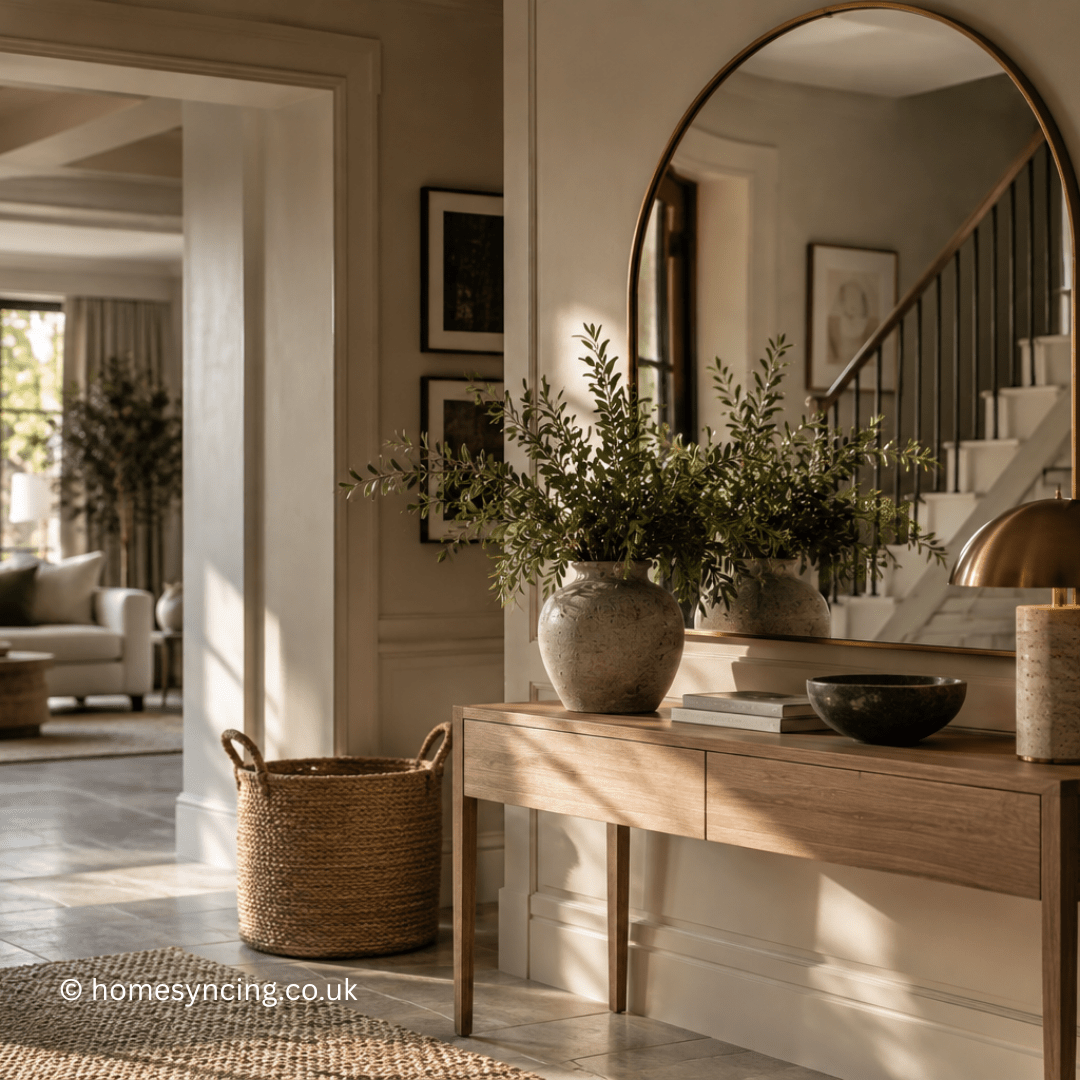
Long before the flick of a switch could illuminate a room, mirrors had an important part to play in the home. Positioned to catch daylight, candlelight or the glow of a fire, they brought brightness into shadowy corners and lent a greater sense of space to even the most modest room.
Walk through an old country house today and you can still see this quiet ingenuity at work. A mirror might catch the light from a tall sash window, reflect the greenery beyond a doorway or multiply the warm glow of lamps and candles after dusk.
The principle remains remarkably useful.
A well-placed mirror can make a narrow hallway feel more generous, bring light into a darker sitting room and draw attention to a particularly lovely view. It can also provide a focal point, introduce a new shape to a scheme and help a room feel more balanced.
Choosing one, then, is about rather more than finding an attractive frame. Size, proportion, shape, position and even the view within the glass all have a part to play.
Consider the View
Before considering the mirror itself, think about what you would like to see within it.
A mirror effectively creates another view in a room. Whatever stands opposite it becomes part of the composition: perhaps a window overlooking the garden, an old painting, a vase of seasonal branches or an architectural detail worth noticing.
Of course, the opposite is equally true. A mirror facing an untidy corner, television or busy doorway may simply give greater prominence to something you would rather overlook.
Take a little time to experiment before reaching for the picture hooks. Stand where the mirror is likely to hang and consider the sightline from different parts of the room.
A mirror positioned opposite or adjacent to a window can be particularly effective. As the light changes through the day, so too does the reflection, bringing glimpses of sky, foliage and shifting sunlight further into the house.
It is a simple decorative idea, but one that can subtly alter the atmosphere of an entire room.
Get the Proportions Right
Scale matters enormously with mirrors.
Choose one that is too small and it can look rather lost, particularly above a substantial fireplace or sideboard. Go too large without considering its surroundings and it may overpower everything nearby.
Above a console table, chest or sideboard, a mirror measuring roughly two-thirds to three-quarters of the width of the furniture beneath it will often create a pleasing sense of proportion. It is a useful starting point rather than an inflexible rule; period features, ceiling height and the character of the furniture should always have the final say.
Do not be afraid of using a generous mirror in a small room, either.
It may seem counter-intuitive, but one substantial mirror can often make a compact space feel calmer and larger than several small decorative pieces. A tall mirror in a narrow hallway draws the eye upwards, while a large mirror resting against a wall can give a bedroom or dressing room an appealing sense of depth.
In older houses, where walls and alcoves are rarely perfectly symmetrical, exact measurements are not always the answer. Sometimes a slightly unexpected scale feels far more natural than something meticulously matched.
Find a Shape That Suits the Room
The shape of a mirror can subtly change the character of a space.
Round mirrors have an appealing softness. Against the straight lines of doors, cupboards, fireplaces and furniture, a circle provides contrast and can make a scheme feel more relaxed. They are especially effective above console tables, washstands and smaller pieces of furniture.
Oval mirrors have a similarly gentle quality, but often feel a little more traditional. Their elongated proportions work beautifully above a dressing table or chest of drawers and sit particularly comfortably in period interiors.
Rectangular mirrors provide greater structure. Hung horizontally, they can emphasise the width of a room or a long mantelpiece; vertically, they draw the eye upwards and give a greater impression of height.
Then there is the enduring appeal of the arch.
Although arched mirrors have enjoyed renewed attention in contemporary interiors, there is nothing particularly new about the shape. Arches have appeared in British architecture for centuries, from ecclesiastical windows and stone doorways to garden gates and Victorian interiors. A well-proportioned arched mirror therefore has the useful ability to feel both current and established.
Look to the architecture of the room for clues. Curves can soften a space dominated by straight lines, while a simple rectangular mirror may provide welcome restraint in a room already rich in decorative detail.
Choose a Frame with Character
A frame can make the difference between a mirror that merely fits and one that feels as though it has always belonged.
Timber brings warmth and texture. Oak, walnut and darker stained woods work particularly well alongside natural materials such as stone, linen and wool, while painted or gently weathered timber can feel wonderfully at home in cottages and country interiors.
Metal offers something different. Antique brass, bronze and aged gold introduce warmth without excessive ornamentation and can sit surprisingly well alongside both old and new furniture. Slim black frames provide stronger definition and are useful where a cleaner architectural line is wanted.
More decorative mirrors deserve consideration too. Gilt frames, foxed glass and carved timber can introduce a sense of history, particularly in rooms with original fireplaces, panelling or traditional furniture.
An antique mirror need not live in an entirely traditional interior. In fact, the contrast of an old, imperfect frame against a restrained contemporary wall can be particularly effective.
Perfection is not always the goal. Patina, small marks and the gentle signs of age can give a mirror much of its charm.
Make More of Natural Light
Few decorative objects can alter the light in a room quite as effectively as a mirror.
The key is positioning.
Rather than automatically hanging one in the centre of an empty wall, look first at where daylight enters the room and where it fades. A mirror placed where it can catch that light may carry a sense of brightness considerably further into the space.
Hallways are especially good candidates. Often narrow and with limited natural light, they can benefit enormously from a generously sized mirror. As well as being useful for a final glance on the way out, it can make the entrance to a home feel lighter and more welcoming.
In a dining room, a mirror can take on a different character as evening falls. Reflected lamps and candlelight add depth and atmosphere, recalling one of the reasons mirrors became such valued features of historic interiors in the first place.
Bedrooms generally call for something gentler. Position a mirror to reflect daylight, a favourite picture or perhaps a view through the window rather than placing it where the bed dominates the reflection.
The best position is often discovered by observing the room at several times of day.
Think Beyond the Obvious Places
Mirrors need not always sit above fireplaces and console tables.
A small mirror tucked between pictures can add an unexpected glimmer to a gallery wall. A tall design placed at the end of a landing can make a confined space feel longer. A mirror opposite an open doorway can offer an intriguing glimpse into the room beyond.
Alcoves are another opportunity, particularly in older properties. A mirror placed behind a table lamp, collection of ceramics or arrangement of flowers can give the display considerably more depth.
Even kitchens can benefit. A carefully positioned mirror or antiqued mirrored panel can introduce light without making a hardworking room feel overly polished.
The most memorable interiors often use mirrors in places where they perform a purpose rather than simply occupying an empty wall.
Look for Quality
A mirror is likely to remain in your home far longer than many smaller decorative accessories, so it is worth looking closely at how it has been made.
The reflection should be clear and consistent without obvious distortion. Frames should feel properly constructed, corners neatly joined and decorative finishes convincing rather than superficial.
For larger mirrors, the quality of the fittings is every bit as important as the appearance of the frame. Always use fixings suitable for both the weight of the mirror and the type of wall, and seek professional advice where necessary for particularly large or heavy pieces.
Vintage and antique mirrors require slightly different judgement. Their glass may be softly mottled or foxed with age, creating a reflection that is less than perfect but infinitely more atmospheric. In such cases, signs of age are not necessarily defects; they are part of the object’s history.
Allow a Room to Evolve
Perhaps the most appealing interiors are those that do not appear to have been assembled all at once.
A mirror inherited from family, discovered in an antiques shop or moved from another room can sit happily beside newer furniture. Different periods and materials give a home depth and prevent it from feeling too carefully coordinated.
There is little need for every metal finish to match, either. An aged brass mirror can coexist perfectly well with iron curtain poles, pewter handles or a contemporary lamp. What matters is that the room feels connected as a whole.
Before buying something new, it can even be worth wandering through your own home. A mirror that has become unremarkable in one room may feel entirely different when moved somewhere unexpected.
A Different Way of Seeing Your Home
The most successful mirrors do something rather clever: after a while, you stop noticing the mirror and begin noticing what it reveals.
A patch of afternoon sunlight. The branches of a tree moving outside. Candlelight across a dining table. A favourite painting seen from another angle.
That is perhaps why mirrors have remained such enduring features of our homes. Their usefulness may be practical, but their appeal is atmospheric.
Rather than choosing a mirror simply to fill a vacant stretch of wall, consider what you would like it to bring to the room. Perhaps that is more light, a sense of height, a stronger focal point or simply a beautiful view worth seeing twice.
Choose carefully and a mirror becomes more than something to look into. It becomes another way of looking at the home itself.
See Our Range of Mirrors here.
Further Reading: Affordable Decorating Ideas That Will Transform Your Home, Sustainable Chic: A Beginner’s Guide to Circular Design, How to Choose Wall Art for your Home
Daily Inspiration: Follow Us on Instagram, BlueSky, Threads , Pinterest, Twitter, TikTok